Promoting sustainable waste at Higher Level: The same tools as SL, with different places: South Korea, the EU and England. At HL, link each tool to law, economics or ethics, and judge which mix of tools works best for a society.
Practise this as you read
- Sort each tool: law, money or values.
- Judge a tool by who it helps and who pays.
Free preview
This is the free notes preview
You're reading the free notes. Aimnova Pro unlocks the full study experience — and you can try it with your first topic free to keep:
- FlashcardsLock in vocabulary and key terms with spaced repetition.
- Practice questionsAnswer exam-style questions and get instant AI marking.
- Mock exams & past-paper vaultSit full mocks and see exactly how examiners award marks.
- Personalised study planA daily plan built around your exam date and weak areas.
Make the right choice the easy one: Most people will manage waste sustainably only if something pushes them. Societies can promote better choices with prices, rules, knowledge and good facilities.
The tools
- People and companies change when a better choice is cheaper, required, easier or normal.
- Taxes and incentives change prices; legislation changes the rules.
- Social policies (sorting rules, targets for councils) organise everyone's waste.
- Education and campaigns change what people know and value.
- Better access to bins, collections and recycling centres makes the right choice easy.
- Tools work best together: a charge plus free recycling plus a campaign.
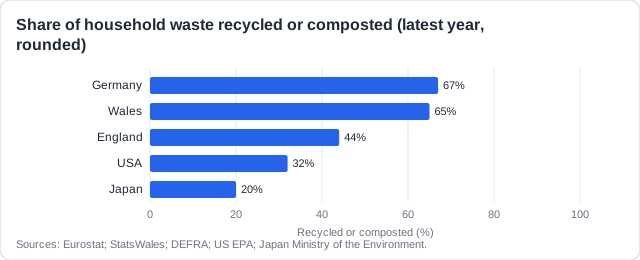
Real example: England's household recycling rate rose quickly in the 2000s but has stayed at about 44% since around 2013, far below Wales next door. Without new laws or funding, the tools that worked at first stopped raising it.
Reading a chart: Asked to identify a value? Give the number and its unit, read carefully from the scale: 'about 44%'.
Stop wasting time on topics you know
Our AI identifies your weak areas and focuses your study time where it matters. No more overstudying easy topics.
Money is a strong push. Economic tools make wasting more expensive and sustainable choices cheaper: the polluter pays principle.
Taxes and incentives
- Landfill tax: a charge per tonne buried, so councils and firms recycle or reduce instead.
- Pay-as-you-throw: households pay by the bag or the kilo, so wasting costs them money.
- Deposit-return: pay a little extra for a bottle, get it back when you return it.
- Subsidies: grants for compost bins, repair shops or recycling plants.
- Risk: charges can lead to illegal dumping and hit poorer households hardest.
Remember it as: Make waste cost money, and saving it pay.
Real example: since 1995 households in South Korea must buy official bags for general waste: the more they throw away, the more they pay. Recycling is collected free, so sorting saves families money.
Two sides to a charge: Charges cut waste, but some people may dump rubbish illegally to avoid them, and the cost hits poorer households hardest. Say both in an evaluation.
Laws set rules everyone must follow. They can ban an item, make companies responsible for their waste, or require sorting.
Legislation and social policies
- Bans on single-use items: plastic bags, straws, cutlery, polystyrene boxes.
- Extended producer responsibility: makers pay to collect and recycle what they sell.
- Compulsory sorting at home and at work, and targets for councils.
- Packaging limits and rules on recycled content in new products.
- Laws work only if enforced, with fines and checks, and with cheap alternatives available.
Laws work when
- They are enforced with fines
- Cheap alternatives exist
- People understand why
Laws fail when
- Nobody checks
- Banned goods are smuggled in
- Alternatives cost too much
Real example: the European Union's 2019 single-use plastics law banned plastic straws, cutlery and plates from July 2021, and makes producers of items such as cigarette filters pay towards clean-up: extended producer responsibility.
See how examiners mark answers
Answer exam-style questions with model answers. Learn exactly what earns marks and what doesn't.
People cannot sort or reduce waste if they do not know how, or have nowhere to take it. Education, campaigns and good facilities remove those barriers.
Education, campaigns and access
- Campaigns and lessons show the impacts of waste and how to reduce, reuse and recycle.
- Clear labels and colour-coded bins make sorting easy.
- Access: enough bins, frequent collections and nearby recycling centres.
- Low recycling often means poor access (flats with no space for bins), not just attitudes.
- Values matter: more ecocentric societies tend to sort and reduce more.
Know
- Lessons in school
- Clear bin labels
Care
- Campaigns on impacts
- Local champions
Can
- Bins for every flat
- Recycling centres nearby
Real example: the UK campaign Love Food Hate Waste, started in 2007, gave tips on planning meals, storing food and using leftovers. Household food waste in the UK fell by about a fifth over the next five years.
Do not blame the people: 'People refuse to recycle' or 'there are many people' does not explain a low rate. Give a cause: fewer bins, flats with no space, costly collection, or little education.
Recycling and energy-from-waste rates change over time, and differ between places, because of the tools above.
Why the shares change
- Campaigns, laws and education promoting recycling and energy from waste.
- International targets (such as EU recycling and landfill targets) that must be met.
- Lack of space for new landfills, and a wish to avoid their leachate, gas and pests.
- New technology and facilities for recycling and for energy from waste.
- The need for cleaner energy, and money earned from selling it.
- Rates level off when the easy materials are already recycled and habits stop changing.
Real example: in England recycling rose from about 11% in 2000-01 to about 44% by 2013, driven by the landfill tax, EU targets and new collections. Since then it has stayed flat: the easy materials are already recycled and the market for some plastics is weak.
Three reasons, three different ideas: When asked for reasons a share changed, give three different causes, such as a law, a lack of landfill space and new technology. The same reason for recycling and incineration counts once.
Study smarter, not longer
Most students waste 40% of study time on topics they already know. Our AI tracks your progress and optimizes every minute.
Recycling is the most promoted option, so you must be able to judge it: how far does it make waste management sustainable?
Evaluating recycling
- For: less waste to landfill or incineration, so less land, methane and leachate.
- For: fewer new resources extracted, smaller ecological footprint, and green jobs.
- Against: costly collection, sorting and plants; needs a market for the material.
- Against: not all waste can be recycled; the process uses energy and can pollute.
- Against: it is end-of-pipe: it does not cut consumption, and may give a false sense of doing enough.
Effective because
- Less land, methane and leachate
- Fewer new resources
- Jobs and awareness
Limited because
- Costs and needs markets
- Not everything recyclable
- Does not cut consumption
Real example: after China stopped buying most foreign recycling in 2018, prices for mixed paper and plastic fell. Some towns in the USA cut their kerbside recycling, showing that recycling depends on a market for the material.
Two traps: Recycling does not reduce the amount of waste produced, so never claim it does. And 'it reduces waste' alone is too vague: say what it saves, such as landfill space or new resources.
How this comes up: Paper 2, Section B (b): explain, with examples, how sustainable waste management can be promoted [7]: one point per mark, each tool tied to a named place.
Many governments want households to send less waste to landfill.
Using named examples, explain how societies can promote more sustainable management of solid domestic waste.
Model answer plan
See the mark-by-mark plan — for / against / judgement, with marking guidance — in study mode.