The circular economy at Higher Level: The same principles as SL, with different examples: Amsterdam, Fairphone, Renault and Kalundborg. At HL, link the circular economy to economics: who pays to redesign, who gains, and whether growth can be circular.
Practise this as you read
- Trace a resource through every loop.
- Weigh a circular plan's gains against its costs.
Free preview
This is the free notes preview
You're reading the free notes. Aimnova Pro unlocks the full study experience — and you can try it with your first topic free to keep:
- FlashcardsLock in vocabulary and key terms with spaced repetition.
- Practice questionsAnswer exam-style questions and get instant AI marking.
- Mock exams & past-paper vaultSit full mocks and see exactly how examiners award marks.
- Personalised study planA daily plan built around your exam date and weak areas.
Close the loop: In a circular economy, nothing is simply thrown away: what one stage leaves becomes the input to another.
Linear v circular
- A linear economy is take, make, dispose: materials are used once and thrown away.
- A circular economy keeps products and materials in use for as long as possible.
- Principle 1: design out waste and pollution from the start.
- Principle 2: keep products and materials circulating at their highest value.
- Principle 3: regenerate nature: return nutrients to the soil, protect ecosystems.
- Waste becomes a resource for another process, as in natural cycles.
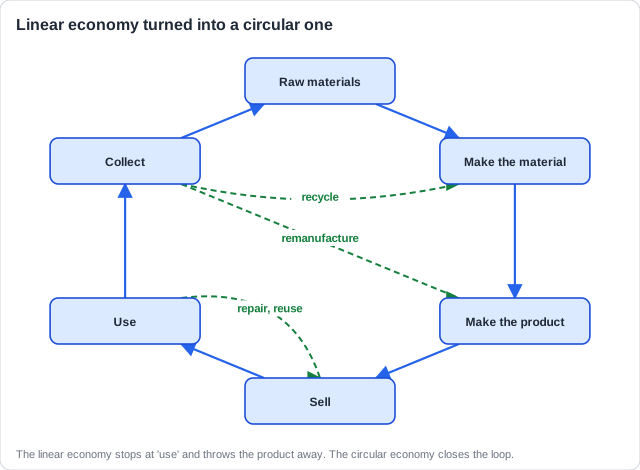
Real example: in 2020 Amsterdam became one of the first cities with a circular strategy: halve its use of new raw materials by 2030 and be fully circular by 2050, starting with food, consumer goods and building.
See how examiners mark answers
Answer exam-style questions with model answers. Learn exactly what earns marks and what doesn't.
The circular economy is easiest to see by following one resource from beginning to end, and asking how it can come back instead of being thrown away.
Following a resource's path
- Follow one resource: extraction, manufacture, use, then recovery.
- At each stage ask: how can less be used, and how can it come back?
- The best recovery keeps the product whole; recycling breaks it down to material.
- A closed loop means the material returns as the same product, again and again.
Extract
- Metals such as cobalt and tin are mined, some from fair-trade or recycled sources.
Make
- Fairphone builds a phone from modules that click in and out.
Use
- Owners replace a worn battery or broken screen themselves with spare parts.
Recover
- Old phones are taken back to be refurbished, or their metals recycled.
Real example: the Dutch company Fairphone sold its first phone in 2013. Because owners can swap the battery, screen and camera, a phone stays in use for years longer: repair keeps it whole, which saves more than recycling it.
Remember it as: Follow the resource: dig, make, use, bring back.
Product recovery has several loops. The smaller the loop, the more value is kept.
Product recovery strategies
- Repair: fix it so its owner keeps using it.
- Reuse: pass it on or refill it, as it is.
- Refurbish / remanufacture: rebuild used products or parts to work like new.
- Recycle: break it down into material to make something new.
- Inner loops (repair, reuse) save the most energy and material; recycling is the last loop.
- Food and natural fibres follow the biological cycle: compost or digest, back to the soil.
Technical cycle
- Metals, plastics, electronics
- Repair, reuse, remanufacture
- Recycle last
Biological cycle
- Food, wood, cotton, paper
- Compost or digest
- Nutrients back to the soil
Real example: at its Choisy-le-Roi factory near Paris, the car maker Renault remanufactures used engines, gearboxes and other parts so they work like new. They are sold again for far less energy and material than new parts.
Use the right word: Reuse keeps the item whole; recycling breaks it down to material. Saying which one you mean shows you understand the loops.
Study smarter, not longer
Most students waste 40% of study time on topics they already know. Our AI tracks your progress and optimizes every minute.
Most waste is decided at the design stage. A circular economy designs products so they last, can be fixed, and can come apart at the end.
Designing out waste
- Durable: built to last for years, not months.
- Repairable: spare parts and manuals; parts that can be swapped easily.
- Easy to take apart: so materials can be separated for recycling.
- Recyclable or compostable materials, with no toxic substances that spoil recycling.
- New business models: renting, sharing, leasing, taking products back.
- Industrial symbiosis: one firm's waste is another firm's raw material.
Last
- Durable materials
- Long guarantees
Fix
- Spare parts
- Swappable modules
Return
- Easy to take apart
- Take-back schemes
Real example: in Kalundborg, Denmark, firms have shared waste since the 1970s: the power station's spare heat warms homes and factories, and gypsum from cleaning its smoke goes to a plasterboard factory. This is industrial symbiosis.
The circular economy is called holistic because it manages waste by changing the whole system that makes it.
A holistic view, and its limits
- Holistic: it looks at the whole system, every stage of a product's life, not just the bin.
- It links environment, economy and society: jobs, costs and resources together.
- Limits: not everything can be recycled; recycled material needs a market.
- Limits: needs new design, investment and a change in culture and habits.
- Limits: recycling and remanufacture still use energy; jobs in old industries may be lost.
- Recycling rates level off when these limits are reached.
Strengths
- Less landfill and fewer resources
- Less energy and emissions
- New jobs in repair
Limits
- Needs markets and redesign
- Habits slow to change
- Costs and old jobs lost
Real example: China passed a Circular Economy Promotion Law in 2008, encouraging industrial parks to share waste. Yet its use of raw materials kept rising as its economy grew: circular methods slow the growth of waste but do not stop it alone.
When recycling stops rising: Asked why a recycling rate levelled off? Give a limit: only some waste is recyclable, there is a limited market, habits are hard to change further, or facilities are full. Do not explain why it rose.
Practice with exam-style questions
Answer exam-style questions and get AI feedback that shows you exactly what examiners want to see in a full-marks response.
How this comes up: Paper 1: a fact file on a circular plan, then 'Evaluate' [6]: up to four for, four against, and a conclusion.
Amsterdam plans to halve its use of new raw materials by 2030 and to be fully circular by 2050, following the loop in Figure 1.
Evaluate the potential impact of Amsterdam's circular strategy.
Model answer plan
See the mark-by-mark plan — for / against / judgement, with marking guidance — in study mode.