Resource insecurity at Higher Level: This statement is Higher Level only. It follows what happens when a society cannot be sure of the water, food, energy or minerals it needs, and why the places that hold them gain power.
Practise this as you read
- Explain how the unequal spread of resources can lead to conflict.
- Discuss how power shifts when resource use changes.
Free preview
This is the free notes preview
You're reading the free notes. Aimnova Pro unlocks the full study experience — and you can try it with your first topic free to keep:
- FlashcardsLock in vocabulary and key terms with spaced repetition.
- Practice questionsAnswer exam-style questions and get instant AI marking.
- Mock exams & past-paper vaultSit full mocks and see exactly how examiners award marks.
- Personalised study planA daily plan built around your exam date and weak areas.
Not enough, not sure, not fair: resource insecurity holds back development, pushes people to damage the environment, and can turn into geopolitical tension or even war. The cause is often an inequitable spread of resources.
What resource insecurity leads to
- Resources are spread unequally: water, fertile land, oil and ores sit in some places, not others.
- Hinders development: no reliable water, food or energy means less farming, industry, health and schooling.
- Environmental degradation: people over-pump, over-farm or mine carelessly to get what they lack.
- Tension and conflict: between countries sharing a river or oil field, or within a country.
- Insecurity grows with population growth, overconsumption, climate change and embargoes.
- Power shifts when resource use changes: oil gave power to OPEC; batteries give it to mineral producers.
Remember it as: Short of it: can't develop, wreck the land, fight for it.
Never wonder what to study next
Get a personalized daily plan based on your exam date, progress, and weak areas. We'll tell you exactly what to review each day.
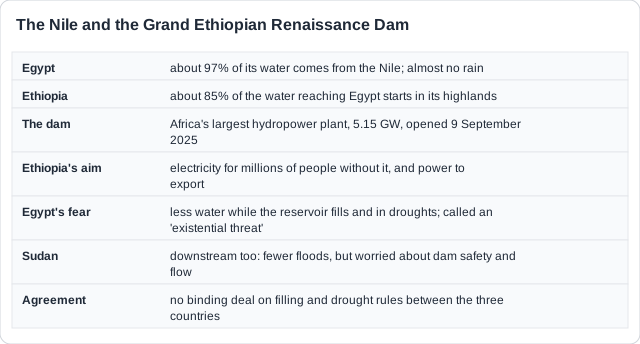
Water is the resource most often shared across borders. Egypt and Ethiopia show how a dam upstream can become a question of national survival downstream: the Grand Ethiopian Renaissance Dam.
Water: tension between and within countries
- Rivers that cross borders are a source of tension: upstream countries control the flow.
- Egypt gets about 97% of its water from the Nile, but most of it starts in Ethiopia.
- Ethiopia built the GERD for electricity; Egypt fears less water in droughts.
- Climate change can add to tension: drought in Syria (2006-2010) pushed farmers into cities before the 2011 civil war.
- Within a country: when clean water costs too much for the poor, protests follow (Cochabamba, 2000).
Within a country: in 2000 the city of Cochabamba, Bolivia, privatised its water supply. Water bills rose sharply, poorer families could not pay, and weeks of protests forced the government to cancel the deal.
Oil shows how controlling a resource gives a country power over others. Most of the world's exported oil comes from members of OPEC.
Oil, and food, as power
- Oil production is centred on OPEC countries, such as Saudi Arabia, Iraq and Iran.
- 1973: Arab oil producers cut supply to countries backing Israel; the price rose from about USD 3 to nearly 12 a barrel.
- Importing countries faced fuel queues, rationing and a recession.
- Oil is tied to national security, so it has fed wars and tension in the Middle East.
- Food too: in 2008 food prices soared and riots broke out in countries such as Haiti and Egypt.
Real example: in October 1973 Arab oil producers placed an embargo on the USA and other countries that supported Israel in a war. Within months the oil price had risen nearly four times. Countries that imported oil saw petrol queues and rationing, which is why many, such as Denmark and Japan, started to cut their need for imported oil.
Power shifts when use shifts: As the world moves from oil to batteries and wind turbines, power moves from the oil producers to the countries that mine and process lithium, cobalt and rare earths.
Stop wasting time on topics you know
Our AI identifies your weak areas and focuses your study time where it matters. No more overstudying easy topics.
Phones, electric cars and wind turbines need cobalt, lithium and rare earth elements. A few countries mine them, and one, China, does most of the work to refine them.
Critical minerals
- Batteries, magnets and phones need lithium, cobalt and rare earth elements.
- Mining is centred on Australia, China, Chile and the DRC; refining mostly in China.
- 2010: China halted rare earth exports to Japan for about two months during a dispute.
- 2025: China required licences for seven rare earths; the DRC suspended cobalt exports for months.
- In eastern DRC, armed groups have funded fighting with minerals such as tin, tantalum and gold.
- Mining harms land and water; artisanal mining of cobalt is unsafe, sometimes with child labour.
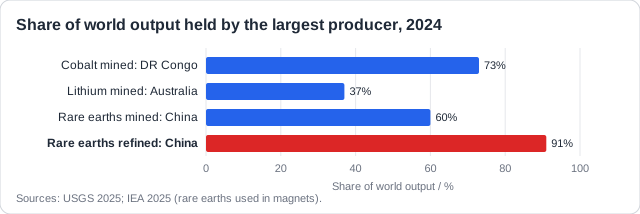
Real example: in 2010, during a dispute over a fishing boat near islands both countries claim, China halted rare earth exports to Japan for about two months. Japan responded by investing in an Australian rare earth miner and recycling more. In the DRC, cobalt dug by artisanal mining pollutes rivers and has involved children, while the money from minerals in the east has funded armed groups.
Insecurity is about too little, but too much can also hurt: the resource curse.
The resource curse
- Having plenty of a resource does not guarantee development: this is the resource curse.
- Money can go to elites and corruption, not schools and clinics.
- One export means boom and bust when prices change.
- Fights over who gets the money can lead to conflict.
- Weak rules let companies pollute: spills and gas flaring.
Real example: Nigeria has earned huge sums from oil since the 1970s, yet many people in the oil-producing Niger Delta still lack clean water and jobs. Oil spills and gas flaring have polluted farmland, creeks and air: a 2011 United Nations study found that cleaning up Ogoniland alone could take 25-30 years. Anger over who gets the oil money fed years of armed attacks on pipelines.
A trap: Showing that a resource is spread unequally is only half an answer. Say HOW it leads to conflict: who wants it, who controls it, and what they do.
See how examiners mark answers
Answer exam-style questions with model answers. Learn exactly what earns marks and what doesn't.
How this comes up: Paper 2, Section B (b): explain how the inequitable distribution of natural resources can lead to conflict [7]. It could also be a (c) [9] on whether resource insecurity is the main cause of conflict, or a Paper 1 part on a case study.
Egypt gets about 97% of its water from the Nile, but most of that water starts in Ethiopia, where Africa's largest hydropower dam opened in 2025.
Explain how the inequitable distribution of natural resources can lead to conflict.
Model answer plan
See the mark-by-mark plan — for / against / judgement, with marking guidance — in study mode.