Short-term economics at Higher Level: This statement is Higher Level only and uses the economics lens: why money made now so often wins over a resource that would last for ever.
Practise this as you read
- Explain how economic interests led to the depletion of a named resource.
- Evaluate ways of making the long term pay.
Free preview
This is the free notes preview
You're reading the free notes. Aimnova Pro unlocks the full study experience — and you can try it with your first topic free to keep:
- FlashcardsLock in vocabulary and key terms with spaced repetition.
- Practice questionsAnswer exam-style questions and get instant AI marking.
- Mock exams & past-paper vaultSit full mocks and see exactly how examiners award marks.
- Personalised study planA daily plan built around your exam date and weak areas.
Cash now beats fish later: Businesses, shoppers and governments often choose what pays in the short-term, even when it means a resource is depleted and gone for the future.
Why economics favours the short term
- Profit now: money earned today counts for more than money in 20 years.
- Jobs and votes: politicians protect today's jobs; elections come every 4-5 years.
- Debts: boats and machines are bought with loans that must be paid every month.
- Competition: if I leave the fish, someone else takes them (the tragedy of the commons).
- Prices ignore nature: the damage is an external cost, not in the price.
- Subsidies keep too many boats fishing when the catch would not pay for itself.
Remember it as: Cash now, cost later: someone else pays.
The tragedy of the commons adds to it: with no owner, each boat gains from every extra fish it takes, while the loss is shared by all, so every boat keeps fishing.
Practice with exam-style questions
Answer exam-style questions and get AI feedback that shows you exactly what examiners want to see in a full-marks response.
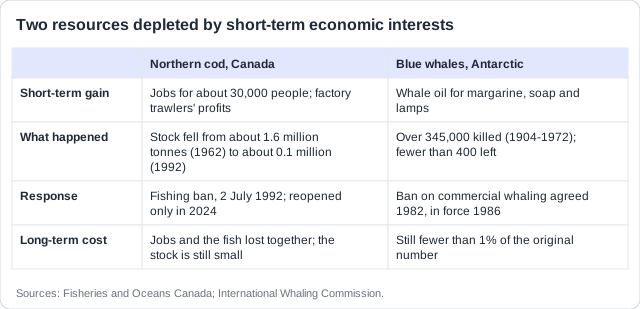
The Northern cod off Newfoundland, Canada, is the classic case of a stock depleted because short-term economic interests won.
The Northern cod collapse
- Cod were fished off Newfoundland, Canada, for about 500 years.
- From the 1950s factory trawlers caught far more, all year round.
- Scientists' estimates were too high, and quotas stayed high to protect jobs.
- The stock fell from about 1.6 million tonnes (1962) to about 0.1 million (1992).
- 2 July 1992: a fishing ban; about 30,000 people lost their jobs overnight.
- The ban lasted 32 years: fishing reopened only in 2024, on a small scale.
Why it happened: factory trawlers from Europe, the Soviet Union and then Canada caught huge numbers, including young fish before they could spawn. When scientists warned that the stock was falling, governments kept the quota high, because cutting it meant losing jobs and votes in fishing towns. The long-term cost was far greater: both the fish and the jobs were lost.
Whales were the oil wells of the early 1900s. whale oil paid so well that whalers killed them far faster than they could breed.
Antarctic blue whales
- Whales were hunted for whale oil and meat; one blue whale gave tonnes of oil.
- Over 345,000 Antarctic blue whales were killed from 1904 to 1972.
- From 200,000-300,000 they fell to fewer than 400.
- Whalers moved on to the next largest species as each one ran out.
- Whales breed slowly, so a stock takes decades to recover.
- The International Whaling Commission agreed a ban in 1982, in force in 1986.
Why the short term won: A whale caught this year was money now. A whale left to breed would give a calf only every few years, and another whaling fleet might catch it first. So it paid each fleet to keep hunting, even as the whales ran out.
Today, nearly 40 years after the ban, there are perhaps a few thousand Antarctic blue whales: still fewer than 1% of the number before whaling began.
Feeling unprepared for exams?
Get a clear study plan, practice with real questions, and know exactly where you stand before exam day. No more guessing.
Economics explains why the short term wins. A subsidy or an external cost makes using up a resource look cheaper than it really is.
The economics behind it
- Subsidies: about USD 35 billion a year went to fishing (2018); 22 billion of it added boats and fuel.
- External costs: the price of fish leaves out the empty sea left behind.
- Short time scales: firms report profits every few months; governments face elections.
- Open access: with no owner, a fish left in the sea is someone else's catch.
Short-term view
- Catch as much as possible this year
- Keep jobs and boats busy now
- Pay the loans on the boat
- Win the next election
Long-term view
- Leave enough fish to breed
- Jobs that last for generations
- A stock that keeps paying out
- A sea that stays healthy
A trap: Do not just say 'people are greedy'. Name the economic reason: profit now, debts, jobs and votes, competition for a shared resource, subsidies, or costs left out of the price.
The fixes work by making the long term pay, or by stopping the short-term choice.
Making the long term pay
- Science-based quotas: catch limits set from scientists' advice, not from what fleets want.
- Moratoria: stop all taking until the stock recovers (cod, whales).
- Tradable quotas: each fisher owns a share, so a bigger stock means a more valuable share.
- Cut harmful subsidies: the WTO agreement on fishing subsidies came into force in 2025.
- Eco-labels let shoppers choose sustainably caught fish.
Real example: since 1990 Iceland has managed its fisheries with tradable quotas. Each boat owner holds a share of a catch limit set from scientists' advice, so they gain when the stock grows. In 2025 the World Trade Organization's agreement banning subsidies for fishing overfished stocks came into force. Shoppers can also look for an eco-label such as the blue fish label of the Marine Stewardship Council.
Strengths
- Stocks can recover, e.g. humpback whales
- Fishers gain from a healthy stock
- Less money spent on overfishing
Limits
- Jobs are lost in the short term
- Quotas can be ignored or poorly enforced
- Slow breeders take decades to recover
Memorize terms 3x faster
Smart flashcards show you cards right before you forget them. Perfect for definitions and key concepts.
How this comes up: Paper 2, Section B: outline [4], explain [7] or discuss [9] how economic interests lead to the depletion of a resource. Section A may give a graph of a fish stock and its catch.
In 1992 Canada banned fishing for Northern cod off Newfoundland, after the stock had fallen by more than 90% in 30 years.
Explain how economic interests can favour short-term responses that lead to the depletion of a named natural resource.
Model answer plan
See the mark-by-mark plan — for / against / judgement, with marking guidance — in study mode.