The SDGs and resources at Higher Level: This statement is Higher Level only. It asks how the UN's Sustainable Development Goals help every country manage its natural resources together. You do not need to know every goal: learn the resource goals, two real examples and the strengths and limits of the framework.
Practise this as you read
- Outline how the SDGs guide the use of one resource.
- Evaluate the SDGs as a framework, with two named examples.
Free preview
This is the free notes preview
You're reading the free notes. Aimnova Pro unlocks the full study experience — and you can try it with your first topic free to keep:
- FlashcardsLock in vocabulary and key terms with spaced repetition.
- Practice questionsAnswer exam-style questions and get instant AI marking.
- Mock exams & past-paper vaultSit full mocks and see exactly how examiners award marks.
- Personalised study planA daily plan built around your exam date and weak areas.
One plan for every country: The SDGs give every country the same list of goals and targets. They are universal, and they are reached through global partnership. Several of them are about using natural resources sustainably.
The points to remember
- The SDGs are 17 goals with 169 targets, agreed by all UN members in 2015, for 2030.
- They are universal: every country takes part, rich and poor.
- They work by global partnership (SDG 17): sharing money, technology and knowledge.
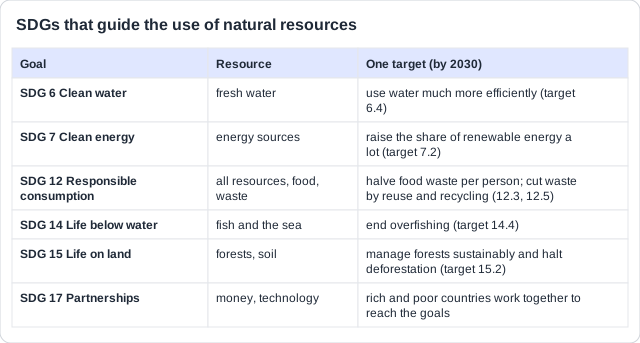
- Several goals manage resources: water (6), energy (7), consumption (12), sea (14), land (15).
- Each country turns them into national plans and reports progress at the UN.
How it works in practice: a government writes the goals into its own plans, then reports its progress at the UN in a Voluntary National Review. Almost every UN member has given one.
Practice with exam-style questions
Answer exam-style questions and get AI feedback that shows you exactly what examiners want to see in a full-marks response.
Example 1 is an energy resource: how Kenya used SDG 7 to plan its electricity.
SDG 7 in Kenya
- SDG 7 asks for affordable, clean energy and more renewable energy.
- Kenya made geothermal power the centre of its plan, mostly at Olkaria.
- By 2023 about 88% of its electricity came from renewable sources; geothermal alone was about 47%.
- Partners such as the World Bank and Japan helped pay for the power stations.
- But Maasai families were moved from the land: one goal can harm people's rights.
Goal
- SDG 7: affordable, clean energy for all, and much more renewable energy by 2030
Resource
- Kenya sits on the Rift Valley, where hot rock lies near the surface: a huge geothermal resource
Partners
- Loans and grants from partners such as the World Bank and Japan helped build the Olkaria power stations
Result
- 2023: about 88% of Kenya's electricity was renewable; geothermal alone gave about 47%
Goals can pull against each other: To build the Olkaria IV power station, Maasai families were moved from their land, and the World Bank's own Inspection Panel investigated how it was done. Clean energy (SDG 7) came at a cost to fair treatment of local people.
Example 2 is about consuming less and wasting less: how South Korea turned food waste into a resource.
SDG 12 in South Korea
- SDG 12 asks countries to halve food waste and cut waste by reuse and recycling.
- In 1995 South Korea recycled only about 2% of its food waste.
- It banned food waste from landfill in 2005 and made households pay by weight from 2013.
- Food waste now becomes animal feed, compost and biogas: about 95% is recycled.
- A clear target plus a tax-like charge changed millions of habits.
1995
- Most food waste went to landfill
- Only about 2% was recycled
- Rotting waste made smells and methane
Today
- Food waste is banned from landfill (2005)
- Households pay by the weight they throw away
- About 95% becomes feed, compost or biogas
Real example: in Seoul, thousands of bins weigh the food waste as it goes in and read the resident's RFID card, so each household pays for what it wastes. Paying by weight gives people a reason to buy and cook only what they eat.
Feeling unprepared for exams?
Get a clear study plan, practice with real questions, and know exactly where you stand before exam day. No more guessing.
The SDGs are a framework, not a law. To judge them, weigh what a shared plan achieves against what it cannot force.
Strengths and limits of the framework
- Strength: a shared framework: every country works towards the same goals and dates.
- Strength: measurable targets, so progress can be tracked and compared.
- Strength: partnership brings money and technology to poorer countries.
- Limit: voluntary: no country can be forced to meet them.
- Limit: goals can conflict, e.g. growth (SDG 8) against forests (SDG 15).
- Limit: off track: in 2024 only about 17% of targets were on course.
Remember it as: Shared, measurable, partnered: but voluntary, in conflict, off track.
| Limit | Real example |
|---|---|
| Voluntary | a country that misses its SDG 12 targets faces no penalty |
| Goals in conflict | Kenya's clean energy (SDG 7) came with a trade-off: Maasai families moved |
| Off track | the UN SDG Report 2024 found only about 17% of targets were on course for 2030 |
| Unequal means | poorer countries need partners' money to build plants like Olkaria |
How this comes up: Paper 1: use data on a place to outline its progress towards an SDG. Paper 2: outline how the SDGs guide resource management, or evaluate them with two named examples.
In 1995 South Korea recycled about 2% of its food waste. After a landfill ban (2005) and charges by weight (2013), it now recycles about 95%.
To what extent can the SDGs help a country manage its resources sustainably?
Model answer plan
See the mark-by-mark plan — for / against / judgement, with marking guidance — in study mode.