Strategies for resource use at Higher Level: This statement is Higher Level only. It asks how a society can be steered to use natural capital differently: by government plans, by taxes, bans and subsidies, and by pressure from campaigners and communities. Learn each tool with one real example and one strength and limit.
Practise this as you read
- Outline tools that reduce use and tools that encourage use.
- Evaluate one strategy with a named example and a judgement.
Free preview
This is the free notes preview
You're reading the free notes. Aimnova Pro unlocks the full study experience — and you can try it with your first topic free to keep:
- FlashcardsLock in vocabulary and key terms with spaced repetition.
- Practice questionsAnswer exam-style questions and get instant AI marking.
- Mock exams & past-paper vaultSit full mocks and see exactly how examiners award marks.
- Personalised study planA daily plan built around your exam date and weak areas.
Steering how resources are used: Left alone, people often use too much of some natural capital and too little of cleaner choices. Governments can plan ahead (management) or step in directly (intervention).
The points to remember
- Management: a government plans how resources are used, e.g. a national action plan for the SDGs.
- Intervention: a government steps in to change what people and firms use.
- Some interventions reduce or stop the use of a resource: taxes, fines, laws.
- Others encourage a better choice: subsidies, laws, campaigns, research, education.
- Not only governments: NGOs, local communities and social movements change behaviour too.
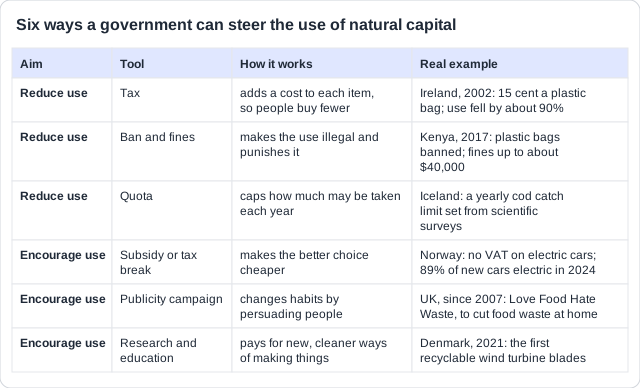
Real example of management: each country writes a national action plan for the UN goals and reports on it at the UN in a Voluntary National Review. It sets the targets; the tools in the table are how the targets are reached.
Stop wasting time on topics you know
Our AI identifies your weak areas and focuses your study time where it matters. No more overstudying easy topics.
The first kind of intervention makes a harmful use of a resource harder or more expensive, or stops it altogether.
Tools that reduce or stop use
- Taxes make a resource dearer, so people use less, e.g. a higher price of fossil fuels.
- Fines punish people and firms that break the rules.
- Legislation sets limits or bans, e.g. carbon emission restrictions on power stations.
- Quotas cap how much can be taken, e.g. tonnes of fish a year.
- Protected areas ban logging, fishing or building in one place.
Problem
- Ireland, 2001: each person used about 328 plastic shopping bags a year, and bags were about 5% of all litter
Tax
- March 2002: a levy of 15 cent on every plastic bag at the till
Result
- Within months use fell by over 90%, to about 21 bags each; bags fell to about 0.3% of litter
Top-up
- Use crept back to 31 bags by 2006, so in 2007 the levy rose to 22 cent; the money goes into an Environment Fund
Real example of a ban: in August 2017 Kenya banned making, selling or carrying plastic bags, with fines of up to about 40,000 US dollars or up to four years in prison. A quota works the same way for fish: Iceland sets a yearly cod catch from scientific surveys.
The second kind of intervention makes a better use of resources easier, cheaper or more attractive.
Tools that encourage use
- Subsidies and tax breaks make the cleaner choice cheaper.
- Legislation can require the better option, e.g. a share of recycled material.
- Publicity campaigns persuade people to change habits.
- Research funds new, cleaner ways of making things.
- Education helps people understand why and how to change.
A tax break: Norway
- Electric cars pay no VAT or import tax
- Petrol and diesel cars are taxed heavily
- Electric share of new cars: about 42% in 2019, 89% in 2024
A campaign: the UK
- Love Food Hate Waste, run since 2007
- Recipes for leftovers and tips on storing food
- Aims to cut the food thrown away at home
| Research funded | What it replaces |
|---|---|
| CarbonCure (Canada) injects captured carbon dioxide into fresh concrete, where it turns into stone | concrete that only releases carbon dioxide when its cement is made |
| Siemens Gamesa's recyclable wind turbine blade (Denmark, 2021): its resin can be separated at the end of its life | old blades that end up in landfill |
| Pivot Bio (USA) sells soil microbes that fix nitrogen from the air for maize | part of the fertilizer made by the Haber process |
Legislation works both ways: A law can stop a use (a ban) or require a better one (all new homes must have solar panels, or products must contain recycled plastic). Say which direction your example pushes.
See how examiners mark answers
Answer exam-style questions with model answers. Learn exactly what earns marks and what doesn't.
Change does not only come from governments. NGOs, local communities and social movements cannot make laws, but they can change what people and companies do.
Campaigns, social media and action
- NGOs run campaigns that put pressure on firms and governments.
- Social media spreads a campaign fast and cheaply to millions of people.
- Social movements bring many people together, e.g. marches and school strikes.
- Local communities take action themselves, such as recycling and repair.
- They have no power to make laws, so they work by persuading and by example.
Target
- 2010: Greenpeace showed that Nestle bought palm oil from suppliers clearing Indonesian rainforest, home of the orangutan
Campaign
- It posted a shocking spoof KitKat advert online; it spread on YouTube and Facebook
Pressure
- Thousands of people posted angry comments and sent emails to the company
Change
- Within about two months Nestle promised to stop buying palm oil from cleared rainforest
Real example of community action: in 2003 the small town of Kamikatsu, Japan, made a zero-waste pledge. Residents wash and sort their rubbish into 45 categories at one centre, and about 80% of it is now recycled.
Every strategy has strengths and limits. To evaluate one, weigh how well it changes behaviour against its cost, its fairness and how easy it is to enforce.
Weighing the strategies
- Taxes: fast and raise money for the environment, but can be regressive.
- Bans and fines: clear and strong, but need enforcement; people may break or dodge them.
- Subsidies: popular, but cost the government money and may help richer people most.
- Campaigns and education: cheap, but slow and voluntary.
- Research: can solve the problem at its root, but is uncertain and takes years.
- Strategies work best combined: a tax on the bad choice plus a subsidy for the good one.
Remember it as: Make the bad choice dearer and the good choice cheaper, and tell people why.
| Problem | Real example |
|---|---|
| A tax wears off | Irish bag use crept from 21 to 31 bags each by 2006, so the levy rose |
| A ban needs enforcing | plastic bags were smuggled into Kenya from neighbouring countries |
| A subsidy is costly | Norway gave up so much tax that in 2023 it began charging VAT on the dearest electric cars |
| A tax can be unfair | a higher fuel price is regressive: it hits poor rural drivers hardest |
Name the tool, not just the aim: 'Reduce plastic' is an aim, not a strategy. Name the tool (a 15 cent levy, a ban with fines, a subsidy) and say how it changes what people do.
Study smarter, not longer
Most students waste 40% of study time on topics they already know. Our AI tracks your progress and optimizes every minute.
How this comes up: Paper 2: outline strategies a government could use, or evaluate one strategy (a tax, a ban, a subsidy) with a named example. Paper 1: read a fact file or graph on a strategy and judge how well it worked.
In August 2017 Kenya banned making, selling and carrying plastic bags, with fines of up to about 40,000 US dollars or up to four years in prison.
Evaluate the use of bans to reduce a society's use of a natural resource.
Model answer plan
See the mark-by-mark plan — for / against / judgement, with marking guidance — in study mode.