Technology for mitigation at Higher Level: This statement is Higher Level only. It covers technology that helps mitigate climate change: everyday apps and sensors in smart cities, and new technology from research, such as carbon capture, direct air capture and green hydrogen, in named societies.
Practise this as you read
- Outline how one technology cuts or removes carbon dioxide in a named society.
- Evaluate a technology using its real scale, cost and results.
Free preview
This is the free notes preview
You're reading the free notes. Aimnova Pro unlocks the full study experience — and you can try it with your first topic free to keep:
- FlashcardsLock in vocabulary and key terms with spaced repetition.
- Practice questionsAnswer exam-style questions and get instant AI marking.
- Mock exams & past-paper vaultSit full mocks and see exactly how examiners award marks.
- Personalised study planA daily plan built around your exam date and weak areas.
Two kinds of technology: Some climate technology is in your pocket: socially embedded technology, such as an app. Some comes from research and development in universities and industry, such as machines that catch carbon dioxide.
The points to remember
- Socially embedded technology: everyday tools such as apps and sensors in smart cities.
- Research and development technology: new ways to cut or remove carbon, often from universities.
- Mitigation technology either cuts emissions at the source or removes CO2 already in the air.
- A technology only helps once it is implemented at scale in a real society.
| Socially embedded | Research and development | |
|---|---|---|
| What | Apps and sensors in daily life | New machines and industrial processes |
| Who uses it | Citizens | Power stations, factories, steelworks |
| Real example | Charging-point apps in Oslo | Carbon capture at Sleipner, Norway |
Remember it as: App in your pocket, machine in the factory.
Study smarter, not longer
Most students waste 40% of study time on topics they already know. Our AI tracks your progress and optimizes every minute.
In a smart city, technology makes the low-carbon choice the easy one. People do not need to care more; they just need to know where the nearest charger or recycling point is.
Smart-city technology
- Sensors and apps give people live information, so the low-carbon choice is the easy choice.
- Apps show the nearest free charging point, so driving an electric car is less of a worry.
- Apps and maps show the nearest recycling centre and what it takes.
- Sensors switch street lights and heating on only when needed, saving energy.
- They work best alongside policy: cheap charging, clean electricity, collection services.
Worry
- Drivers feared running out of charge with no charger nearby
App
- Apps and maps show every public charger in Norway and whether it is free right now
Policy
- No purchase tax on electric cars and cheap clean electricity from hydropower
Impact
- In 2025, 95.9% of new cars sold in Norway were fully electric
Technology plus policy: The apps did not do it alone: tax breaks and clean electricity mattered too. Say both in an answer.
Carbon capture and storage catches carbon dioxide where it is made and locks it deep underground. It is the oldest of these technologies, and the best tested.
Carbon capture and storage (CCS)
- CCS catches CO2 from a power station, factory or gas field before it reaches the air.
- The CO2 is compressed and pumped into rock deep underground (old gas fields, sandstone).
- Strength: cuts emissions from industries that are hard to clean up (cement, gas).
- Limit: costly, uses extra energy, and is still tiny: about 51 million tonnes a year worldwide.
- Limit: the world releases about 38 billion tonnes of CO2 a year from fossil fuels.
1996: start
Norway's Sleipner gas field contains about 9% CO2, which must be removed before the gas is sold.
Store
Equinor pumps the CO2 into sandstone over 800 m below the North Sea floor.
Why
Norway's 1991 CO2 tax made storing it cheaper than releasing it.
Impact
Nearly 1 million tonnes a year; more than 19 million tonnes stored so far.
Practice with exam-style questions
Answer exam-style questions and get AI feedback that shows you exactly what examiners want to see in a full-marks response.
Direct air capture goes further than CCS: it removes carbon dioxide that is already in the air. Its first big test is in Iceland, a society with plenty of geothermal energy and the right rock.
Direct air capture
- Direct air capture removes CO2 already in the air, so it can make emissions negative.
- Fans push air through filters; heat releases the CO2 for storage.
- In Iceland the CO2 is pumped into basalt, where it turns to stone within about two years.
- It needs lots of energy, which must be renewable or it adds as much CO2 as it removes.
- So far it captures far less than planned, at a high cost per tonne.
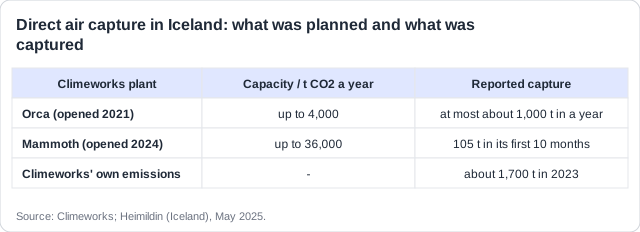
Real example: Climeworks, a company started at a Swiss university, ETH Zurich, built Orca in 2021 beside a geothermal power station. The partner company Carbfix pumps the CO2 into basalt. But in 2023 Climeworks emitted more CO2 than its plants removed.
Some industries cannot simply plug into renewable electricity. Steelmaking burns coal to strip oxygen from iron ore. Green hydrogen can do that job instead.
Green hydrogen
- Green hydrogen is made by splitting water with renewable electricity: no CO2 released.
- It can replace coal and gas where electricity alone cannot: steel, fertiliser, ships.
- Steel uses coal to remove oxygen from iron ore; hydrogen does it and makes water vapour instead of CO2.
- Limit: it needs huge amounts of clean electricity and costs more than coal today.
Real example: HYBRIT, a project of three Swedish companies (SSAB, LKAB and Vattenfall), makes iron with hydrogen at a pilot plant in Luleå. In 2021 it delivered the world's first fossil-free steel to Volvo. Used across SSAB, it could cut Sweden's total CO2 emissions by about 10%.
Not all hydrogen is green: Most hydrogen today is made from natural gas, which releases CO2. Only hydrogen made with renewable electricity is green.
Feeling unprepared for exams?
Get a clear study plan, practice with real questions, and know exactly where you stand before exam day. No more guessing.
How this comes up: Paper 1 or Paper 2 Section A: a fact file on a technology (carbon capture, direct air capture) to outline and evaluate. Section B: technology in a named society, with strengths and limits.
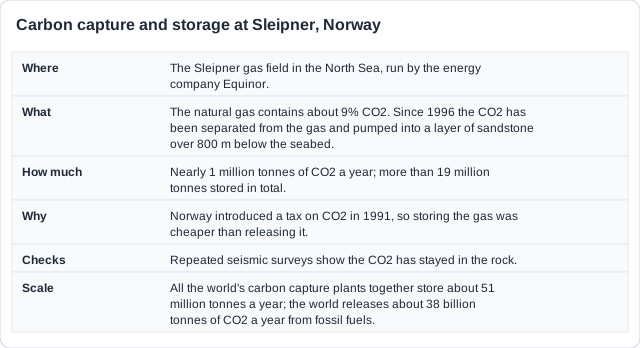
The fact file describes carbon capture and storage at the Sleipner gas field in Norway.
Evaluate carbon capture and storage as a way to mitigate climate change.
Model answer plan
See the mark-by-mark plan — for / against / judgement, with marking guidance — in study mode.