The greenhouse effect at Higher Level: The same greenhouse effect as SL, with different real cases: Earthshine on the Moon, Venus and Mercury, the last ice age and Lytton's record heat. At HL, explain the atmosphere's whole role in keeping temperatures fit for life: the greenhouse effect and the way heat is spread.
Practise this as you read
- Write the five-step chain from memory.
- Link the greenhouse effect to how the air spreads heat.
Free preview
This is the free notes preview
You're reading the free notes. Aimnova Pro unlocks the full study experience — and you can try it with your first topic free to keep:
- FlashcardsLock in vocabulary and key terms with spaced repetition.
- Practice questionsAnswer exam-style questions and get instant AI marking.
- Mock exams & past-paper vaultSit full mocks and see exactly how examiners award marks.
- Personalised study planA daily plan built around your exam date and weak areas.
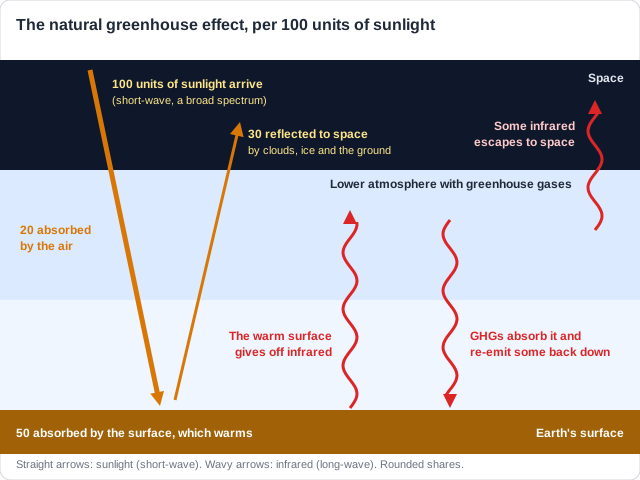
Energy in, energy out: The Earth gets its energy from the Sun as short-wave radiation and sends it back to space as long-wave radiation. The balance sets our temperature.
The points to remember
- The Sun gives out a broad spectrum: ultraviolet, visible light and some infrared.
- It arrives as short-wave radiation, which passes easily through the air.
- Of every 100 units: about 30 reflected to space, 20 absorbed by the air, 50 absorbed by the surface.
- The warmed surface gives off long-wave (infrared) radiation.
- For a steady temperature, energy in = energy out. If more comes in than leaves, the Earth warms.
Remember it as: Sun = short, Earth = long.
Real example: at Big Bear Solar Observatory in California, scientists measure Earthshine: sunlight reflected by the Earth that dimly lights the dark part of the Moon. It shows that the Earth reflects about 30% of the sunlight it receives.
Name both kinds: Questions often ask for the difference: short-wave sunlight comes in and passes through the air; long-wave infrared goes out and is absorbed by greenhouse gases.
Stop wasting time on topics you know
Our AI identifies your weak areas and focuses your study time where it matters. No more overstudying easy topics.
The greenhouse effect works in five steps. Learn them in order: a full answer needs the complete chain.
How the greenhouse effect works
- Sunlight (short-wave) passes through the greenhouse gases and warms the surface.
- The warm surface re-radiates energy upwards as infrared (long-wave) radiation.
- Greenhouse gases in the troposphere absorb this outgoing infrared ...
- ... and re-radiate it in all directions, some back down to the surface.
- So much of the heat is kept, raising the average surface temperature to about 15 °C.
- The main natural greenhouse gases: carbon dioxide, methane, water vapour, nitrous oxide.
Real example: Venus is almost twice as far from the Sun as Mercury, yet it is hotter, about 465 °C. Its thick atmosphere is about 96% carbon dioxide, so almost none of the infrared from its surface escapes.
Two answers that score nothing: The surface re-radiates infrared; it does not 'reflect heat'. And the ozone hole is not the cause of the greenhouse effect: ozone near the ground and CFCs are human-made extras, not the main gases.
Warm enough for life: The greenhouse effect is not a problem in itself. Without it the Earth would be frozen solid; with it, the average is a mild 15 °C.
About 15 °C, not about -18 °C
- With the greenhouse effect the Earth's average is about 15 °C; without it, about -18 °C.
- That is about 33 °C warmer: warm enough for liquid water and life.
- It is a natural process: it worked long before people.
- The Earth's temperature depends on how much greenhouse gas is in the air.
- More greenhouse gas: warmer. Less: colder.
Remember it as: Minus 18 without it, plus 15 with it: 33 degrees of help.
With the greenhouse effect
- Average about 15 °C
- Liquid water: oceans, rivers, rain
- Mild nights
Without it
- Average about -18 °C
- Oceans frozen
- Most life impossible
Real example: in the last ice age, about 20,000 years ago, ice cores show only about 180 ppm of carbon dioxide in the air, against about 280 ppm before industry. The world was about 6 °C colder, and ice sheets covered much of North America and northern Europe.
See how examiners mark answers
Answer exam-style questions with model answers. Learn exactly what earns marks and what doesn't.
People have added greenhouse gases faster than nature removes them. The extra gas strengthens the natural effect, which is called the enhanced greenhouse effect.
Natural, enhanced, and climate change
- Enhanced greenhouse effect: the extra warming from greenhouse gases added by people.
- It comes from burning fossil fuels, clearing forests, farming cattle and rice, and fertilisers.
- It causes global warming: a rise in the mean global temperature.
- Climate change includes global warming but is broader: changes in rain, storms, ice and sea level.
- Natural = keeps us alive. Enhanced = the problem.
Natural greenhouse effect
- Gases that were always there
- Keeps the Earth about 15 °C
- Essential for life
Enhanced greenhouse effect
- Extra gases added by people
- Raises the mean global temperature
- Leads to climate change
Real example: in June 2021 the village of Lytton, Canada, reached 49.6 °C, the hottest temperature ever recorded in Canada, and burned down in a wildfire the next day. Scientists found the heatwave would have been almost impossible without climate change.
How this comes up: Paper 2, Section B (b): the whole role of the atmosphere in keeping the surface warm enough for life.
The surface of the Moon swings from about 120 °C by day to about -170 °C at night, while most of the Earth's surface stays between about -40 °C and 40 °C.
Explain how the atmosphere plays a role in maintaining life-supporting temperatures over the Earth's surface.
Model answer plan
See the mark-by-mark plan — for / against / judgement, with marking guidance — in study mode.