Challenges in climate management at Higher Level: This statement is Higher Level only. It covers what holds climate action back: lack of belief, money, planning and leadership, inequalities between countries, and different perspectives between groups of people.
Practise this as you read
- Explain why the ability to act on climate change varies between countries.
- Discuss which challenge matters most, with named examples.
Free preview
This is the free notes preview
You're reading the free notes. Aimnova Pro unlocks the full study experience — and you can try it with your first topic free to keep:
- FlashcardsLock in vocabulary and key terms with spaced repetition.
- Practice questionsAnswer exam-style questions and get instant AI marking.
- Mock exams & past-paper vaultSit full mocks and see exactly how examiners award marks.
- Personalised study planA daily plan built around your exam date and weak areas.
Knowing is not doing: The science and the technology exist, yet action is slow. Five kinds of barrier stand between a climate plan and a real cut in emissions.
The five challenges
- Belief: some people doubt climate change is real or serious.
- Money and planning: some governments lack the funds or a plan.
- Leadership: leaders, companies, NGOs or individuals fail to act.
- Inequality: fossil fuel economies v others; rich v poor countries.
- Perspective: young v old; coastal and low-lying v inland and upland.
Real example: in a 2024 survey, 72% of Americans thought global warming is happening and about 60% that it is mostly caused by humans. In Emery County, Utah, a coal-mining area, only 51% thought it is happening. Where people are climate sceptics, leaders have little reason to act.
1. Lack of belief
- If people do not believe climate change is serious, they will not vote for or pay for action.
- Doubt can be about whether it is happening, whether humans cause it, or whether it is urgent.
- Belief differs between places and political groups, so national support is uneven.
- Doubt is spread by misinformation and helped by the fact that the worst harm seems far away.
Learn what examiners really want
See exactly what to write to score full marks. Our AI shows you model answers and the key phrases examiners look for.
Even a government that wants to act needs money and a plan. Many poorer countries rely on climate finance that arrives late or as loans.
2. Lack of money and planning
- Mitigation and adaptation cost money: renewables, sea walls, new technology.
- Poorer countries often cannot fund them and must borrow or wait for climate finance.
- Some governments have no long-term plan, or other priorities come first: war, debt, poverty.
- Richer countries promised $100 billion a year by 2020; it was first met in 2022, two years late.
- Countries without the know-how depend on technology transfer from others.
2009: promise
Rich countries promise $100 billion a year for poorer countries by 2020.
2020: missed
The target year passes without the money.
2022: met
$115.9 billion is provided, two years late; much of it as loans.
2024: new goal
COP29 agrees $300 billion a year by 2035, far below what poorer countries asked for.
Strategies need someone to lead them: a president, a company boss, a campaign group, or each of us. When leaders step back, action stalls.
3. Lack of leadership
- Political leaders can reverse policy: the USA left Paris in January 2026.
- Transnational companies can slow change: in 2025 BP cut its spending on renewables.
- NGOs and individuals can lead, but cannot pass laws or build power grids.
- Without leadership, action waits: everyone hopes someone else will act first.
| Stakeholder | Real example of leadership stepping back |
|---|---|
| Political leader | The USA left the Paris Agreement in January 2026 and announced it would leave the UNFCCC |
| Transnational company | BP cut its renewables spending by about 70% in 2025 and raised oil and gas spending to $10 billion a year |
| Individuals | Most people say they care about climate change, yet few change how they travel or eat |
Never wonder what to study next
Get a personalized daily plan based on your exam date, progress, and weak areas. We'll tell you exactly what to review each day.
Countries do not start equal. Some earn their living from oil and gas; some emit almost nothing but suffer most. Read the chart: the gap between the top and the bottom is huge.
4. International inequalities
- Economies that profit from fossil fuels lose income if the world stops using them.
- They may block strong agreements: at COP28 OPEC urged members to reject wording on fossil fuels.
- High-income countries emit far more per person than low-income ones.
- Low-income countries say richer countries caused the problem, so they should cut first and pay.
- The countries that emit least are often hit hardest, with the least money to adapt.
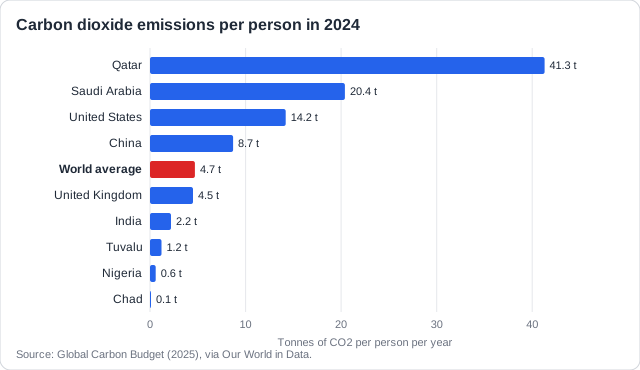
Use the numbers: Fossil fuel exporters (Qatar, Saudi Arabia) are at the top; low-income countries (Nigeria, Chad) at the bottom. That gap is why countries disagree about who should cut first.
People see climate change differently depending on their age and where they live. Their risks are different, so their priorities are too.
5. Differences in perspective
- Younger people will live with the effects longest, so many want faster action.
- Older people can push too, but some worry more about jobs and costs now.
- Coastal and low-lying communities face sea level rise and storm surges first.
- Inland and upland communities may feel safer, and may depend on coal or fossil fuel jobs.
- Different risks give different priorities, which makes agreement harder.
Young
- Greta Thunberg's school strike in 2018 grew into Fridays for Future, led by young people
Older
- Over 2,500 older Swiss women won a case in 2024: the court ruled Switzerland had not done enough
Low-lying
- Tuvalu: since 2024 up to 280 people a year may move to Australia by ballot; 8,750 entered the first one
Upland
- Silesia, Poland: coal mining towns agreed in 2021 to close their mines only by 2049
Remember it as: Belief, money, leaders, inequality, perspective: five brakes on action.
Stop wasting time on topics you know
Our AI identifies your weak areas and focuses your study time where it matters. No more overstudying easy topics.
How this comes up: Paper 2 Section A [4]: explain why the ability to act varies between countries. Section B: explain or discuss the challenges, with named examples, and judge which matters most.
The Netherlands and Bangladesh both have large areas of low-lying land at risk from rising seas. The Netherlands has spent billions of euros on sea defences; Bangladesh relies more on cyclone shelters and warnings.
Explain how the ability to implement mitigation and adaptation strategies may vary from one country to another.
Model answer plan
See the mark-by-mark plan — for / against / judgement, with marking guidance — in study mode.