The UN and climate change at Higher Level: This statement is Higher Level only. It covers the UN's role: the UNFCCC, the IPCC and the COP summits, the Kyoto and Paris agreements, the most recent COP, and the Kigali Amendment on HFCs.
Practise this as you read
- Evaluate how successful international agreements have been, with named examples.
- Discuss the value of agreements for a country aiming to be carbon neutral.
Free preview
This is the free notes preview
You're reading the free notes. Aimnova Pro unlocks the full study experience — and you can try it with your first topic free to keep:
- FlashcardsLock in vocabulary and key terms with spaced repetition.
- Practice questionsAnswer exam-style questions and get instant AI marking.
- Mock exams & past-paper vaultSit full mocks and see exactly how examiners award marks.
- Personalised study planA daily plan built around your exam date and weak areas.
One table for every country: No country can stop climate change alone. The UN gives the world three tools: a treaty, the UNFCCC; the science, from the IPCC; and a yearly meeting to make deals, the COP.
The UN's three tools
- The UNFCCC (1992) aims to stabilize greenhouse gas concentrations at a level that prevents dangerous interference with the climate.
- The IPCC (1988) gives the science: reports on causes, impacts and the cuts needed.
- COP summits (yearly since 1995) are where countries negotiate the deals.
- Climate is a global problem, so the UN brings almost every country to one table.
- The UN cannot force a country: every deal needs agreement by consensus.
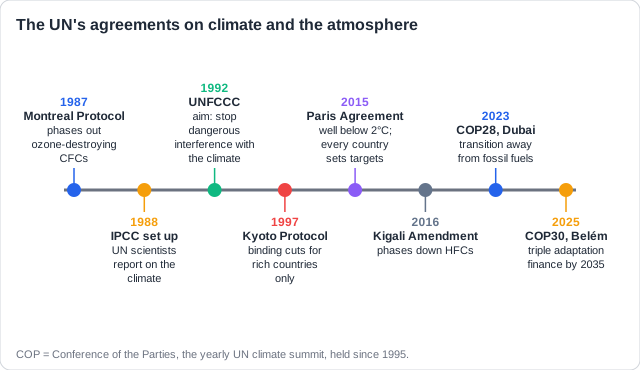
Real example: the IPCC's report of 2021-2023 said it is 'unequivocal' that humans have warmed the planet. Governments approve each summary line by line, so every country accepts the science used in the COP talks.
Know your predicted grade
Take timed mock exams and get detailed feedback on every answer. See exactly where you're losing marks.
The Kyoto Protocol was the first deal with binding cuts. It asked rich countries to act first, because they had released most of the carbon dioxide so far.
The Kyoto Protocol, 1997
- Kyoto Protocol (COP3, 1997; in force 2005): the first deal with legally binding cuts.
- Only developed countries had targets: about 5% below 1990 by 2008-2012.
- Fair because rich countries caused most of the CO2 so far.
- But the USA never ratified it and Canada left in 2011.
- Developing countries such as China had no target, and their emissions grew fast.
Impact: the countries that kept their targets met them overall, partly because old factories in eastern Europe closed. But the USA, the biggest emitter then, never chose to ratify it. World emissions kept rising: by 2012 they were about 50% higher than in 1990.
Binding is not the same as effective: Kyoto's targets were binding, but they covered too few countries. A deal works only if the big emitters are in it.
The Paris Agreement swapped binding targets for near-universal ones. Every country now writes its own plan, its NDC, and must make it stronger every five years.
The Paris Agreement, 2015
- Paris Agreement (COP21, 2015): keep warming well below 2°C, and try for 1.5°C.
- Every country sets its own target, its NDC, and updates it every five years.
- A global stocktake every five years checks progress (the first was at COP28, 2023).
- The targets are not legally binding: only reporting and updating are.
- Strength: almost everyone is in; weakness: the pledges add up to too little.
| Kyoto (1997) | Paris (2015) | |
|---|---|---|
| Who has targets | Developed countries only | Every country |
| Who sets them | Agreed together | Each country (its NDC) |
| Binding? | Yes, the targets | Only reporting and updating |
| Weakness | USA out; China had no target | Pledges add up to too little |
Impact: before Paris the world was heading for about 3.5-4°C. With the new pledges it is heading for about 2.3-2.5°C (UN, 2025), still far above 1.5°C. The first global stocktake in 2023 said the world was off track.
Get feedback like a real examiner
Submit your answers and get instant feedback — what you did well, what's missing, and exactly what to write to score full marks.
Each COP builds on the last. Read the list as a story: from 'less coal' to 'away from fossil fuels', and from cutting emissions to paying for the damage.
The recent COPs
- COP26 Glasgow (2021): coal to be 'phased down', not phased out.
- COP27 Egypt (2022): a fund for loss and damage in poorer countries.
- COP28 Dubai (2023): transition away from fossil fuels; triple renewables by 2030.
- COP29 Baku (2024): rich countries to give $300 billion a year by 2035.
- COP30 Belém (2025): triple adaptation finance by 2035; no fossil fuel roadmap agreed.
Place
- Held at the edge of the Amazon rainforest, 10-22 November 2025
Agreed
- The 'Global Mutirão' (a Brazilian word for working together): triple money for adaptation by 2035
Forests
- A new Tropical Forest Forever Facility, with over $5.5 billion announced, pays countries to keep forests standing
Missing
- No roadmap away from fossil fuels in the final text; Brazil will write one outside the talks
What next: COP31 meets in Antalya, Türkiye, on 9-20 November 2026, with Australia leading the talks. COP27 (2022) set up a fund for loss and damage in the countries hit hardest.
The Kigali Amendment shows UN treaties working together. A treaty written for the ozone layer was changed to stop a climate problem it had created by accident: HFCs.
Montreal, then Kigali
- The Montreal Protocol (1987) banned CFCs to save the ozone layer.
- Industry replaced them with HFCs, which do not harm ozone.
- But HFCs are greenhouse gases, often over 1,000 times stronger than CO2.
- The Kigali Amendment (2016, in force 2019) cuts HFCs by over 80% by 2047.
- It could avoid up to 0.4°C of warming by 2100: an ozone treaty fixing a climate problem.
1987: ban
The Montreal Protocol phases out CFCs that were thinning the ozone layer.
Swap
Fridges and air conditioners switch to HFCs, which leave ozone alone.
Problem
HFCs trap heat: one kilogram can warm like more than a tonne of CO2.
2016: Kigali
Countries agree in Kigali, Rwanda, to cut HFCs by over 80% by 2047.
HFCs, not CFCs: CFCs damage the ozone layer (banned in 1987). HFCs do not; they are greenhouse gases (cut by Kigali).
Learn what examiners really want
See exactly what to write to score full marks. Our AI shows you model answers and the key phrases examiners look for.
How valuable are these agreements? Questions ask you to weigh them, so learn the points on both sides, and compare climate deals with the one treaty everyone calls a success.
Value of international agreements
- For: a global problem needs global cooperation; one country alone cannot fix it.
- For: COP deals carry UN recognition and can be binding, and they raise the profile of the issue.
- For: deals can bring money and trade benefits, and promote equity between rich and poor countries.
- Against: deals are slow and need consensus, so they are often weakened.
- Against: targets may be voluntary, and a country can leave (the USA left Paris in January 2026).
- Montreal worked: few countries and companies, a ready substitute, no lifestyle change.
| Agreement | Success? | Why |
|---|---|---|
| Montreal (1987) | High: about 99% of ozone-destroying gases phased out | Few makers; a substitute ready |
| LRTAP (1979) | High: EU sulfur oxides down almost 95% since 1990 | Clear limits; cleaner fuels |
| Kyoto (1997) | Low: world emissions kept rising | USA out; no target for China |
| Paris (2015) | Partial: forecast down from 3.5-4°C to about 2.5°C | Voluntary; USA left in 2026 |
Remember it as: Ozone was easy: few makers, a swap ready. Climate is hard: everyone, everything.
How this comes up: Paper 2 Section B (c) [9]: how successful have international agreements been? Paper 1 [4]: from a fact file, discuss the value of international agreements (for, against, and a conclusion).
In November 2025, thirty years after the first COP, the UN climate summit met in Belém, Brazil. Global emissions were still rising.
To what extent has the UN's COP process been successful in addressing climate change?
Model answer plan
See the mark-by-mark plan — for / against / judgement, with marking guidance — in study mode.