Who leads the response at Higher Level: This statement is Higher Level only. It asks who leads the response to climate change, governments or others, and the four kinds of response: economic measures, legislation, goal setting and personal life changes.
Practise this as you read
- List policies a government could use to cut a country's emissions.
- Evaluate one economic, one legal and one industry response by its real impact.
Free preview
This is the free notes preview
You're reading the free notes. Aimnova Pro unlocks the full study experience — and you can try it with your first topic free to keep:
- FlashcardsLock in vocabulary and key terms with spaced repetition.
- Practice questionsAnswer exam-style questions and get instant AI marking.
- Mock exams & past-paper vaultSit full mocks and see exactly how examiners award marks.
- Personalised study planA daily plan built around your exam date and weak areas.
Not only governments: Governments are not the only ones who act on climate change. NGOs, companies and ordinary people are stakeholders who can lead too, with four kinds of response.
The points to remember
- Governments lead with laws and money: taxes, subsidies and targets that everyone must follow.
- Non-governmental stakeholders lead too: NGOs, companies, community groups and individuals.
- Responses fall into four kinds: economic, legislation, goal setting and personal life changes.
- Governments can force change; others push, set an example or take governments to court.
- Judge each response by its impact: did emissions actually fall?
| Who leads | Real example |
|---|---|
| Government | Bhutan's constitution (2008) says at least 60% of the country must stay forest |
| NGO | ClientEarth and Friends of the Earth won a UK court case in 2022 over a weak climate plan |
| Company | Microsoft promised in 2020 to remove more carbon than it emits by 2030 |
| Individual | Greta Thunberg's school strike in 2018 grew into a worldwide youth movement |
Remember it as: Pay, law, promise, lifestyle: four ways to respond.
See how examiners mark answers
Answer exam-style questions with model answers. Learn exactly what earns marks and what doesn't.
Economic measures change prices, so the low-carbon choice becomes the cheaper one. Governments can tax carbon, cap it and trade it, or pay people to switch.
Economic measures
- Put a price on carbon: a carbon tax makes each tonne of CO2 cost money (polluter pays).
- Emissions trading (cap and trade): a cap on total emissions; firms buy and sell allowances.
- Subsidies make low-carbon choices cheaper: solar panels, electric cars, heat pumps.
- Tariffs tax imported goods by their carbon, so firms cannot escape by moving abroad.
- Price signals make the cheapest cuts happen first, without banning anything.
Cap
- The EU sets a limit on the CO2 from about 10,000 power stations and factories, and lowers it every year
Trade
- Each firm needs one allowance per tonne; firms that cut emissions sell spare ones
Tariff
- From 2026 a carbon tariff (CBAM) charges importers of steel, cement and fertiliser for their carbon
Impact
- By 2024 emissions in these sectors were about 50% below 2005, mostly from closing coal power
Other real measures: Sweden has taxed carbon since 1991, now over €100 a tonne, one of the highest in the world. The US Inflation Reduction Act of 2022 gave about $370 billion in subsidy and tax credits for clean energy and electric cars.
Legislation turns a promise into a duty. A climate law sets a target in law, so the government must keep to it, and others can hold it to account.
Legislation
- Legislation = laws a country passes to cut its own emissions.
- A climate law can set a legally binding target (e.g. net zero by 2050) and steps to get there.
- Laws can also ban or limit things: coal power plants, petrol cars, inefficient buildings.
- Because it is law, people and NGOs can take the government to court if it falls behind.
- Laws last beyond one government, so businesses can plan and invest.
2008: the law
The UK Climate Change Act: the first legally binding national target, an 80% cut by 2050.
Carbon budgets
Five-year limits on emissions, advised by an independent Climate Change Committee.
2019: net zero
The target was raised to net zero by 2050.
Impact
By 2024 UK emissions were 54% below 1990; the last coal plant closed in September 2024.
The court as a check: in July 2022 the High Court ruled that the UK's net zero plan did not show how the targets would be met. Two NGOs, ClientEarth and Friends of the Earth, brought the case, and the government had to write a new plan in 2023.
Investigate your own government: Every country lists its climate plan (its NDC) on the UN climate website. Find your country's: its target, its date, and its main mitigation and adaptation policies.
Study smarter, not longer
Most students waste 40% of study time on topics they already know. Our AI tracks your progress and optimizes every minute.
Goal setting is led by industry, not law. A company promises a cut by a date, often before any law makes it, and its customers and investors watch whether it delivers.
Goal setting by industry
- Goal setting = a company or group commits publicly to cut emissions by a date.
- Goals include net zero dates and switching to 100% renewable electricity.
- B Corp branding shows a company meets checked social and environmental standards.
- Industry can move faster than law: one company can change a whole market.
- Weakness: goals are voluntary; without checks they can be greenwashing.
| Ørsted (energy, Denmark) | Patagonia (clothing, USA) | |
|---|---|---|
| Goal | Swap coal for wind power | Put the planet before profit |
| What it did | Sold its oil and gas; built offshore wind farms | Became a B Corp in 2011 |
| Impact | 85% coal in 2009; 86% renewable by 2019, 21 years early | Owners gave it to a trust and a climate charity in 2022 |
A goal is not a result: Voluntary goals can be greenwashing: a promise with no plan or checks. Credit a goal only with the evidence that emissions really fell, as at Ørsted.
Personal life changes are the smallest scale: what each person throws away, eats and burns. On their own they are small; together they shift what companies sell and what voters demand.
Personal life changes
- Personal life changes = choices individuals make every day.
- Reduce waste: less landfill means less methane.
- Eat less meat: livestock produce methane and need far more land.
- Use less energy: heating, flights, cars; walk, cycle or take the train.
- One person's cut is small, but millions together change markets and politics.
Real example: in Sweden, the word flygskam spread from 2018. In 2019 the number of domestic air passengers fell by 9%, as more people took the train.
Judge the impact carefully: Sweden also brought in a tax on flights in 2018, so the fall was not only personal choice. Personal change works best when a price or a law pushes the same way.
Practice with exam-style questions
Answer exam-style questions and get AI feedback that shows you exactly what examiners want to see in a full-marks response.
How this comes up: Paper 1 (May 2026): a chart of a country's emissions by sector, then 'List two policy changes by the government'. Paper 2: outline or evaluate responses led by governments, NGOs, companies or people.
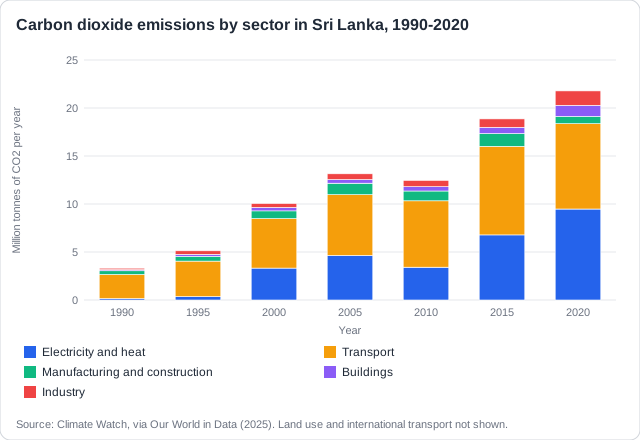
Sri Lanka's carbon dioxide emissions rose more than sixfold between 1990 and 2020. The chart shows the emissions from each sector.
List two policy changes by the government of Sri Lanka that could lead to a reduction in the carbon emissions shown in the chart.
Model answer plan
See the mark-by-mark plan — for / against / judgement, with marking guidance — in study mode.
Answers that score nothing: 'Ban fossil fuels' is not credited: no country can do that overnight. 'Reduce emissions' alone is not a policy. Name the action: a carbon tax, a subsidy, a law.