Adaptation plans at Higher Level: The same statement as SL, with different real cases: the Maldives at every scale, Bangladesh's National Adaptation Plan, the Malé seawall and Hulhumalé, Copenhagen's Cloudburst Plan. At HL, weigh the politics and money of planning: who decides, and who pays.
Practise this as you read
- Describe plans at three scales, with a place for each.
- Compare and contrast two named societies.
Free preview
This is the free notes preview
You're reading the free notes. Aimnova Pro unlocks the full study experience — and you can try it with your first topic free to keep:
- FlashcardsLock in vocabulary and key terms with spaced repetition.
- Practice questionsAnswer exam-style questions and get instant AI marking.
- Mock exams & past-paper vaultSit full mocks and see exactly how examiners award marks.
- Personalised study planA daily plan built around your exam date and weak areas.
Plans from the household to the planet: Adaptation is planned at every scale, from one family to the United Nations. An adaptation plan decides what to protect first.
The points to remember
- Individuals and households: small, cheap changes, e.g. raising a house on a higher base.
- Communities: shared shelters, village early-warning volunteers, community seed banks.
- Cities: resilience plans for floods and heat, e.g. parks that store storm water.
- Nations: adaptation plans with laws, money and priorities for decades ahead.
- International: the UN helps poorer countries plan and pay for adaptation.
- Bigger scales set the rules and money; smaller scales act fastest and know local needs.
Remember it as: House, village, city, country, world: everyone plans, at their own size.
Real example: in the Maldives, islanders rebuild homes on raised floors; the capital, Malé, is ringed by a seawall; and the government wrote a national programme of action in 2007, because most of the country is less than 1 metre above sea level.
Learn what examiners really want
See exactly what to write to score full marks. Our AI shows you model answers and the key phrases examiners look for.
The poorest countries face the worst impacts with the least money. The UN created a process to help them decide what is most urgent and to pay for it.
NAPAs and the UNDP process
- NAPA = National Adaptation Programme of Action, set up under the UNFCCC in 2001.
- For the least developed countries: it lists their most urgent adaptation needs.
- Steps: assess what is most at risk, ask local communities, rank priority activities.
- Priority projects can then get international funding, e.g. from the Least Developed Countries Fund.
- The UN Development Programme (UNDP) helps developing countries through this process and to get money.
- Since 2010, National Adaptation Plans (NAPs) add medium- and long-term planning.
Real example: with UNDP support, Bangladesh wrote a National Adaptation Plan for 2023-2050. It lists 113 interventions across 11 climate stress areas, such as salty water and river floods, costing about US$230 billion, far more than the country can pay alone.
Say who it is for: A NAPA is for the least developed countries and lists URGENT needs. Name a country that has one.
A whole country plans: National plans decide the big structures, the laws and the money. The best ones work with nature as well as against it.
What a national adaptation plan does
- A national plan looks decades ahead, because sea level and rainfall keep changing.
- It sets safety standards in law, e.g. how big a flood a dyke must withstand.
- It mixes structural works (dykes, barriers) with non-structural ones (zoning, warnings).
- It often gives water more room instead of only building higher walls.
- It needs steady funding: rich countries pay themselves; poorer ones need help.
Real example: after high waves flooded the Maldives' capital in 1987, Japan paid for a seawall around Malé, finished in 2002. From 1997 the government built a new island, Hulhumalé, raised about 2 metres above sea level, about 0.6 metres higher than Malé, so people can move to safer ground.
Never wonder what to study next
Get a personalized daily plan based on your exam date, progress, and weak areas. We'll tell you exactly what to review each day.
Cities write their own resilience plans, because floods and heat hit dense streets hardest.
What a city resilience plan does
- Cities face cloudbursts, heatwaves and surges, and have dense, costly property.
- A resilience plan maps where water and heat do most harm, then ranks projects.
- Blue-green measures: parks, squares and streets that store or carry storm water safely.
- Grey measures: bigger drains and underground tunnels.
- Residents help too: valves against sewer backflow, green roofs, rain barrels.
Real example: on 2 July 2011 over 100 mm of rain fell on Copenhagen in about two hours, causing about US$1 billion of damage. In 2012 the city adopted a Cloudburst Plan: about 300 projects over 20 years, from parks that flood safely to large rainwater tunnels.
Plans link up: City plans sit inside national rules and funding, and households add their own small measures. Mention more than one scale when you can.
Two societies, side by side: A common question asks you to compare and contrast the adaptation of two societies. Learn one pair well, with similarities and differences.
How to compare and contrast
- Compare = say what is the same in both; contrast = say what is different.
- Name two societies and keep both in every point.
- Use headings: flood defences, warnings, health, buildings, money, plans.
- Mix both: a point of similarity, then a point of difference, and so on.
- Only similarities, or only differences, caps the answer below full marks.
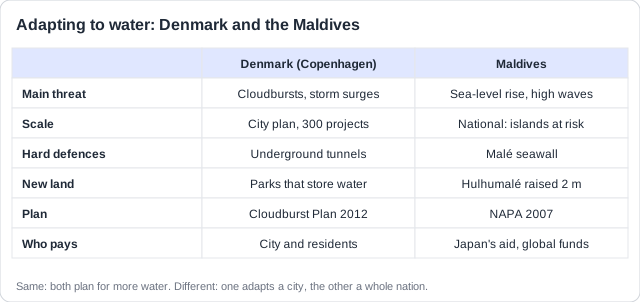
Real example: Copenhagen can pay for its own tunnels and parks from city and household money, while the Maldives depended on Japan for its seawall and on international funds for its programme of action: wealth decides who designs and who pays.
Stop wasting time on topics you know
Our AI identifies your weak areas and focuses your study time where it matters. No more overstudying easy topics.
How this comes up: Paper 2, Section B (b): compare and contrast two named societies, seven separate points.
Copenhagen, in Denmark, and the Maldives both expect much more water: one from cloudbursts and surges, the other from the rising sea.
Compare and contrast the adaptation strategies to climate change of Denmark and the Maldives.
Model answer plan
See the mark-by-mark plan — for / against / judgement, with marking guidance — in study mode.