Climate and the tragedy of the commons at Higher Level: This statement is Higher Level only. It uses one idea, the tragedy of the commons, to explain why the world keeps warming even though every country is harmed, and why only cooperation between almost every country can stop it.
Practise this as you read
- Explain how carbon dioxide in the air shows the tragedy of the commons.
- Judge whether climate change can be avoided without worldwide cooperation.
Free preview
This is the free notes preview
You're reading the free notes. Aimnova Pro unlocks the full study experience — and you can try it with your first topic free to keep:
- FlashcardsLock in vocabulary and key terms with spaced repetition.
- Practice questionsAnswer exam-style questions and get instant AI marking.
- Mock exams & past-paper vaultSit full mocks and see exactly how examiners award marks.
- Personalised study planA daily plan built around your exam date and weak areas.
The air belongs to everyone, so no one looks after it: The atmosphere is the biggest commons on Earth. The tragedy of the commons explains why the world keeps filling it with carbon dioxide.
The points to remember
- The atmosphere is a commons: shared by everyone, owned by no one.
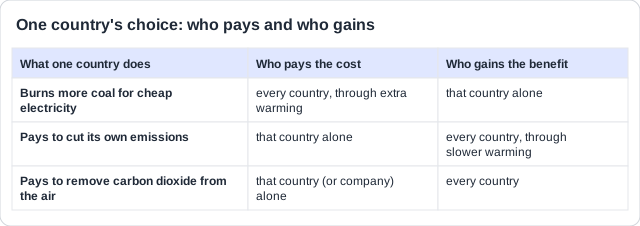
- When one nation burns fossil fuels, it gains the cheap energy itself.
- But the costs, a warmer climate, are shared by all nations and their ecosystems.
- So each nation, acting in its own self-interest, keeps emitting: the tragedy of the commons.
- No owner means no one is responsible for looking after it.
Real example: in 1968 the ecologist Garrett Hardin described a pasture open to every herder. Each herder gains the full profit from one more cow, but the damage to the grass is shared, so they all add cows until the pasture is ruined. Swap the pasture for the air and the cows for power stations, and you have climate change.
See how examiners mark answers
Answer exam-style questions with model answers. Learn exactly what earns marks and what doesn't.
Why does no country simply fix the problem? Because each acts in its own self-interest, and no single country's emissions decide the outcome.
Why no country can fix it alone
- Each country's share of emissions is small compared with the whole.
- Even the largest emitter, China, makes less than a third.
- So a country that cuts alone pays the full cost but slows warming only a little.
- Governments often favour short-term gain over long-term harm.
- The combined effect of everyone's small share is catastrophic climate change.
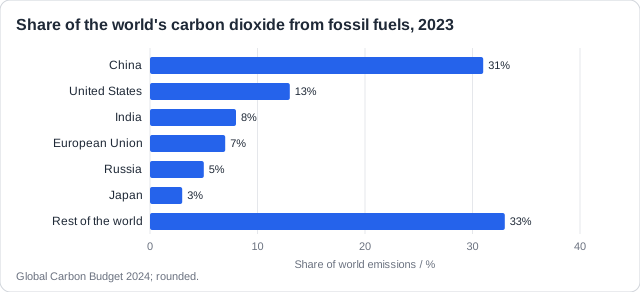
Real example: if Japan, the world's fifth largest emitter, stopped all its fossil-fuel use tomorrow, it would cut world emissions by only about 3%, while bearing the whole cost itself. That is why each country waits for the others.
The commons creates a free-rider problem: a country can enjoy a cooler planet that others paid for.
Free-riders
- A free-rider gains from others' cuts without cutting itself.
- Cleaner air and slower warming cannot be kept from countries that do not pay.
- So every country is tempted to wait for others to act first.
- If many free-ride, agreements collapse, and nobody cuts enough.
Remember it as: I gain, we all pay. You pay, we all gain.
Price
- On 1 July 2012 Australia began charging big polluters 23 Australian dollars per tonne of carbon dioxide
Cost
- Opponents said Australians paid higher power bills while bigger emitters did nothing
Repeal
- After an election fought on 'axe the tax', the price was scrapped on 17 July 2014: the first developed country to repeal one
Lesson
- When a country thinks others are free-riding, acting alone is hard to keep going
Study smarter, not longer
Most students waste 40% of study time on topics they already know. Our AI tracks your progress and optimizes every minute.
The guide points out the reverse case. Cleaning up the atmosphere also costs one country, while every country shares the benefit.
The reverse case: paying to clean up
- The tragedy also works in reverse.
- Restoring the atmosphere, e.g. carbon capture and storage, costs one nation or company.
- But the benefits of less carbon dioxide are gained by all nations.
- So few want to pay: the same problem as polluting, the other way round.
Orca, Iceland (2021)
- A direct air capture plant, paid for by one Swiss company
- Built to capture 4,000 tonnes of CO2 a year
- That is about three and a half seconds of the world's emissions
Germany's solar panels (from 2000)
- Germany paid guaranteed prices for solar power
- German households paid through their power bills
- Solar panel prices fell about 90% worldwide, 2010-2020
Real example: in both cases one country or company paid, and the whole world gained: less carbon dioxide in the shared air, or cheap solar panels that every country can now use. Reports in 2025 said Orca had captured far less than it was built for, which shows how costly the clean-up is.
The guide's warning is that catastrophic climate change is likely unless countries cooperate on an unprecedented scale: nearly every nation, for decades.
Escaping the tragedy
- Catastrophic change is likely unless nations cooperate on an unprecedented scale.
- Binding agreements with targets that every country signs and that tighten over time.
- Monitoring and openness, so each country can see that others keep their word.
- Sanctions, such as border carbon taxes, so free-riding costs money.
- Finance and technology for poorer countries, so the cost is shared fairly.
- Trust: shared rules and talking, as Elinor Ostrom found for local commons.
| What is needed | Why it helps | A real step |
|---|---|---|
| Every country in | no gap for free-riders | 195 parties joined the Paris Agreement (2015) |
| Shared costs | poorer countries can afford to cut | COP29 (2024): at least 300 billion dollars a year by 2035 |
| Sanctions | free-riding costs money | border carbon taxes on imports |
| Trust | reciprocity: I cut because you cut | Paris pledges reviewed every five years |
Real example: the economist Elinor Ostrom won a Nobel prize in 2009 for showing that people can manage a shared commons, such as forests or irrigation water, without ruining it, when they agree clear rules, watch each other and trust each other. The climate needs the same, but between almost 200 countries at once.
Practice with exam-style questions
Answer exam-style questions and get AI feedback that shows you exactly what examiners want to see in a full-marks response.
How this comes up: Paper 2: explain how a shared resource shows the tragedy of the commons, or judge whether climate change can be avoided without worldwide cooperation. Section A may give each country's share of emissions.
Carbon dioxide measured at Mauna Loa, Hawaii, has risen every year since records began in 1958, although every country breathes the same air.
Explain how the build-up of carbon dioxide in the atmosphere demonstrates the concept of the tragedy of the commons.
Model answer plan
See the mark-by-mark plan — for / against / judgement, with marking guidance — in study mode.