How urgent is action? at Higher Level: This statement is Higher Level only. It asks why people facing the same science still disagree about whether to act, whether action is realistic and how fast it must come: by age, wealth, place and the fuel their economy runs on.
Practise this as you read
- Discuss how one factor shapes a person's view on cutting emissions.
- Compare the views of a developed and a developing country.
Free preview
This is the free notes preview
You're reading the free notes. Aimnova Pro unlocks the full study experience — and you can try it with your first topic free to keep:
- FlashcardsLock in vocabulary and key terms with spaced repetition.
- Practice questionsAnswer exam-style questions and get instant AI marking.
- Mock exams & past-paper vaultSit full mocks and see exactly how examiners award marks.
- Personalised study planA daily plan built around your exam date and weak areas.
Same science, different answers: Almost everyone can see the climate is changing. They disagree on the necessity, the practicality and the urgency of doing something about it.
The points to remember
- People disagree on three questions about climate action.
- Necessity: is action needed at all?
- Practicality: can it be done, with the money, technology and jobs at stake?
- Urgency: how fast must it happen?
- The answers depend on how vulnerable a person or society is, and on their values and income.
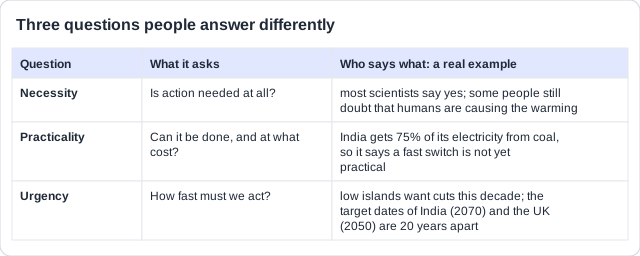
Each view depends on vulnerability: who is harmed first, and who can afford to cope. The next sections take the four contrasts the guide names: age, development, place and fossil-fuel wealth.
Memorize terms 3x faster
Smart flashcards show you cards right before you forget them. Perfect for definitions and key concepts.
Age changes how close the harm feels. But it does not always point the same way.
Age groups
- The young have longer to live with the effects, so many see action as more urgent.
- Older people may be just as concerned, for their children and grandchildren.
- Some older people are vulnerable now: heatwaves harm the elderly most.
- People with an illness linked to climate or pollution, such as lung disease, may care more.
- Others, young or old, see it as less urgent if they think the harm is far away.
Young: Held v Montana, 2023
- 16 young plaintiffs, aged 5 to 22, sued the US state of Montana
- They said its support for fossil fuels harmed their future
- In August 2023 a judge agreed: a first in the USA
Old: the Swiss climate seniors, 2024
- Over 2,000 Swiss women aged 64 and over took their country to court
- Heatwaves put older women's health at risk now
- In April 2024 the European Court of Human Rights agreed
Remember it as: Young: it's my future. Old: it's my health now, and my grandchildren's future.
Developed and developing societies see climate action through very different histories and incomes.
Developed and developing societies
- Developed societies emitted most of the past carbon dioxide and are rich enough to pay for change.
- Developing societies emit far less per person and need energy to lift people out of poverty.
- So many developing countries say fast cuts are less practical for them: the right to develop.
- Yet poorer people are often more concerned: they suffer the worst effects and can least afford to adapt.
- Richer people may act to protect their assets, or because green technology is profitable.
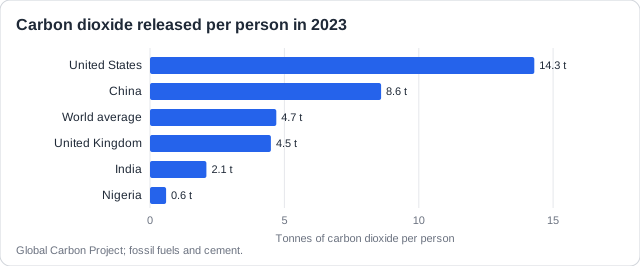
Real example: at the COP26 talks in Glasgow in 2021, India, backed by China, changed the deal's wording from 'phase out' coal to 'phase down' coal at the last minute. India gets 75% of its electricity from coal and argued for its right to develop. Small island states said they were deeply disappointed: for them, delay is dangerous.
Know your predicted grade
Take timed mock exams and get detailed feedback on every answer. See exactly where you're losing marks.
Where you live decides when the harm arrives. Coasts flood first; inland, the risk can feel far away, especially where the local jobs depend on fossil fuels.
Coastal and inland communities
- Coastal and low-lying communities already face floods and storm surges, so action feels urgent.
- Inland and upland communities may feel the effects less, so see it as less urgent.
- Where jobs depend on coal, oil or gas, cuts threaten people's livelihood.
- So the same country can hold opposite views in different places.
Coast: the Torres Strait
- The Torres Strait Islands are only a few metres above the sea
- Floods damage homes, graves and gardens
- In 2022 a UN committee ruled that Australia had failed them
Inland: Clermont, Queensland
- A small town in coal-mining country, far from the sea
- Many jobs depend on the mines
- In 2019 locals turned out against a 'Stop Adani' convoy
Real example: both places are in the same country, Australia. In 2019 a convoy of protesters from the south drove to Clermont to oppose the huge new Carmichael coal mine; local people met them with counter-protests in defence of mining jobs. Three years later, Torres Strait Islanders won their case at the UN. One country, opposite views.
When a society's wealth comes from fossil fuels, cutting them threatens its livelihood. Its view of what is necessary and practical changes with that.
Fossil-fuel economies, values and empathy
- Economies that profit from fossil fuels often see fast cuts as less necessary or impractical.
- Their jobs, taxes and exports depend on oil, gas or coal.
- Economies that import fossil fuels, or sell clean technology, gain from cutting them.
- Values matter too: ecocentrics see action as necessary now; technocentrics trust future technology.
- Anyone, anywhere, can feel empathy for those at risk.
Oil
- Alberta's oil sands make it the heart of Canada's oil industry, with many jobs and tax income
Price
- From 2019 Canada's government put a national price on carbon
Court
- Alberta, with Saskatchewan and Ontario, challenged it; in March 2021 the Supreme Court of Canada ruled the price was lawful
Change
- Public anger at the cost grew, and the price on consumers' fuel was set to zero from April 2025
Empathy and values: Do not assume a person's view from where they live or earn. empathy lets a safe, wealthy person care deeply, and an ecocentric value system sees action as necessary now, wherever you live.
Get feedback like a real examiner
Submit your answers and get instant feedback — what you did well, what's missing, and exactly what to write to score full marks.
How this comes up: Paper 2: discuss how a person's or a society's situation shapes their view on cutting emissions (age, income, place, jobs), with both sides and a conclusion. Paper 1 may give data on two countries to compare.
The Torres Strait Islands lie only a few metres above the sea, while Clermont is a coal-mining town hundreds of kilometres inland in the same country, Australia.
Discuss how where a person lives can influence their view on the urgency of cutting carbon emissions.
Model answer plan
See the mark-by-mark plan — for / against / judgement, with marking guidance — in study mode.