The Sun's radiation at Higher Level: The same spectrum as SL, with different examples: the James Webb and Hubble telescopes, and the UV patterns bees see on flowers. At HL, keep the link 'shorter wavelength, more energy' ready: it explains why UV breaks the bonds in ozone and oxygen later in this topic.
Practise this as you read
- Rank the types of radiation by wavelength, frequency and energy.
- Link each type of sunlight to its role in the biosphere.
Free preview
This is the free notes preview
You're reading the free notes. Aimnova Pro unlocks the full study experience — and you can try it with your first topic free to keep:
- FlashcardsLock in vocabulary and key terms with spaced repetition.
- Practice questionsAnswer exam-style questions and get instant AI marking.
- Mock exams & past-paper vaultSit full mocks and see exactly how examiners award marks.
- Personalised study planA daily plan built around your exam date and weak areas.
One kind of energy, many wavelengths: Light, heat from the Sun and radio signals are all electromagnetic radiation. They differ only in their wavelength.
The points to remember
- The Sun gives out electromagnetic radiation: energy that travels as waves, even through empty space.
- It covers a range of wavelengths: from radio waves (longest) to gamma rays (shortest).
- In order: radio, microwave, infrared, visible light, ultraviolet (UV), X-ray, gamma.
- Long wavelength = low frequency; short wavelength = high frequency.
- Wavelength = the distance from one wave peak to the next; frequency = how many waves pass each second.
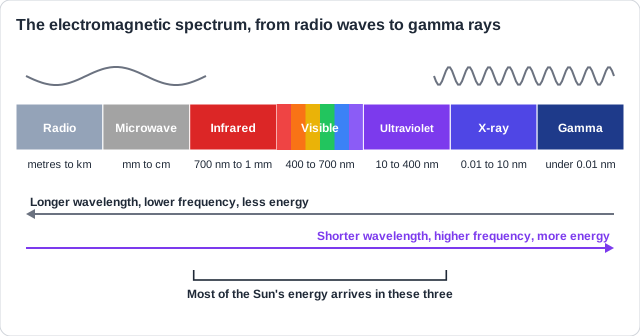
Remember it as: Long and lazy: radio. Short and strong: gamma.
Real example: the James Webb Space Telescope looks at space in infrared, the long waves given out by cool dust and very distant galaxies; the Hubble Space Telescope sees mostly visible light and UV. Same kind of radiation, different wavelengths, so they see different things.
Know your predicted grade
Take timed mock exams and get detailed feedback on every answer. See exactly where you're losing marks.
The Sun gives out the whole spectrum, but not equally. Almost all of its energy arrives as three types: infrared, visible light and UV.
The points to remember
- Most of the Sun's energy arrives as infrared, visible light and UV.
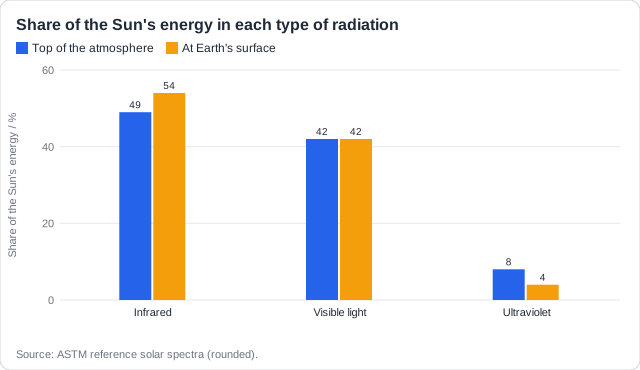
- At the top of the atmosphere: about 49% infrared, 42% visible and 8% UV.
- At the ground, UV is only about 3 to 5%: the atmosphere (the ozone layer) absorbs most of it.
- The Sun gives out the most energy as visible light: our eyes evolved to see the strongest part of sunlight.
Infrared
About half of the Sun's energy, both above the air and at the ground.
Visible light
About 42%: the biggest single band, and the part we see.
Ultraviolet
8% at the top, only about 4% at the ground: the rest is absorbed.
Read the chart: Compare the two bars for each type: the only big change is UV, which halves on the way down.
Each of the three types of sunlight does a different job for life on Earth, the biosphere.
The points to remember
- Infrared = heat: it warms land, sea and air; Earth sends it back out, and greenhouse gases trap some of it.
- Visible light drives photosynthesis, so it is the energy source of almost every food chain.
- Visible light also lets animals see, and day length sets seasons for flowering and migration.
- UV has the most energy of the three: it damages cells and DNA, so too much is harmful.
- A little UV (UVB) is useful: it makes vitamin D in human skin.
- Some animals see UV: bees use UV patterns on flowers to find nectar.
Infrared
- Warms land, sea and air.
- Drives the water cycle and winds.
Visible light
- Photosynthesis: the start of food chains.
- Sight and day length.
Ultraviolet
- Most energy: damages cells and DNA.
- Makes vitamin D in skin.
Real example: honeybees can see UV. Many flowers, such as the black-eyed Susan, have UV patterns we cannot see, called nectar guides, which lead bees to the nectar.
Do not mix up the ozone layer and the greenhouse effect: The ozone layer (stratosphere) absorbs incoming UV from the Sun. Greenhouse gases (troposphere) absorb outgoing infrared from Earth's surface. Different radiation, different layer.
Get feedback like a real examiner
Submit your answers and get instant feedback — what you did well, what's missing, and exactly what to write to score full marks.
How this comes up: Paper 2, Section A: a short question with 2 or 3 marks. Name the type of radiation, then say what it does: one point per mark.
At the top of the atmosphere, about 8% of the Sun's energy is ultraviolet (UV). At the ground it is only about 4%.
Explain why living things at Earth's surface are exposed to much less UV than the Sun gives out.
Model answer plan
See the mark-by-mark plan — for / against / judgement, with marking guidance — in study mode.