Stakeholders and perspectives at Higher Level: This statement is Higher Level only. It is about who changes how people think about climate change: activists, scientists, journalists, teachers, neighbours, faith leaders and companies, and how they do it.
Practise this as you read
- Explain how two named stakeholders can change one person's view.
- Judge which stakeholder matters most, with real examples.
Free preview
This is the free notes preview
You're reading the free notes. Aimnova Pro unlocks the full study experience — and you can try it with your first topic free to keep:
- FlashcardsLock in vocabulary and key terms with spaced repetition.
- Practice questionsAnswer exam-style questions and get instant AI marking.
- Mock exams & past-paper vaultSit full mocks and see exactly how examiners award marks.
- Personalised study planA daily plan built around your exam date and weak areas.
Who changes how we see climate change?: Nobody forms a perspective alone. Every stakeholder that a person listens to, from a famous activist to a teacher, can change what they think and do about climate change.
The points to remember
- A stakeholder is a person or group with an interest in climate change.
- Stakeholders shape an individual's perspective: what they believe, value and do.
- The guide names charismatic individuals, local community groups, NGOs, the media and educational institutions.
- Scientists, businesses, faith groups and governments shape perspectives too.
- A stakeholder can push a view towards action or against it.
Scientist
- James Hansen led NASA's climate research at the Goddard Institute in New York
Testimony
- On 23 June 1988, a very hot day, he gave testimony to the US Senate that global warming had begun
Media
- The New York Times put it on its front page, and the story went round the world
Change
- Global warming became a public issue, not only a scientists' topic; the IPCC was set up later the same year
Notice the chain: one stakeholder (a scientist) needed another (the media) to reach the public. Perspectives usually change through several stakeholders working together.
See how examiners mark answers
Answer exam-style questions with model answers. Learn exactly what earns marks and what doesn't.
A charismatic individual or a group of activists can make people notice a problem they had ignored.
Charismatic individuals and activists
- A charismatic individual puts a human face on a global problem and gets people talking.
- They often reach young people and those who ignore scientists or politicians.
- Activists use protests and civil disobedience to win attention and force a response.
- Both can change what is 'normal' to think and say about climate change.
- But some people reject a figure they dislike, and attention can fade.
Remember it as: A face, a protest, a new normal.
Real example: in January 2020 a news agency cropped the Ugandan activist Vanessa Nakate out of a photo of young climate campaigners at Davos. Her video response went viral. It made millions ask whose voices are heard, and showed that Africa, which emits least, is among the places hit hardest.
Activists: Extinction Rebellion, London: In April 2019 Extinction Rebellion blocked bridges and roads in central London for 11 days, using civil disobedience; over 1,000 people were arrested. On 1 May 2019 the UK Parliament declared a climate emergency, the first national parliament to do so.
Most people never read a climate report. What they know comes through the media, so the media have great power over perspectives.
The media
- The media decide which stories people see, and how they are framed.
- Simple images and data graphics can make a slow, invisible change easy to grasp.
- False balance made climate science look disputed for years.
- Social media spreads both campaigns and misinformation very fast.
- So the media can raise concern or sow doubt.
Raising concern
- Ed Hawkins' warming stripes (2018): one band per year, blue to red
- Shared on TV weather forecasts and T-shirts worldwide
- A slow change becomes easy to see
Sowing doubt
- False balance: a denier set against a scientist
- The debate looked evenly split when it was not
- Misinformation spreads fast on social media
Real example: in 2018 the BBC told its journalists that they do not need a climate change denier to 'balance' a report, because the science is settled. It ended years of false balance on Britain's biggest broadcaster.
Study smarter, not longer
Most students waste 40% of study time on topics they already know. Our AI tracks your progress and optimizes every minute.
Groups close to people's daily lives, such as neighbours, an NGO or a place of worship, can change perspectives because their members trust them.
Community groups, NGOs and faith groups
- Local community groups show what action looks like next door, so it feels possible.
- NGOs campaign, inform, lobby and even take governments to court.
- Faith groups link climate action to values people already hold, such as care for creation.
- Each is trusted by its own members, so it reaches people others cannot.
| Stakeholder | Real example | How it changed perspectives |
|---|---|---|
| Local community group | Totnes, Devon, became the first Transition Town in 2006 | residents saw neighbours grow food and share energy; the idea spread to hundreds of towns |
| NGO | Urgenda and 886 Dutch citizens sued their government | in 2019 the Supreme Court ordered a cut of at least 25% below 1990 by the end of 2020 |
| Faith group | the Islamic Declaration on Global Climate Change, Istanbul, 2015 | Muslim leaders called caring for the Earth a religious duty |
Say how, not only who: Naming a stakeholder is not enough. Say how it changes a person's view: trust, example, new information, values, or a court ruling that makes action a duty.
Schools and universities shape perspectives over years. Businesses shape them through what they sell and what they say, and not always towards action.
Educational institutions and businesses
- Educational institutions teach the science, so students understand the causes and effects.
- Students often carry new ideas home to their families.
- Businesses shape perspectives through advertising, products and what they tell the public.
- Some businesses have spread doubt to protect their profits; others lead change.
- So the same kind of stakeholder can push either way.
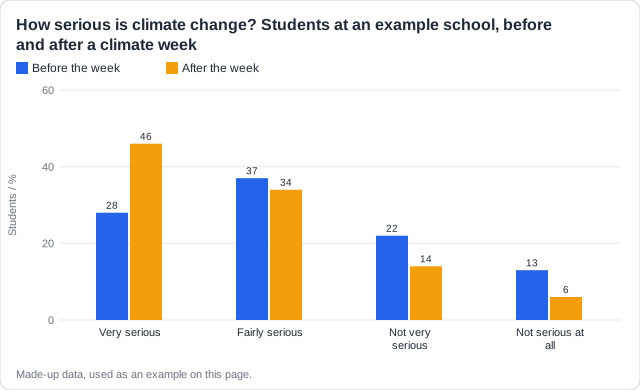
Real example: in 2019 Italy announced that from September 2020 every state school would teach 33 hours a year on climate change and sustainability, the first country to put it into the whole curriculum.
A business: what Exxon knew: A 2023 study in the journal Science found that Exxon's own scientists had predicted global warming accurately between 1977 and 2003. Yet for years the company publicly cast doubt on climate science: a doubt campaign that slowed public concern.
Practice with exam-style questions
Answer exam-style questions and get AI feedback that shows you exactly what examiners want to see in a full-marks response.
How this comes up: Paper 2: explain how stakeholders influence perspectives, or judge which matters most, always with named, real examples. Section A may give survey data on where people's views come from.
In April 2019 Extinction Rebellion blocked roads in central London for 11 days. Two weeks later the UK Parliament declared a climate emergency.
Explain how two different stakeholders can change an individual's perspective on climate change.
Model answer plan
See the mark-by-mark plan — for / against / judgement, with marking guidance — in study mode.