Geoengineering at Higher Level: This statement is Higher Level only. It asks whether people should deliberately re-engineer the climate: shading the planet or pulling carbon dioxide out of the air. You need the methods, a real case for each, and both sides of the argument.
Practise this as you read
- Explain why geoengineering treats the symptom, not the cause.
- Evaluate one named method, with a judgement.
Free preview
This is the free notes preview
You're reading the free notes. Aimnova Pro unlocks the full study experience — and you can try it with your first topic free to keep:
- FlashcardsLock in vocabulary and key terms with spaced repetition.
- Practice questionsAnswer exam-style questions and get instant AI marking.
- Mock exams & past-paper vaultSit full mocks and see exactly how examiners award marks.
- Personalised study planA daily plan built around your exam date and weak areas.
Treating the symptom, not the cause: geoengineering tries to cool the planet or pull carbon dioxide back out of the air. It deals with the symptom, a warmer world, while the cause, burning fossil fuels, goes on.
The points to remember
- Geoengineering is a deliberate, large-scale intervention in the Earth's climate system.
- It is a mitigation strategy, but it treats the symptom (warming), not the cause (emissions).
- Solar radiation management reflects sunlight away to cool the Earth.
- Carbon dioxide removal takes carbon dioxide back out of the air after it is released.
- Only cutting emissions treats the cause: burning fossil fuels and clearing forests.
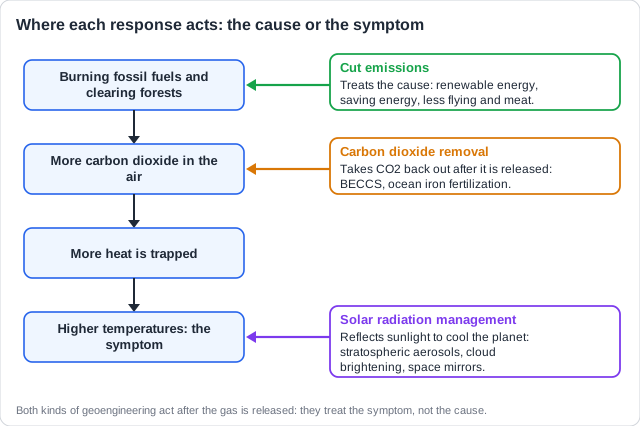
Real example: think of a leaking roof. Fixing the roof treats the cause. Putting buckets under the leak treats the symptom: it helps for now, but the rain still comes in. Geoengineering is the buckets; cutting emissions is fixing the roof.
Practice with exam-style questions
Answer exam-style questions and get AI feedback that shows you exactly what examiners want to see in a full-marks response.
The first family of methods, solar radiation management, would send a little of the Sun's light back to space before it can warm the Earth.
Reflecting sunlight
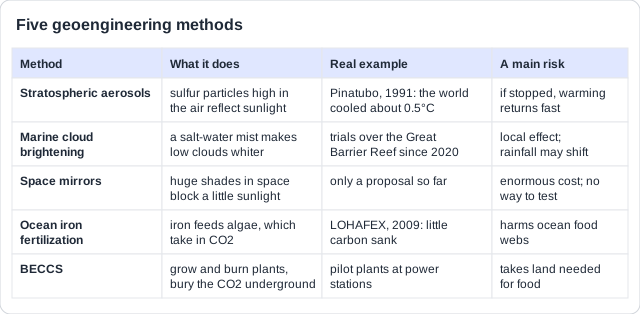
- Stratospheric aerosols: sulfur particles high in the air reflect sunlight, as after a big volcanic eruption.
- Marine cloud brightening: a fine salt-water mist makes low clouds whiter, so they reflect more sunlight.
- Space mirrors: huge shades in space would block a small part of the Sun's light.
- Cloud seeding: adding particles to clouds; seeding high cirrus clouds could thin them and let heat escape.
- All of them cool fast but leave the carbon dioxide in the air.
Eruption
- June 1991: Mount Pinatubo in the Philippines erupted, one of the largest eruptions of the 20th century
Gas
- It put about 15 million tonnes of sulfur dioxide into the stratosphere, where it formed a haze of aerosols
Shade
- The haze spread round the world and reflected some sunlight back to space
Cooling
- The world cooled by about 0.5°C for about two years, then warmed again as the particles fell out
Real example: since 2020 scientists from Southern Cross University have sprayed a sea-water mist from boats off Townsville, Australia, to brighten clouds over the Great Barrier Reef and shade its corals in heatwaves. In 2024 a similar test on an old aircraft carrier in Alameda, California, was stopped by the city council.
Cloud seeding: Countries such as the United Arab Emirates already seed clouds to make rain. For the climate, scientists suggest seeding high cirrus clouds so that they thin and let more heat escape to space.
The second family takes carbon dioxide back out of the air. It lowers the amount of the gas, but only after it has been released, and only slowly.
Removing carbon dioxide
- Ocean iron fertilization: iron is added to the sea so algae grow and take in carbon dioxide.
- When the algae die, some sink and lock carbon in the deep ocean.
- BECCS: grow plants, burn them for energy, capture the carbon dioxide and store it underground.
- These lower carbon dioxide, but slowly, and they do not stop new emissions.
Ocean iron fertilization
- Iron is added so algae bloom
- The algae take in carbon dioxide
- Some sink: carbon locked in the deep sea
BECCS
- Plants take in carbon dioxide as they grow
- They are burned in a power station
- The gas is captured and stored underground
Real example: in July 2012 a company dumped about 100 tonnes of iron sulfate into the Pacific off Haida Gwaii, Canada, without permission, hoping to grow plankton and sell carbon credits. Scientists and the UN condemned it. A 2009 research cruise, LOHAFEX, added 6 tonnes of iron to the Southern Ocean: the algae grew, but tiny animals ate most of them, so little carbon sank. BECCS needs huge areas of land to grow the plants.
Feeling unprepared for exams?
Get a clear study plan, practice with real questions, and know exactly where you stand before exam day. No more guessing.
Supporters, often with a technocentric view, say geoengineering could be a useful extra tool, because the world is not cutting emissions fast enough.
Arguments for geoengineering
- Fast: aerosols could cool the Earth within a year or two, as Pinatubo did.
- Cheap compared with cutting emissions: a 2018 study put aerosols at about 2.25 billion dollars a year.
- Buys time while countries switch to renewable energy.
- Could protect people and places at risk now: coral reefs, heatwave cities, melting ice.
- Fits a technocentric view: technology can solve the problems that people cause.
Remember it as: Fast, cheap, buys time: but only a bucket under the leak.
Real example: the Great Barrier Reef suffered mass bleaching five times between 2016 and 2024. Its scientists say cutting emissions is the only long-term answer, but brighter clouds over the hottest weeks could help the corals survive until emissions fall. That is the 'buy time' argument.
The guide names five disadvantages: high costs, uncertain impacts, political hesitancy, a lack of convincing trials and the risk of conflict between countries. Learn them with a real case each.
Arguments against geoengineering
- Treats the symptom: emissions go on, and ocean acidification continues.
- Uncertain impacts: it could shift rainfall and weaken monsoons; models disagree.
- Lack of convincing trials: it cannot be tested at full scale without doing it.
- High costs for space mirrors and for removing carbon at scale.
- Termination shock: if spraying stopped, warming would return within a few years.
- Political hesitancy and geopolitical conflict: who controls the world's thermostat?
- Moral hazard: it could give countries an excuse to delay cutting emissions.
| Problem | Real example |
|---|---|
| Lack of convincing trials | Harvard's SCoPEx planned a test balloon from Kiruna, Sweden, in 2021; it was cancelled after the Saami Council objected, and the project ended in 2024 |
| Political hesitancy | in 2010 the UN biodiversity convention called for a pause on geoengineering, except small studies |
| Geopolitical conflict | in 2023 Mexico banned solar geoengineering after a US start-up, Make Sunsets, released sulfur balloons there without permission |
| Uncertain impacts | models suggest aerosols could weaken monsoon rains that feed billions |
| Treats the symptom | with carbon dioxide still rising, ocean acidification goes on |
Two traps: Do not write that geoengineering 'solves' climate change: it treats the symptom. And name the risk exactly: termination shock, moral hazard and geopolitical conflict are three different problems.
Memorize terms 3x faster
Smart flashcards show you cards right before you forget them. Perfect for definitions and key concepts.
How this comes up: Paper 1 or 2: evaluate or discuss geoengineering, usually one named method, with arguments on both sides and a judgement. Paper 2, Section A: a table of methods to read and explain.
Since 2020 scientists have sprayed a fine sea-water mist from boats off Townsville, Australia, to brighten clouds over the Great Barrier Reef and shade its corals during heatwaves.
Evaluate marine cloud brightening as a response to climate change.
Model answer plan
See the mark-by-mark plan — for / against / judgement, with marking guidance — in study mode.