Can traditional food systems feed the world? At Higher Level: This statement is Higher Level only. It asks you to evaluate claims that low-productivity, indigenous, traditional or alternative food systems are sustainable, against the need to feed a growing world population. Link it to economics (HL.b) and ethics (HL.c).
Practise this as you read
- Evaluate a claim with evidence on both sides.
- Judge whether low-productivity systems could feed about 9.7 billion people.
Free preview
This is the free notes preview
You're reading the free notes. Aimnova Pro unlocks the full study experience — and you can try it with your first topic free to keep:
- FlashcardsLock in vocabulary and key terms with spaced repetition.
- Practice questionsAnswer exam-style questions and get instant AI marking.
- Mock exams & past-paper vaultSit full mocks and see exactly how examiners award marks.
- Personalised study planA daily plan built around your exam date and weak areas.
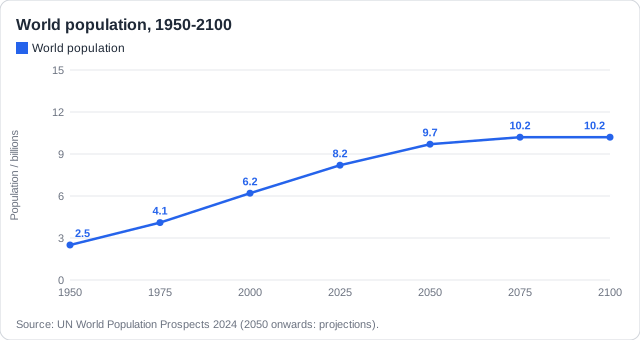
Sustainable, but enough?: Many traditional and alternative food systems are low-input and gentle on the land. The test the guide sets: could they also produce enough food for a world of about 8.2 billion people, heading for about 9.7 billion by 2050?
The points to remember
- Low-productivity systems give less food per hectare, but use few bought inputs.
- Subsistence farming feeds the farmer's family; it has little commercial value (little is sold).
- Some people claim these systems could solve the world's unsustainable food production.
- Any claim must be checked against demand: a growing, mostly urban population.
- About 645 million people still faced hunger in 2025.
Remember it as: Gentle on the land, but enough on the plate?
Never wonder what to study next
Get a personalized daily plan based on your exam date, progress, and weak areas. We'll tell you exactly what to review each day.
The case for: some traditional systems are far more productive and resilient than people expect, and small farms already grow much of the world's food.
The points to remember
- Smallholders (farms under 2 ha) grow about a third of the world's food on about a quarter of its farmland.
- Polycultures grow several crops and animals together: more total food, less risk.
- Low inputs: little fertilizer, pesticide or fossil fuel, so less pollution.
- They keep soils, biodiversity and local crop varieties alive.
- They are resilient: if one crop fails, others survive.
Example: the chinampas of Mexico City: The Aztecs built chinampas in the lake of Xochimilco. Mud from the canals kept them fertile, giving several harvests a year. They fed a great city, and a small area is still farmed today.
The case against: on average, low-input systems produce less food per hectare, and the world's cities need farms that produce a surplus to sell.
The points to remember
- Organic yields average about 19-25% lower than conventional yields.
- Lower yields mean more land for the same food, so more forest may be cleared.
- Subsistence farms produce little surplus: cities of millions cannot be fed from them.
- They need much labour, and young people are leaving for city jobs.
- Without irrigation or reserves, they are vulnerable to drought and pests: hunger can follow.
Remember it as: Lower yields need more land.
Land sharing
- Farm gently everywhere: wildlife lives in the farmland.
- Example: rice-fish paddies, chinampas, agroforestry.
- Needs more land in total.
Land sparing
- Farm intensively on less land, and protect the rest as nature.
- Example: high-yield farms beside protected forest.
- Risks pollution where farming is intensive.
Stop wasting time on topics you know
Our AI identifies your weak areas and focuses your study time where it matters. No more overstudying easy topics.
So can low-productivity systems resolve the unsustainability of food production? Most evidence says: not on their own, but they can be part of the answer.
The points to remember
- The world already grows enough calories for everyone: much is wasted or fed to animals.
- Hunger is often about access and distribution, not only about production.
- Less meat and less waste would make lower-yield systems far more able to feed the world.
- Mixing systems: traditional methods where they work, efficient farms where food is short.
- Values differ: an ecocentric view backs traditional systems; a technocentric view backs high yields.
Claim
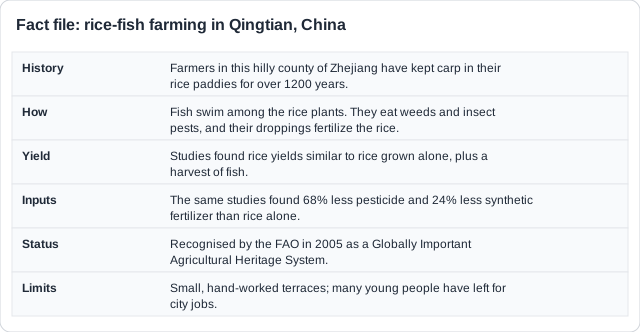
Rice-fish farming in Qingtian uses 68% less pesticide and gives as much rice: it is sustainable.
Test
It works on small, hand-worked terraces; scaling it to feed whole cities would need far more labour, and young people are leaving.
Fix
Spread the method where it fits (many Asian rice areas), and cut waste and meat elsewhere.
Verdict
Part of a sustainable food system, not the whole of it.
How this comes up: This is an evaluation statement: expect a Paper 1 final question [6] ('to what extent', with a resource booklet), or a Paper 2 Section B (b) [7] or (c) [9]. Give both sides, real systems and a judgement.
The fact file describes rice-fish farming in Qingtian, China. World population is projected to rise from 8.2 billion in 2025 to 9.7 billion in 2050.
To what extent could traditional, low-productivity food systems such as rice-fish farming feed the world's population sustainably?
Model answer plan
See the mark-by-mark plan — for / against / judgement, with marking guidance — in study mode.