What soil is made of at Higher Level: The same four parts as SL, with different real cases: cress grown in Moon dust, the chalk downs of England, a giant fungus in Oregon, the flooded Somerset Levels and the new soils of Glacier Bay, Alaska. Soil-forming factors such as climate and parent rock have their own HL page.
Practise this as you read
- Trace each part of a soil back to where it came from.
- Order the processes that turn bare rock into fertile soil.
Free preview
This is the free notes preview
You're reading the free notes. Aimnova Pro unlocks the full study experience — and you can try it with your first topic free to keep:
- FlashcardsLock in vocabulary and key terms with spaced repetition.
- Practice questionsAnswer exam-style questions and get instant AI marking.
- Mock exams & past-paper vaultSit full mocks and see exactly how examiners award marks.
- Personalised study planA daily plan built around your exam date and weak areas.
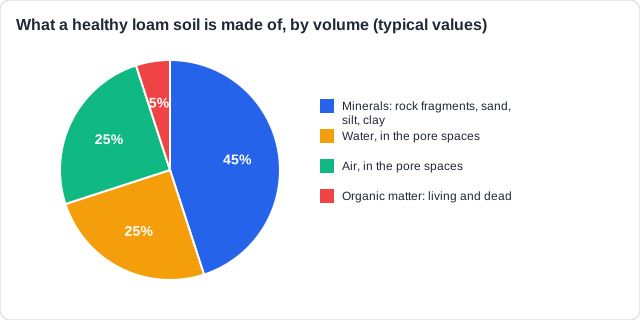
Four parts, mixed together: Soil is not just dirt. It is a mixture of four parts: inorganic (mineral) matter, organic matter, water and air. Living things make it an ecosystem of its own.
The points to remember
- Inorganic (mineral) matter: rock fragments, sand, silt and clay, about 45% of the volume.
- Organic matter: living things and dead, decaying matter (humus), about 5%.
- Water, about 25%, and air, about 25%, fill the pore spaces.
- The parts interact: a soil is a mixture with its own ecosystem and its own soil organisms.
- Soils are named and sorted with keys, many published online.
Remember it as: Rock, rot, rain and air.
Real example: in 2022, scientists at the University of Florida grew a small cress plant in lunar soil brought back by the Apollo astronauts. The plants grew, but slowly and stressed: the dust has minerals but no humus, water or soil life.
Never wonder what to study next
Get a personalized daily plan based on your exam date, progress, and weak areas. We'll tell you exactly what to review each day.
The inorganic part of soil comes from the rock beneath it, the parent rock. Weathering breaks it into ever smaller pieces.
Where the inorganic part comes from
- The inorganic part comes from weathering of the parent rock below or nearby.
- Physical weathering: ice in cracks (freeze-thaw), heating and cooling, roots wedging rock apart.
- Chemical weathering: rainwater, weakly acid, dissolves or changes minerals; iron rusts.
- Biological weathering: lichens, roots and burrowing animals break rock up.
- From biggest to smallest: rock fragments, sand, silt, clay.
- The parent rock decides which minerals the soil holds.
| Weathering | What does it | Example |
|---|---|---|
| Physical | Ice, heat and cold, roots | Water freezes in a crack, expands and splits the rock |
| Chemical | Rainwater, weak acids, oxygen | Rain slowly dissolves limestone; iron in rock rusts |
| Biological | Lichens, roots, animals | Lichens release acids that eat into rock |
Real example: on the chalk downs of southern England, the soil is thin and pale and full of white chalk lumps: it can only hold the minerals its parent rock gives.
Living and dead: The organic part of soil is the living organisms in it and the dead material they break down. Decay turns dead leaves into humus.
The organic part
- Living organisms: bacteria, fungi, earthworms, insects, mites and plant roots.
- Dead material: fallen leaves, dead roots and animals, dung.
- Decomposers break the dead material into dark, crumbly humus.
- Only about 5% of the volume, but vital: humus holds nutrients and water and feeds soil life.
- Without organic matter there is only broken rock, not a fertile soil.
Small but vital: Organic matter is only about 5% of the volume, yet it is critical for fertility: humus holds nutrients and water, and it feeds the soil organisms.
Real example: in Oregon's Malheur National Forest, one honey fungus (Armillaria) spreads through the soil over about 9 km². It is one of the largest living things on Earth.
Stop wasting time on topics you know
Our AI identifies your weak areas and focuses your study time where it matters. No more overstudying easy topics.
About half the volume of a good soil is not solid at all: it is pore space. Water and air share those gaps, and both are needed for life in the soil.
Water and air
- Water fills some pore spaces and carries dissolved nutrients to roots.
- Air fills the rest and gives oxygen to roots and soil organisms for respiration.
- Water and air share the same spaces: more of one means less of the other.
- A waterlogged soil has almost no air, so roots and many organisms cannot respire.
- A very dry soil has plenty of air but too little water for plants.
Remember it as: Water feeds the roots; air lets them breathe.
Well-drained soil
- Water and air both in the pores
- Roots get water, nutrients and oxygen
- Earthworms and bacteria thrive
Waterlogged soil
- Water fills almost every pore
- Little oxygen: roots struggle to respire
- Dead matter decays very slowly
Real example: in the winter of 2013-14, the Somerset Levels in England were flooded for weeks. The fields became waterlogged, the soil lost its air, and much of the grass died and had to be resown.
How fertile soil forms from bare rock: Bare rock becomes fertile soil when weathering supplies the mineral part and living things add the organic part, over hundreds of years.
The processes, in order
- Weathering breaks the parent rock into small particles.
- Wind and water deposit more sediment, making the soil deeper.
- Particles dissolve, releasing soluble minerals; rain adds water.
- Pioneer species colonise: lichens and mosses; moss mats hold the soil in place.
- Nitrogen fixation by bacteria adds nitrates the plants can use.
- Decomposition of dead organisms and leaf litter adds minerals and humus.
- Earthworms and burrowing insects mix the soil and open up pores.
Ice melts
- Since the late 1700s the ice in Glacier Bay, Alaska, has melted back more than 100 km, leaving bare, crushed rock.
Pioneers
- Lichens and mosses grow first; moss mats hold the loose rock and dust in place.
Nitrogen
- Mountain avens and then alder shrubs arrive; bacteria in their roots fix nitrogen into the soil.
Humus
- Their dead leaves decompose into humus, and the soil grows deeper and darker.
Forest
- After about a century, spruce forest grows on a fertile soil where there was only rock.
Processes, not a list of things: 'Lichens, mosses, worms' scores little. Say what each one does: 'lichens release acids that weather the rock', 'earthworms mix the humus into the mineral particles'.
See how examiners mark answers
Answer exam-style questions with model answers. Learn exactly what earns marks and what doesn't.
How this comes up: Paper 2, Section B (a): the processes that turn bare rock into fertile soil, one per point.
In 1883 an eruption of Krakatau, in Indonesia, buried the remaining islands under hot ash and killed every living thing on them.
Outline the processes involved in the formation of fertile soil on these islands after the eruption.
Model answer plan
See the mark-by-mark plan — for / against / judgement, with marking guidance — in study mode.