Harvesting wild species at Higher Level: This statement is Higher Level only. It weighs the claim that harvesting wild species by traditional methods may be more sustainable than clearing land to farm, with Brazil nuts, truffles, honey and insects, and the controversial harvest of pangolins, bears and bushmeat. Link it to environmental ethics (HL.c).
Practise this as you read
- Explain why a wild harvest can be more sustainable than land conversion.
- Evaluate the claim, including when wild harvesting fails.
Free preview
This is the free notes preview
You're reading the free notes. Aimnova Pro unlocks the full study experience — and you can try it with your first topic free to keep:
- FlashcardsLock in vocabulary and key terms with spaced repetition.
- Practice questionsAnswer exam-style questions and get instant AI marking.
- Mock exams & past-paper vaultSit full mocks and see exactly how examiners award marks.
- Personalised study planA daily plan built around your exam date and weak areas.
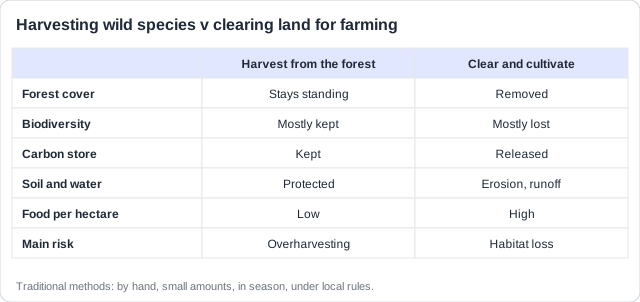
Take from the forest, or replace it?: Food can come from a field that replaced a forest, or from the forest itself. Gathering wild food by traditional methods can be more sustainable, because the ecosystem stays standing.
The points to remember
- Land conversion (clearing forest for crops or cattle) destroys habitat, releases carbon and exposes soil.
- Harvesting keeps the ecosystem and its services: carbon storage, water, soil, biodiversity.
- It gives local people income from a standing forest, so they have a reason to protect it.
- Traditional methods take small amounts, by hand, in season, and leave enough to regrow.
- But it gives less food per hectare, and overharvesting can empty a forest of a species.
Remember it as: Keep the forest standing and take only what regrows.
Practice with exam-style questions
Answer exam-style questions and get AI feedback that shows you exactly what examiners want to see in a full-marks response.
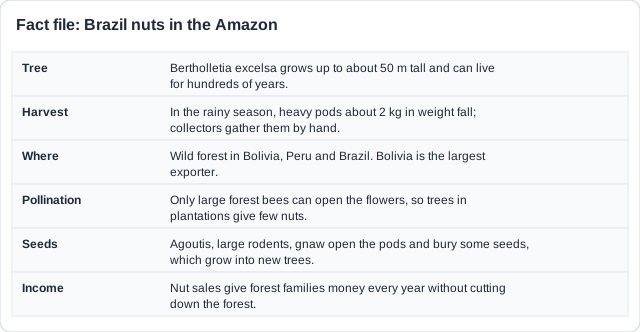
Brazil nuts come from one of the tallest trees of the Amazon, Bertholletia excelsa. Almost all of them are gathered in wild forest, not grown on farms.
The points to remember
- Collectors gather the fallen pods by hand in the rainy season: no trees are cut.
- The trees need large forest bees to pollinate them, so plantations give few nuts: the forest must stay.
- Agoutis bury seeds, which grow into new trees.
- Nut income every year gives families and companies a reason to protect the forest.
- Risk: in heavily harvested areas so many nuts are taken that few young trees grow.
Example: Madre de Dios, Peru: In this Amazon region, families hold long-term Brazil nut concessions. Concession forests stay largely intact, while forest nearby is cleared for gold mining, farming and roads.
Many other wild foods are harvested in traditional ways. The guide calls them secondary forest products.
Truffles
White truffles are fungi on the roots of oak and poplar in Piedmont, Italy. Hunters find them with trained dogs and dig each one out, so the woods must be kept.
Honey
The Hadza of Tanzania follow a bird, the honeyguide, to wild bee nests. They take the honey; the bird eats the wax.
Insects
In southern Africa, mopane worms (big caterpillars) are picked by hand from mopane trees and dried: a protein-rich food and an income.
Bamboo shoots
In China and Southeast Asia, young shoots are cut in spring. Bamboo grows fast from its roots, so the grove keeps producing.
The points to remember
- These products need the ecosystem intact: host trees, pollinators, wild bees.
- Harvests are seasonal and by hand, so pressure on the species is limited.
- Insects turn leaves into protein very efficiently: a sustainable food source.
- When demand rises, outsiders may strip whole areas and take young before they breed.
Feeling unprepared for exams?
Get a clear study plan, practice with real questions, and know exactly where you stand before exam day. No more guessing.
Some wild harvests are controversial because the species are endangered or the trade is huge. Bushmeat is a traditional food in Central Africa, but guns, roads and city demand have changed it.
The points to remember
- Pangolins are hunted for meat and for scales used in traditional medicine.
- All eight pangolin species have been under a CITES Appendix I ban on commercial trade since 2017.
- Bears are killed or farmed for their bile, used in traditional medicine.
- Logging roads open forests to hunters, and city demand turns hunting into trade: forests empty.
- Handling bushmeat can spread diseases from animals to people, such as Ebola.
Can be sustainable
- Common, fast-breeding animals, taken in small numbers for local food.
- Hunting rules, seasons and village control.
Not sustainable
- Rare, slow-breeding species such as pangolins and bears.
- Commercial trade to cities and abroad, with guns and roads.
'Traditional' does not always mean sustainable: What matters is how much is taken compared with how fast the species breeds. In 2020 China removed pangolin scales from its official list of traditional medicine ingredients and gave pangolins its highest legal protection. Ethics matter too: is it right to kill an endangered animal for medicine?
How this comes up: A Paper 1 case study can give a fact file on a wild harvest and ask whether it is sustainable [2-4]. A Paper 2 essay can ask how far traditional harvesting is more sustainable than clearing land [9].
In Bolivia, Peru and Brazil, Brazil nuts are gathered from wild trees in the Amazon rainforest.
Explain why harvesting Brazil nuts by traditional methods may be more sustainable than clearing the forest for farming.
Model answer plan
See the mark-by-mark plan — for / against / judgement, with marking guidance — in study mode.