The global food system at Higher Level: This statement is Higher Level only. It shows how the global food industry decides who gets food and what kind, leading to both hunger and obesity, and why famines come as much from distribution as from crop failure. Link it to economics (HL.b) and ethics (HL.c).
Practise this as you read
- Explain undernourishment and overnourishment with real figures.
- Evaluate crop failure and distribution as causes of famine.
Free preview
This is the free notes preview
You're reading the free notes. Aimnova Pro unlocks the full study experience — and you can try it with your first topic free to keep:
- FlashcardsLock in vocabulary and key terms with spaced repetition.
- Practice questionsAnswer exam-style questions and get instant AI marking.
- Mock exams & past-paper vaultSit full mocks and see exactly how examiners award marks.
- Personalised study planA daily plan built around your exam date and weak areas.
Too little and too much, at the same time: The world grows enough food for everyone, but the global food supply industry sends it where people can pay. The result is malnutrition of both kinds.
The points to remember
- Undernourishment: too little energy or nutrients: hunger, stunted growth, weak immunity.
- Overnourishment: too much energy, fat or sugar: obesity, heart disease, type 2 diabetes.
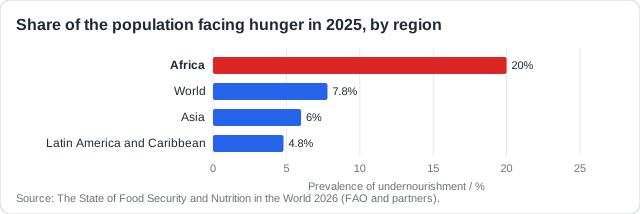
- About 645 million people faced hunger in 2025; over 1 billion lived with obesity in 2022.
- 2.69 billion people could not afford a healthy diet in 2025.
- Food goes to those who can pay, not to those who need it most.
Remember it as: Food follows money, not need.
Memorize terms 3x faster
Smart flashcards show you cards right before you forget them. Perfect for definitions and key concepts.
Having enough food is not the same as eating well. A large mass of food, its biomass, says nothing about its vitamins, minerals or protein.
The points to remember
- Do not assume that more biomass means more nutrition.
- Staples like white rice or cassava give energy but little protein, iron or vitamins.
- Hidden hunger: enough calories, but too few micronutrients (iron, vitamin A, iodine).
- Highly processed food is cheap and filling but full of sugar, fat and salt.
- Double burden: hunger and obesity in the same country, even the same family.
Cassava
- Huge harvests of starchy roots.
- Lots of energy, very little protein.
- A diet of mostly cassava can leave children stunted.
Lentils
- Smaller harvests.
- Rich in protein, iron and fibre.
- Much more nutrition per kilogram.
Example: Mexico's tax on sugary drinks: Mexico has some of the highest rates of obesity and diabetes in the world, alongside rural hunger. In 2014 it taxed sugary drinks by 1 peso per litre. In the first year, purchases of taxed drinks fell by about 6%.
A famine often starts with a crop failure, but people die when they cannot get the food that exists. Ireland in 1845-1849 is the classic case.
The points to remember
- Potato blight, a fungus-like disease, rotted the potato crop year after year.
- Poor families grew one variety (the Lumper) and depended on it: a monoculture.
- Grain and cattle were still exported to Britain while people starved.
- Poor tenants had no money to buy other food, and help came late and was too small.
- About 1 million died and about 1 million emigrated: the population fell by a fifth.
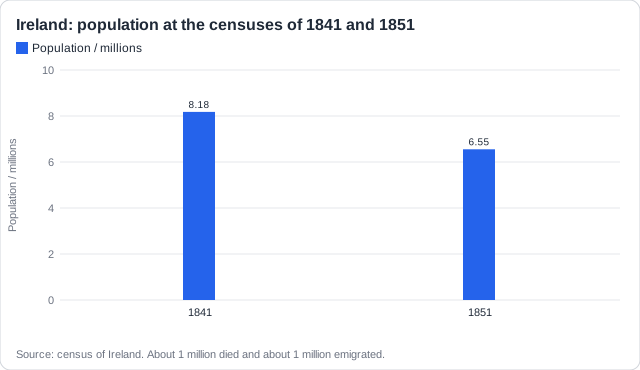
Crop failure or distribution?: Blight caused the crop failure. Distribution turned it into a famine: food left the country, and the poor could not pay for what remained. Say both in the exam.
Know your predicted grade
Take timed mock exams and get detailed feedback on every answer. See exactly where you're losing marks.
In East Africa, famines come when drought meets conflict. Somalia in 2011 shows how the two together stop food reaching people.
Drought
The rains failed in late 2010 and early 2011. Crops failed and many cattle, goats and camels died.
Prices
Local food prices rose sharply, so families who had lost their harvest or herd could not buy food.
Conflict
An armed group controlled much of the south and blocked many aid agencies, so food aid could not get in.
Famine
The UN declared famine in July 2011. About 258 000 people died, half of them children under five.
The points to remember
- Drought is the trigger; conflict and poverty turn it into famine.
- Conflict blocks aid, destroys markets and forces people from their land.
- High prices mean people cannot buy food even where it is on sale.
- Early warning systems and fast aid can prevent famine deaths.
How this comes up: Data questions give hunger or obesity figures by region and ask you to describe or explain them [1-4]. Paper 2 essays ask how far famine is caused by distribution rather than crop failure [9].
During the Irish potato famine of 1845-1849, about 1 million people died, yet grain and cattle were still being exported from Ireland.
Explain why famine is caused as much by distribution problems as by crop failure.
Model answer plan
See the mark-by-mark plan — for / against / judgement, with marking guidance — in study mode.