Inputs to soil at Higher Level: The same inputs as SL, with different real cases: Amazon leaf litter, ammonia from Dutch livestock farms, Saharan dust feeding the Amazon and the Amazon's man-made dark earths. At HL, weigh natural against human inputs and track where each one comes from.
Practise this as you read
- Sort each input: dead organic matter or inorganic, natural or added by people.
- Trace inputs from other ecosystems back to their source.
Free preview
This is the free notes preview
You're reading the free notes. Aimnova Pro unlocks the full study experience — and you can try it with your first topic free to keep:
- FlashcardsLock in vocabulary and key terms with spaced repetition.
- Practice questionsAnswer exam-style questions and get instant AI marking.
- Mock exams & past-paper vaultSit full mocks and see exactly how examiners award marks.
- Personalised study planA daily plan built around your exam date and weak areas.
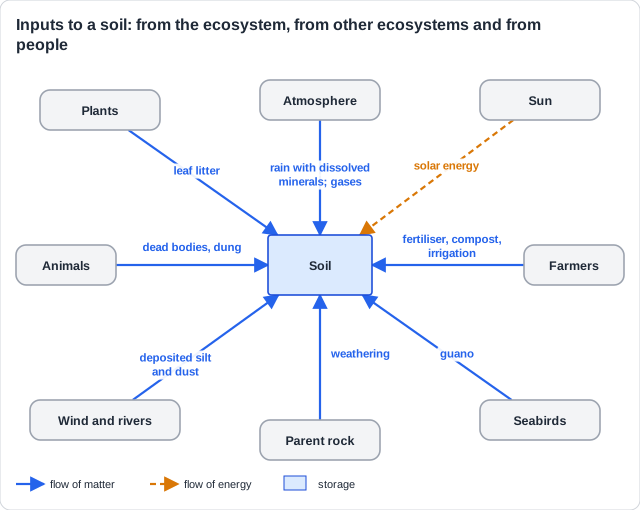
Two kinds of input: Matter enters a soil as dead organic matter (from living things) and as inorganic minerals (from rock, water and air). This page starts with the dead organic matter.
Dead organic matter in
- Plant litter: fallen leaves, twigs, fruit, dead roots.
- Dead animals: bodies and body parts, from earthworms to deer.
- Manure: animal dung and urine (excretion).
- Decomposers turn this dead matter into humus and release minerals such as nitrates.
- Most of it comes from within the ecosystem: the plants and animals living on the soil.
Remember it as: Leaves, bodies, dung: the dead feed the soil.
Real example: in the Amazon rainforest, leaves fall all year. In the heat and damp, decomposers break most of them down within a year, so the nutrients they hold return to the soil quickly and are taken up again by the trees.
Get feedback like a real examiner
Submit your answers and get instant feedback — what you did well, what's missing, and exactly what to write to score full marks.
The inorganic inputs come from the rock below, from the air and from the water falling on the soil. Energy comes in as sunlight.
Inorganic inputs
- Weathering of the parent rock releases minerals (from within the ecosystem).
- Precipitation: rain carries dissolved minerals and adds water.
- Deposition: dust, ash, silt and mud laid down by wind or water.
- Gases and air: oxygen, carbon dioxide and nitrogen; bacteria fix nitrogen into nitrates.
- Humidity: water vapour from the air.
- Solar energy: sunlight warms the soil; this is an input of energy, not matter.
Real example: in the Netherlands, ammonia from livestock farms drifts onto nearby heaths and settles on the soil. The extra nitrogen lets grasses crowd out the heather: a gas input from the air, made by people.
Inputs from far away: Most inputs come from within the ecosystem: its plants, its animals, the rock under it. Some are carried in from other ecosystems by wind, water or animals.
From other ecosystems
- Some inputs come from other ecosystems, carried in by wind, water or animals.
- Wind-blown deposition: dust from deserts, ash from volcanoes.
- Waterborne deposition: silt and mud left by floods and rivers.
- Guano: seabird and bat droppings, rich in nitrogen and phosphorus, brought from the sea.
From within the ecosystem
- Weathering of the parent rock
- Leaf litter from the plants above
- Decomposition of dead matter
From other ecosystems
- Dust blown from deserts
- Silt left by river floods
- Guano from seabirds that feed at sea
Real example: NASA satellite data (2015) showed that wind carries about 28 million tonnes of dust a year from the Sahara across the Atlantic to the Amazon. It brings about 22,000 tonnes of phosphorus, close to what the rainforest soil loses each year.
Learn what examiners really want
See exactly what to write to score full marks. Our AI shows you model answers and the key phrases examiners look for.
In a managed soil, many inputs are added by people. They are called anthropogenic inputs.
Inputs people add
- Compost, manure and other organic matter dug in.
- Fertiliser: inorganic nitrates, phosphates and potassium.
- Other agrochemicals: pesticides, and lime to make soil less acid.
- Irrigation water, pumped from rivers and wells.
- Salt: irrigation water leaves salt behind as it evaporates (salinization).
- Biochar: charcoal mixed into soil to hold nutrients and carbon.
Remember it as: Feed it, spray it, water it, salt it.
Real example: in the Amazon, people centuries ago mixed charcoal, bones, pottery and food waste into the soil. These terra preta soils are still dark and fertile today, while the soils around them are poor: an early form of biochar.
Two traps: Pesticides are an input, but they add no nutrients: do not give them as an input to a nutrient store. And 'fertiliser' alone is vague: say 'inorganic fertiliser such as nitrates' or 'compost'.
Some questions ask about the inputs to one store, such as the minerals in the A horizon. Then an input is anything that adds to that store, even from another horizon of the same soil.
Inputs to one store
- First ask: which store is the question about? An input must cross into that store.
- Into the mineral store of the A horizon: decomposition of litter, leaching down from the O horizon.
- ... nitrogen fixation, inorganic fertiliser, capillary rise of water with minerals from the B horizon.
- Changes inside one store are not inputs to it: nitrification turns one nutrient into another.
- Pesticides add no nutrients; plain 'water' is not a mineral input.
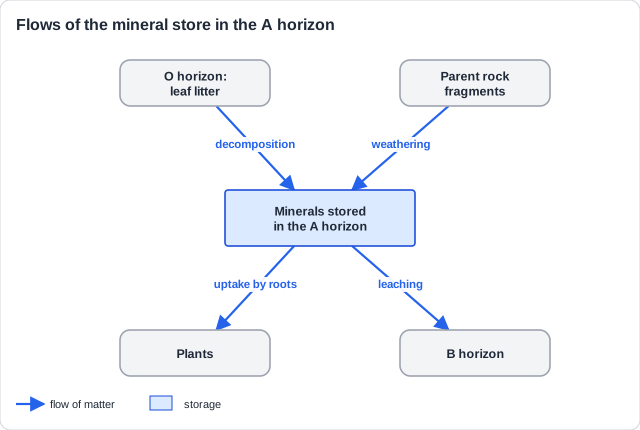
Worked example: A beech wood's A horizon: decomposition of the litter adds minerals. Other inputs: minerals leached down from the O horizon, and water rising from the B horizon by capillary action, carrying minerals.
For the whole soil, movement between horizons is a flow inside the system, not an input: always check which boundary the matter crosses.
Never wonder what to study next
Get a personalized daily plan based on your exam date, progress, and weak areas. We'll tell you exactly what to review each day.
Inputs and outputs together: Some questions ask for two inputs AND two outputs. Outputs have their own page; here are the ones to know for these questions.
Outputs from a soil
- Nutrients and water taken up by plant roots.
- Soluble nutrients leached down to the groundwater.
- Soil and nutrients carried off by erosion in wind or water.
- Water lost by evaporation and run-off; nitrogen gas by denitrification.
- Carbon dioxide from the respiration of soil organisms; methane where there is no air.
Just naming
- 'Water'
- 'Nutrients'
- 'Organic matter'
Outlining
- Water is added by rain soaking in
- Nitrates are lost by leaching to groundwater
- Dead leaves fall and add organic matter
Real example: in an Amazon terra preta garden, inputs are leaf litter and charcoal mixed in by people; outputs are nutrients taken up by the crops and carbon dioxide from the soil's decomposers.
How this comes up: Paper 2, Section B (a): two inputs and two outputs of matter, each outlined, not just named.
In the hills of Rwanda, small farms grow bananas and beans on steep slopes. Heavy rain falls twice a year, and farmers spread manure from their cows.
Outline two inputs and two outputs of matter in this soil system.
Model answer plan
See the mark-by-mark plan — for / against / judgement, with marking guidance — in study mode.