How sustainable is a diet? At Higher Level: This statement is Higher Level only. It compares the footprints of diets: what is eaten, how it is farmed, how far it travels, and how diets are changing, including veganism and the planetary health diet. It builds on trophic levels and diets (5.2.10) and footprints (1.3).
Practise this as you read
- Discuss whether a plant-based diet has a smaller footprint, with both sides.
- Design a survey of food preferences and worldviews.
Free preview
This is the free notes preview
You're reading the free notes. Aimnova Pro unlocks the full study experience — and you can try it with your first topic free to keep:
- FlashcardsLock in vocabulary and key terms with spaced repetition.
- Practice questionsAnswer exam-style questions and get instant AI marking.
- Mock exams & past-paper vaultSit full mocks and see exactly how examiners award marks.
- Personalised study planA daily plan built around your exam date and weak areas.
What you eat matters most: A diet's ecological footprint depends on what is eaten, how it is farmed, and how it reaches the plate. The biggest single factor is how much meat, especially beef, is in it.
The points to remember
- Food from lower trophic levels (plants) wastes less energy, so it needs less land and water.
- Cattle and sheep give off methane and need land for pasture and feed, often from deforestation.
- Farming type matters: intensive monoculture can use much fertilizer, water and pesticide.
- Supply chain and food miles add emissions, but usually far less than the farm stage.
- Diet changes in society (more or less meat, veganism) shift the footprint of whole countries.
Remember it as: What, how, and how far: in that order.
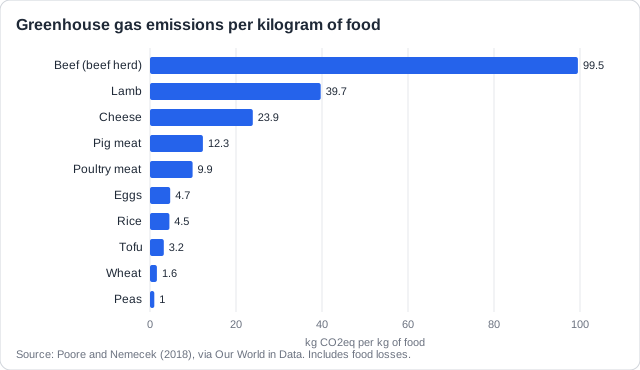
But not always: A plant food can have a big footprint too: rice paddies give off methane, and soya grown on cleared rainforest carries the land-use change with it. Beef from well-managed grass on land that cannot grow crops does better than beef from a feedlot.
Real systems to quote. Lower footprints: lentils and peas on the Canadian prairies, which fix their own nitrogen; vegetables in Dutch greenhouses; free-range poultry; rotational grazing in Australia. Higher footprints: beef ranching on cleared land in Brazil; cattle feedlots in the USA; soya and rice monocultures.
See how examiners mark answers
Answer exam-style questions with model answers. Learn exactly what earns marks and what doesn't.
A supply chain can be short, like a farmers' market, or long, like prawns farmed in Thailand and sold in a European supermarket. Its length has three parts.
The points to remember
- Physical distance: the kilometres food travels, its food miles.
- Economic distance: how many businesses (traders, processors, shops) stand between farmer and eater.
- Social distance: how little the eater knows about who grew the food, and how.
- Year-round supply of seasonal food means more imports, heated greenhouses or air freight.
- Transport is usually a small share of a food's emissions; air freight is the big exception.
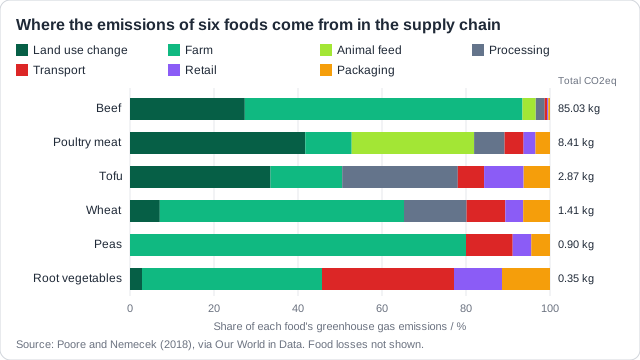
Example: is local always better?: A study for the UK government in 2005 found that tomatoes grown in heated British greenhouses in winter could cause more emissions than tomatoes grown in the Spanish sun and trucked to Britain. Fresh green beans flown from Kenya, though, have a large footprint because of the flight.
Diets change as societies change. When people get richer and move to cities, they usually eat more meat, dairy and processed food. In some rich countries a counter-trend has begun.
The points to remember
- Rising incomes usually mean more meat: more land, water and greenhouse gases.
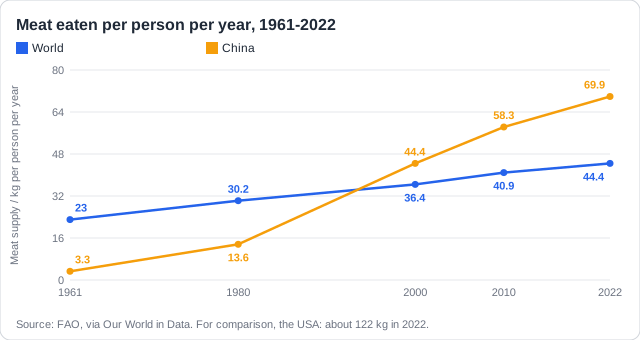
- China's meat supply per person rose about five times, from 13.6 kg (1980) to 69.9 kg (2022).
- The world average rose from 23 kg (1961) to 44 kg (2022) per person a year.
- Veganism (no animal foods) and vegetarian or flexitarian diets are growing in some countries.
- Plant-based milks and meat alternatives make cutting meat easier, but some are highly processed.
Example: Veganuary. Started in the UK in 2014, this campaign asks people to try a vegan diet for January. Hundreds of thousands sign up each year, and supermarkets have added vegan ranges. One month is a small change, but it shows how a cultural shift can spread.
Study smarter, not longer
Most students waste 40% of study time on topics they already know. Our AI tracks your progress and optimizes every minute.
In 2019 the EAT-Lancet Commission designed the planetary health diet: healthy for people, and possible for about 10 billion people by 2050 within Earth's limits.
The points to remember
- About half the plate is vegetables and fruit.
- The rest is mostly whole grains, plant proteins (beans, lentils, nuts) and plant oils.
- Red meat only about 14 g a day: roughly one small burger a week.
- Worldwide, fruit, vegetables, nuts and legumes would double; red meat and sugar would fall by over half.
- It is flexible: it fits many food cultures, and vegans and meat-eaters alike.
Remember it as: Half a plate of plants, a burger a week.
For the diet
- Less land, water and greenhouse gas than typical rich-country diets.
- Healthier: fewer deaths from diet-related diseases.
Against, or hard to do
- Costs more than many poor families can pay.
- Clashes with food cultures and the livelihoods of livestock farmers.
The guide asks you to create a survey on food preferences and worldviews. Here is one designed step by step: it compares students at a school in Lyon, France, with their grandparents.
Aim
Do students and their grandparents in Lyon differ in how much meat they eat, and in their environmental worldview?
Sample
At least 30 people in each group, chosen at random from class lists and families, so both groups are fairly represented.
Food questions
Closed questions: 'How many days a week do you eat meat? 0, 1-2, 3-4, 5-7.' Easy to count and compare.
Worldview
Agree or disagree, on a 5-point scale: 'Technology will solve our food problems' (technocentric); 'Animals have a right to life' (ecocentric).
Fair and safe
Neutral wording, a pilot with five people first, consent, and no names on the forms.
Results
Bar charts of meat days and of worldview scores for each group, then compare the two.
The points to remember
- Clear aim and two or more groups to compare (age, culture, town and country).
- A large, random or stratified sample, so results represent each group.
- Closed questions and a Likert scale (strongly agree to strongly disagree) are easy to analyse.
- Link statements to worldviews: technocentric, ecocentric, anthropocentric.
- Ethics: consent, anonymity, neutral wording; a pilot survey first.
Practice with exam-style questions
Answer exam-style questions and get AI feedback that shows you exactly what examiners want to see in a full-marks response.
How this comes up: Paper 2 (May 2026, HL) set a Section B (c) [9]: discuss whether a plant-based society has a smaller ecological footprint than a meat-eating one. Data questions give a supply-chain chart and ask why a food has a large share of its emissions from transport [1].
Supermarkets in northern Europe sell strawberries, tomatoes and green beans all year round, much of it imported.
'A diet of seasonal, locally grown food is always more sustainable than a diet that includes imported food.' Discuss this statement.
Model answer plan
See the mark-by-mark plan — for / against / judgement, with marking guidance — in study mode.