High-tech farming at Higher Level: This statement is Higher Level only. It shows how high-tech greenhouses, vertical farms and precision agriculture reach very high yields and supply cities, and why they are not always sustainable when they depend on fossil fuels. Link it to environmental economics (HL.b).
Practise this as you read
- Explain why yields are so high, using real data.
- Evaluate their sustainability: energy, costs and benefits.
Free preview
This is the free notes preview
You're reading the free notes. Aimnova Pro unlocks the full study experience — and you can try it with your first topic free to keep:
- FlashcardsLock in vocabulary and key terms with spaced repetition.
- Practice questionsAnswer exam-style questions and get instant AI marking.
- Mock exams & past-paper vaultSit full mocks and see exactly how examiners award marks.
- Personalised study planA daily plan built around your exam date and weak areas.
Farming with technology instead of land: In controlled-environment agriculture, the farmer removes almost every limiting factor. Yields can be many times higher than in a field, close to the cities that eat the food.
The points to remember
- High-tech greenhouses: glasshouses with heating, extra CO2, lamps and hydroponics.
- Vertical farms: crops in stacked trays inside buildings, lit only by LED lamps.
- Hydroponics: roots grow in water with dissolved nutrients, not in soil.
- Precision agriculture: GPS, sensors and drones give each part of a field just what it needs.
- They grow food near cities, on little land, all year round.
Remember it as: Control the light, heat, water and CO2: no limiting factor left.

Feeling unprepared for exams?
Get a clear study plan, practice with real questions, and know exactly where you stand before exam day. No more guessing.
The Netherlands is a small, crowded country, yet it is the world's second-largest exporter of farm products by value, after the USA. Much of that comes from about 10 000 hectares of glasshouses, many in the Westland.
The points to remember
- Heating and lamps give the right temperature and light all year.
- CO2 from the gas boilers is piped in: more photosynthesis, faster growth.
- Plants grow in rock wool slabs; unused water and nutrients are collected and reused.
- Predatory insects eat the pests and bumblebees pollinate, so few pesticides are used.
- Dutch tomato yields are about 500 tonnes per hectare, against a world average of about 36.
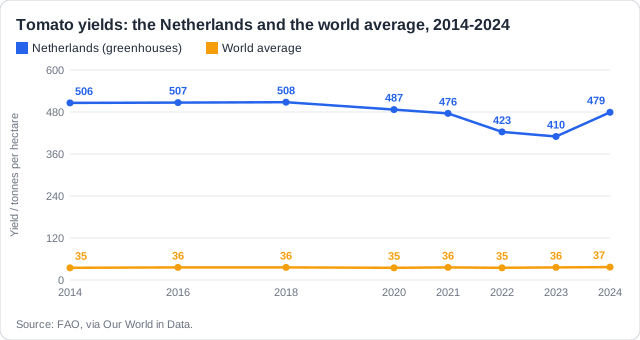
Reading the graph: Quote both lines with years and units: in 2018 Dutch yields were 508 t/ha, about 14 times the world average of 36 t/ha. Then describe the dip: down to 410 t/ha in 2023, before recovering to 479.
Vertical farms go further: no field at all. They are built in or next to cities, so salad can be picked in the morning and sold the same day.
The points to remember
- Many layers on one plot: far more food per square metre of land than a field.
- No soil, no weather: year-round harvests, no pesticides, little water (it is recycled).
- Grown where people live: few food miles and fresher food.
- Mostly leafy greens and herbs: staple crops like wheat or rice are far too cheap to grow this way.
- Precision agriculture brings the same idea to fields: fertilizer and water only where needed.
Problem
Singapore, a city of about 6 million people, farms only about 1% of its land and imports more than 90% of its food.
Sky Greens
Since 2012 it has grown leafy vegetables in rotating towers about 9 m tall, turned slowly by water power so every plant gets sunlight.
30 by 30
In 2019 Singapore set a goal to produce 30% of its nutritional needs locally by 2030, mostly with high-tech farms.
Reality
High energy, building and labour costs closed several farms, and local output stayed far below the goal.
Memorize terms 3x faster
Smart flashcards show you cards right before you forget them. Perfect for definitions and key concepts.
High productivity is not the same as sustainability. These farms swap land and weather for energy, and much of that energy still comes from fossil fuels.
The points to remember
- Greenhouses burn natural gas for heat and CO2; vertical farms use electricity for light all day.
- So they can have a high carbon footprint, unless the energy is renewable.
- They depend on energy prices: when gas prices soared in 2022, Dutch tomato output fell by about a fifth.
- They need costly buildings and technology, so the food is often expensive.
- Fixes: geothermal heat, heat pumps, solar and wind power, and LEDs that use less electricity.
Strengths
- Very high yields on little land: land spared for nature.
- Water and nutrients recycled; few pesticides.
- Fresh food close to cities, all year round.
Weaknesses
- Fossil-fuel dependent: gas and electricity.
- Vulnerable to energy prices: Dutch tomatoes fell from 910 000 t (2020) to 726 000 t (2023).
- Costly: the US vertical farm firm AeroFarms went bankrupt in 2023.
How this comes up: A data question gives a graph of yields or production and asks you to compare, describe a change, or suggest a reason [1-3]. A Paper 2 essay asks how far high-tech farming can feed cities sustainably [7-9].
The graph shows tomato yields in the Netherlands and the world average, 2014-2024.
Using the graph, explain why Dutch tomato yields are so much higher than the world average, and why they fell in 2022 and 2023.
Model answer plan
See the mark-by-mark plan — for / against / judgement, with marking guidance — in study mode.