Regenerative farming and permaculture at Higher Level: This statement is Higher Level only. It looks at mixed farms where pigs, chickens and grazing herds do farm work, the advantages and disadvantages of these techniques, and how plant-based diets fit into them. Link it to environmental ethics (HL.c).
Practise this as you read
- Outline how animals are used to clear, plough and fertilize.
- Evaluate the techniques: both sides, with real farms.
Free preview
This is the free notes preview
You're reading the free notes. Aimnova Pro unlocks the full study experience — and you can try it with your first topic free to keep:
- FlashcardsLock in vocabulary and key terms with spaced repetition.
- Practice questionsAnswer exam-style questions and get instant AI marking.
- Mock exams & past-paper vaultSit full mocks and see exactly how examiners award marks.
- Personalised study planA daily plan built around your exam date and weak areas.
Mixed farms that rebuild the soil: Regenerative farming and permaculture both use mixed farming: crops, animals and often trees on the same land, each one helping the others.
The points to remember
- Mixed farming: crops and livestock (and trees) are farmed together, not in separate monocultures.
- Animals do jobs that machines and chemicals do on other farms: clear, plough, fertilize.
- The aim is to improve productivity (healthier soil) and diversify it (many products).
- Many products spread the risk: if one fails or its price falls, the others still earn.
Remember it as: Let the animals do the work.
Compare a monoculture of maize, fed with bought fertilizer and sprayed against pests, with a regenerative farm that sells beef, eggs, chicken and pork from the same fields, and buys almost no fertilizer at all.
Memorize terms 3x faster
Smart flashcards show you cards right before you forget them. Perfect for definitions and key concepts.
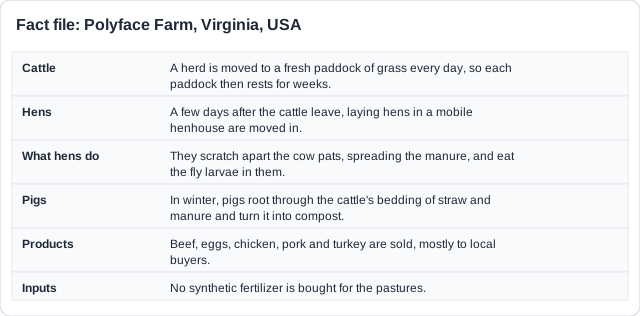
On Polyface Farm in Virginia, USA, each animal follows the next across the fields, and each one does a job.
The points to remember
- Pigs root up the ground with their snouts: they clear weeds and scrub and plough the soil.
- Chickens scratch and peck: they eat weeds, seeds and insect larvae, and spread manure.
- Their manure fertilizes the soil, so less or no synthetic fertilizer is needed.
- Animals are moved often, so no patch is overused and the land can recover.
- The farm sells several products from the same land: meat and eggs.
Animals can also do harm: Left too long in one place, pigs turn the ground to mud, damage roots and leave bare soil that erodes. Chickens kept on one spot strip it bare. The benefit comes from moving them.
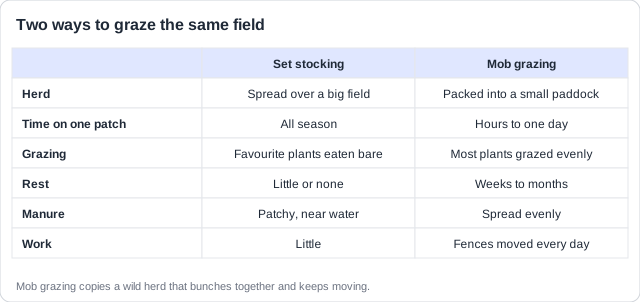
Mob grazing copies wild herds, such as bison or wildebeest, that bunch together against predators and keep moving.
The points to remember
- A dense herd grazes a small paddock for hours or a day, then moves to fresh grass.
- The paddock then rests for weeks or months, so plants regrow deeper roots.
- Trampled grass and evenly spread manure feed soil life and add organic matter.
- More organic matter means soil holds more water and stores more carbon.
- It takes work: fences and water troughs must be moved every day.
Example: Allan Savory in Zimbabwe: The Zimbabwean scientist Allan Savory promotes 'holistic planned grazing': herds kept bunched and moved on, to bring bare, eroding grassland back to life. Supporters show green land where it was bare. Many range scientists say careful studies find no clear advantage over other well-managed grazing. Use it as a claim to evaluate, not a proven fact.
Know your predicted grade
Take timed mock exams and get detailed feedback on every answer. See exactly where you're losing marks.
These systems are not automatically better. Weigh them up, and remember that animals are not essential: plant-based systems can also be regenerative.
Advantages
- Less synthetic fertilizer and herbicide: manure and animals do the work.
- More soil organic matter, water storage and carbon.
- Many products: a more stable income; often better animal welfare.
- More habitats and wildlife than a monoculture.
Disadvantages
- Lots of labour and skill: animals moved every day.
- Lower output per hectare of any one product; higher prices.
- Cattle still give off methane; meat needs much more land than plants.
- Overgrazing, mud and erosion if animals stay too long.
Plant-based options
- Plant-based regenerative farms build fertility with green manures (clover) and compost.
- A forest garden grows food in layers: nut and fruit trees, shrubs, perennial vegetables.
- Plant-based food feeds more people per hectare, because energy is lost at each trophic level.
- So a plant-based diet fits these systems: fewer animals, more land for food or nature.
Examples: Tolhurst Organic in Oxfordshire, England, grows vegetables with no animals or animal manure, using two-year clover leys and plant compost. At Dartington in Devon, a forest garden planted from 1994 grows fruit, nuts and leaves in layers, like a woodland.
How this comes up: Paper 2 essays: outline [4], evaluate [7] or discuss [9] regenerative techniques. A Paper 1 case study may give a fact file on a mixed farm and ask for advantages or disadvantages [2-4].
On Polyface Farm in Virginia, USA, laying hens follow the cattle across the pastures and pigs turn the winter bedding into compost.
Outline two advantages and two disadvantages of using animals such as pigs and chickens to do farm work.
Model answer plan
See the mark-by-mark plan — for / against / judgement, with marking guidance — in study mode.