Alternative farming approaches at Higher Level: This statement is Higher Level only. It covers farming approaches developed in response to the ecological crisis: zero tillage, soil regeneration, rewilding, permaculture and non-commercial cropping, and the issues each tackles. Link them to environmental economics (HL.b) and ethics (HL.c).
Practise this as you read
- Outline each approach with a real example.
- Evaluate what each does for soils, water, wildlife, food and local income.
Free preview
This is the free notes preview
You're reading the free notes. Aimnova Pro unlocks the full study experience — and you can try it with your first topic free to keep:
- FlashcardsLock in vocabulary and key terms with spaced repetition.
- Practice questionsAnswer exam-style questions and get instant AI marking.
- Mock exams & past-paper vaultSit full mocks and see exactly how examiners award marks.
- Personalised study planA daily plan built around your exam date and weak areas.
Farming differently because of the ecological crisis: Intensive farming feeds billions, but it erodes soils, pollutes water and destroys habitats. In response, farmers and scientists have developed alternative approaches that work with nature rather than against it.
The points to remember
- Zero tillage: sow seed straight into the soil, without ploughing.
- Soil regeneration: rebuild soil with cover crops, compost and less disturbance.
- Rewilding: let farmland return to nature, with free-roaming animals.
- Permaculture: design a farm like a natural ecosystem, with many plants and animals together.
- Non-commercial cropping: grow food to eat or share locally, not to sell on world markets.
Remember it as: Don't plough, rebuild, rewild, design, share.
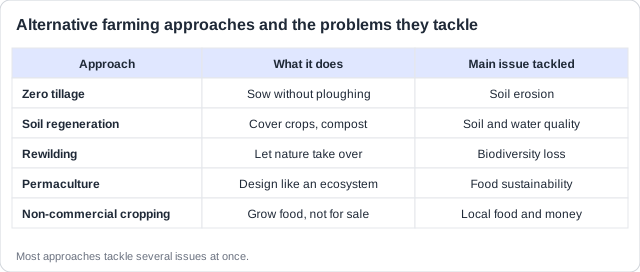
The guide links them to four issues: food sustainability (feeding people without using up natural capital), water quality, local economic stability (steady jobs and income in the area) and restoring and conserving soils.
See how examiners mark answers
Answer exam-style questions with model answers. Learn exactly what earns marks and what doesn't.
Ploughing turns the soil over. It buries weeds, but it leaves bare soil that wind and rain carry away, and it breaks up the soil's structure and its life.
The points to remember
- Zero tillage (no-till): a drill cuts a slot, drops the seed in and closes it; old crop remains stay on top.
- The cover of crop remains protects the soil from erosion and keeps in moisture.
- Less disturbance means more organic matter, more earthworms and fungi, and more carbon stored.
- Cover crops grown between main crops take up leftover nitrogen, so less washes into rivers.
- Drawbacks: weeds are often killed with herbicides, and yields can dip in the first years.
Remember it as: Keep the soil covered, keep it in place.
Argentina: zero tillage
- From the 1990s, farmers on the Pampas stopped ploughing.
- By the 2010s about nine-tenths of the grain area was sown without ploughing.
- Soil erosion fell and less fuel was used, but herbicide use rose.
Maryland: cover crops
- Nitrogen from fields fed algal blooms in Chesapeake Bay.
- The state pays farmers to sow winter rye on bare fields.
- Its roots take up leftover nitrogen: cleaner water, less erosion.
Rewilding goes further: it takes land out of farming altogether, or farms it very lightly.
The points to remember
- Large herbivores (cattle, pigs, ponies, deer) graze, browse and root like wild animals once did.
- A mosaic of scrub, grassland and woodland forms, with many niches: biodiversity rises.
- Soils recover without ploughing or chemicals, and store more carbon.
- Income can come from ecotourism and selling meat from the free-roaming animals.
- Critics say it takes land out of food production, so food must be grown elsewhere.
Example: the Knepp Estate, England: On heavy clay that lost money as an arable and dairy farm, the owners stopped farming intensively in 2001. Free-roaming animals now shape the land. In 2020 white storks raised chicks there, the first in Britain for over 600 years, and the estate now makes a profit, mainly from meat and nature tourism.
Study smarter, not longer
Most students waste 40% of study time on topics they already know. Our AI tracks your progress and optimizes every minute.
Permaculture was named in 1978 by Bill Mollison and David Holmgren in Tasmania, Australia.
The points to remember
- Permaculture grows many species together: trees, shrubs, vegetables and animals in layers.
- Perennial plants (fruit and nut trees) give food for years without ploughing.
- Waste is a resource: manure and plant remains go back to the soil as compost.
- Non-commercial cropping grows food for the family or community, not for export.
- It keeps money and food local, so the area is less exposed to world prices and shortages.
Austria
On mountain slopes at about 1100-1500 m, Sepp Holzer's Krameterhof farm grows fruit trees, vegetables and fish on terraces with ponds: a famous permaculture farm.
Cuba, 1991
When the Soviet Union broke up, Cuba lost most of its imported fuel, fertilizer and food. Food was rationed.
Havana
People turned empty city land into organic gardens in raised compost beds, called organoponicos, and grew vegetables to eat or sell next door.
Result
Fresh vegetables came from inside the city, with no synthetic fertilizer, few food miles and local jobs.
How this comes up: A Paper 1 case study can give a fact file on a farm and ask how its approach helps the environment or the local economy [3-4]. A Paper 2 essay can ask you to evaluate alternative approaches [7-9].
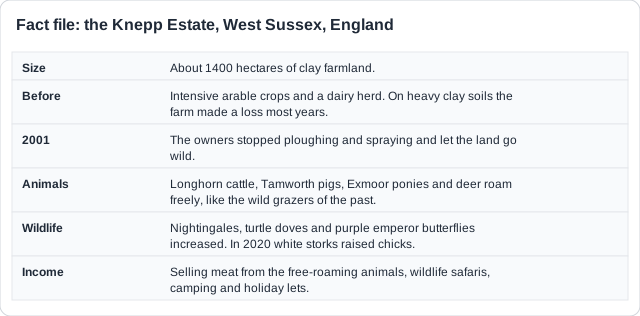
The fact file describes the Knepp Estate in England, rewilded since 2001.
Explain how rewilding at Knepp can address two different issues caused by intensive farming.
Model answer plan
See the mark-by-mark plan — for / against / judgement, with marking guidance — in study mode.