Contrasting farming choices at Higher Level: This statement is Higher Level only. It explains why farmers in one biome make different choices, such as wheat or cattle on the prairies, because of differences in local soils and climate. It builds on soils (5.1) and biomes (2.4).
Practise this as you read
- Explain one pair of contrasting choices in one biome, with real figures.
- Link each choice to the soil and the climate.
Free preview
This is the free notes preview
You're reading the free notes. Aimnova Pro unlocks the full study experience — and you can try it with your first topic free to keep:
- FlashcardsLock in vocabulary and key terms with spaced repetition.
- Practice questionsAnswer exam-style questions and get instant AI marking.
- Mock exams & past-paper vaultSit full mocks and see exactly how examiners award marks.
- Personalised study planA daily plan built around your exam date and weak areas.
The land decides first: Inside one biome, farmers often make very different choices: crops on one farm, animals on the next. The main reasons are the local soil and the local climate.
The points to remember
- Rainfall: enough water lets crops grow; too little suits grazing animals instead.
- Temperature and the growing season decide which crops can ripen.
- Soil: deep, fertile soil suits crops; thin, poor, wet or salty soil suits grass.
- Slope: flat land can be ploughed by machines; steep land is left as pasture.
- Farmers can change the limits (irrigation, lime, fertilizer), but it costs money and energy.
Remember it as: Wet and rich: plough it. Dry, thin or steep: graze it.
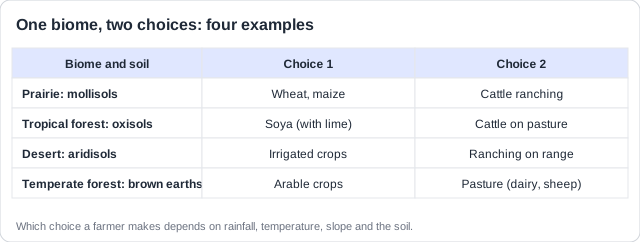
Each biome has its own typical soil: mollisols under grassland, oxisols under tropical forest, aridisols in deserts, and brown earths in temperate forest.
Memorize terms 3x faster
Smart flashcards show you cards right before you forget them. Perfect for definitions and key concepts.
The Great Plains of the USA are one biome, the temperate grassland, on one kind of soil, the mollisol. Yet the east is ploughed for grain and the west is cattle country. The difference is water.
The points to remember
- Mollisols have a deep, dark topsoil full of humus from grass roots: very fertile.
- Rain falls from east to west: about 1000 mm in eastern Kansas, only 300-400 mm in eastern Montana.
- In the wetter east, crops get enough water, so farmers grow wheat and maize for a high income per hectare.
- In the dry west, crops would fail in dry years, so the grass is kept for cattle ranching.
- Ranches are extensive: few cattle per hectare over huge areas, with few inputs.
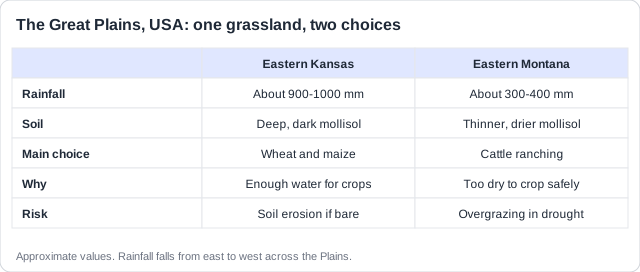
Example: the Dust Bowl, a wrong choice: In the 1920s farmers ploughed the dry western plains for wheat. When drought came in the 1930s, the bare mollisol blew away in huge dust storms. The lesson: the dry west suits grass and grazing, not the plough. Kansas, in the wetter centre and east, is still called 'the Wheat State'.
In the tropical forest and savanna of Mato Grosso, the rain is plentiful but the soil is poor. Here the two choices are soya and cattle.
The points to remember
- Oxisols are deep and well drained but acidic and low in nutrients: heavy rain has leached them.
- Soya grows well only after lime (to reduce acidity) and fertilizer are added every year.
- Soya is grown on flat land near roads, where machines work and the crop can be trucked out.
- Cattle graze sown grass on cleared land with few inputs, often on rougher or remote land.
- Both often follow deforestation: the forest is cleared first, then the land is used.
Remember it as: Rich rain, poor soil: lime it for soya, or graze it.
Soya in Mato Grosso
- Needs lime, fertilizer and machines: high costs.
- High income per hectare; sold abroad, mainly to China.
- Brazil became the world's largest soya exporter.
Cattle in Mato Grosso
- Grass needs few inputs: low costs.
- Low income per hectare, but works on poor or remote land.
- The state has the largest cattle herd in Brazil.
Science changed the choice. From the 1970s, Brazil's farm research agency Embrapa showed how lime and phosphate fertilizer make these acidic soils good for soya. Without those inputs, grazing was the only choice.
Know your predicted grade
Take timed mock exams and get detailed feedback on every answer. See exactly where you're losing marks.
Farmers can push back the limits set by soil and climate, but only by adding inputs. In a desert, the input is water.
The points to remember
- Desert aridisols: with irrigation, crops can grow; without it, only sparse grazing.
- Irrigation brings salinization: water evaporates and leaves salts in the soil.
- Brown earths (temperate forest): drier, flatter east = arable; wetter, hillier west = pasture.
- Changing the limits costs money, energy and water, so it is not always sustainable.
Desert
The Imperial Valley, California, gets under 80 mm of rain a year. Unwatered, its aridisols carry only sparse shrubs, enough for a few cattle.
Canal
Since the 1940s a canal has brought Colorado River water to the valley, so lettuce, carrots and alfalfa now grow there all winter.
Cost
The water leaves salts behind, so fields must be drained and flushed, and the river is shared by seven US states and Mexico.
England
On brown earths, dry, flat East Anglia (about 600 mm) grows wheat and barley; wet, hilly Devon grows grass for dairy cows.
How this comes up: A Paper 1 case study or a Paper 2 data question gives a fact file on a farming region and asks you to explain why two farming choices are made [3-4]. In a Paper 2 essay, explain one pair from one biome.
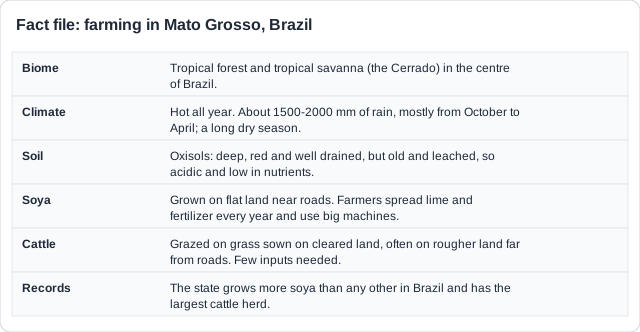
The fact file describes farming in Mato Grosso, Brazil.
With reference to the fact file, explain why some farmers in Mato Grosso grow soya while others raise cattle.
Model answer plan
See the mark-by-mark plan — for / against / judgement, with marking guidance — in study mode.