aimnova.
DashboardMy LearningPaper MasteryStudy Plan

Aimnova site navigation

Stay in the loop

Get the latest study resources and updates

New features, study tips and exam insights — straight to your inbox.

IB Diploma

  • IB Past Papers
  • IB Study Notes
  • IB Question Bank
  • IB Mock Exams
  • IB Revision

IB Subjects

  • IB Math AA
  • IB Math AI
  • IB Economics
  • IB Business Management
  • IB Physics
  • IB Biology
  • View all IB subjects→

IB Past Papers

  • IB Math AA HL Past Papers
  • IB Math AA SL Past Papers
  • IB Math AI HL Past Papers
  • IB Math AI SL Past Papers
  • IB Economics HL Past Papers
  • IB Economics SL Past Papers
  • IB ESS Past Papers
  • View all past papers→

Study Resources

  • Study Notes
  • Question Bank
  • Mock Exams
  • Flashcards
  • Revision Guide
  • Exam Skills
  • Command Terms
  • Grade Calculator
  • Exam Timetable 2026

Aimnova

  • Features
  • Pricing
  • For Teachers
  • For Schools
  • For Parents
  • About Us
  • Blog
  • Contact
aimnova.

AI-powered study platform for smarter revision, past-paper analysis and examiner-style feedback.

TermsPrivacyCookies·© 2026 Aimnova. All rights reserved.4d879c2

Aimnova is not affiliated with or endorsed by the International Baccalaureate Organization (IB).

NotesESS HLTopic 4.4Water quality index
Back to ESS HL Topics
4.4.155 min read

Water quality index (ESS HL)

IB Environmental Systems and Societies • Unit 4

Your first topic is free to keep

Know exactly what to write for full marks

Practice with exam questions and get AI feedback that shows you the perfect answer — what examiners want to see.

Start Free

Contents

  • The water quality index at Higher Level
  • What a water quality index is
  • Calculating a WQI
  • Strengths and limits of a WQI
  • Exam-style question
The water quality index at Higher Level: This statement is Higher Level only. It combines several water tests into one weighted score, using Vernier's index as the example.

Practise this as you read

  • Calculate a WQI from Q-values and weights.
  • Evaluate the use of a WQI to judge water quality.

Free preview

This is the free notes preview

You're reading the free notes. Aimnova Pro unlocks the full study experience — and you can try it with your first topic free to keep:

  • FlashcardsLock in vocabulary and key terms with spaced repetition.
  • Practice questionsAnswer exam-style questions and get instant AI marking.
  • Mock exams & past-paper vaultSit full mocks and see exactly how examiners award marks.
  • Personalised study planA daily plan built around your exam date and weak areas.
Start Studying Free Full access to Aimnova Pro · cancel anytime
Many tests, one score: Oxygen, pH, bacteria, nutrients: each test tells part of the story. A water quality index puts them together into one score, giving the most important tests the most weight.

What a WQI is

  • A water quality index (WQI) combines several water tests into one number.
  • It is a weighted average: tests that matter more for life count more.
  • It shows the degree of contamination of a water sample, from 0 to 100.
  • Vernier's WQI uses nine tests, from dissolved oxygen (0.17) to total solids (0.07).
  • The weights add up to 1.00.
Remember it as: Test it, weight it, add it: one number for the whole sample.
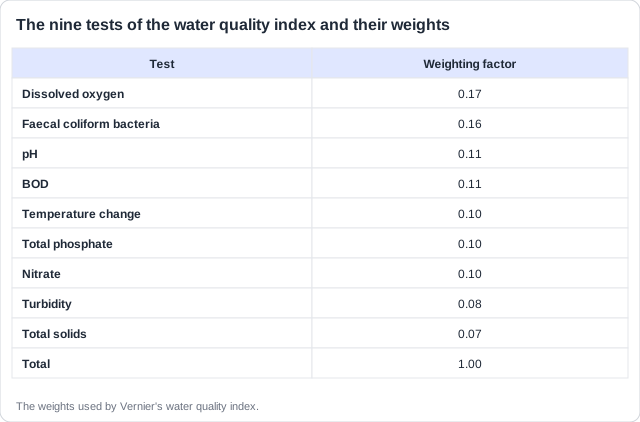
Table of the nine tests and their weights: dissolved oxygen 0.17, faecal coliform bacteria 0.16, pH 0.11, BOD 0.11, temperature change 0.10, total phosphate 0.10, nitrate 0.10, turbidity 0.08, total solids 0.07, total 1.00
Oxygen and bacteria carry the most weight: they matter most for fish and for people.

Faecal coliform bacteria show the risk of disease. Turbidity and total solids show how much soil and other particles it carries.

Learn what examiners really want

See exactly what to write to score full marks. Our AI shows you model answers and the key phrases examiners look for.

Try AI Feedback FreeYour first topic is free to keep • No credit card required

Worked example: the same class tested Millbrook below its sewage works for all nine tests.

Working out the WQI

  • Measure each test, e.g. dissolved oxygen with a probe.
  • Turn each result into a Q-value (0-100) using that test's chart.
  • Multiply each Q-value by its weight.
  • Add the answers: that total is the WQI.
  • Fewer tests? Divide the total by the sum of the weights used.
  • Read the rating: 90-100 excellent, 70-90 good, 50-70 medium, 25-50 bad, 0-25 very bad.
Remember it as: Q times weight, then add: divide by the weights if tests are missing.
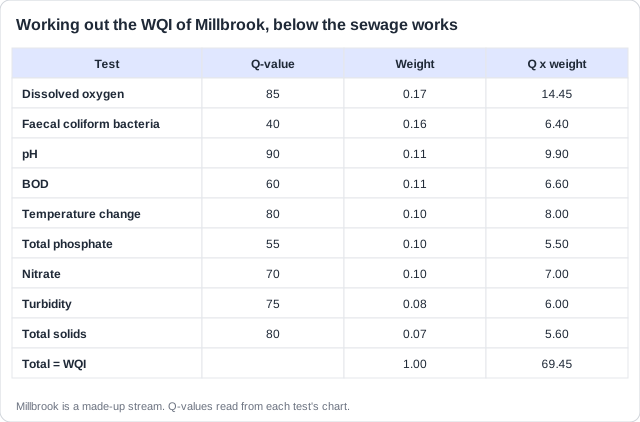
Table: Q-values for Millbrook multiplied by their weights: dissolved oxygen 85 times 0.17 is 14.45, faecal coliform 40 times 0.16 is 6.40, and so on; the total, the WQI, is 69.45
Each row is Q-value × weight; the WQI is the sum of the last column.
1

Formula

WQI = sum of (Q-value × weight).

2

Work it out

14.45 + 6.40 + 9.90 + 6.60 + 8.00 + 5.50 + 7.00 + 6.00 + 5.60 = 69.45.

3

Rate it

69 is in the 50-70 band: medium quality, just short of good.

4

Explain it

The low Q-values for bacteria (40) and phosphate (55) pull it down: sewage.
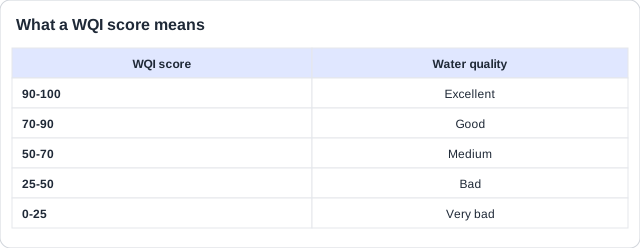
Table: a WQI of 90-100 is excellent, 70-90 good, 50-70 medium, 25-50 bad and 0-25 very bad
The rating bands of Vernier's index.

Canada and India publish water quality indices for their rivers. One number is powerful, but it can also hide things.

Strengths and limits of a WQI

  • Strength: one simple number to compare sites and years, and to explain to the public.
  • Strength: it combines many tests, so it is broader than any one test.
  • Limit: averaging hides one very bad result, e.g. high bacteria.
  • Limit: the weights are a judgement, and the charts were made for rivers in the USA.
  • Limit: it leaves out toxins such as metals and pesticides, and one sample is only a snapshot.
Remember it as: Simple to share, easy to compare, but an average can hide a danger.

Strengths

  • One number: easy to compare.
  • Easy for the public to understand.
  • Combines many tests.

Limits

  • Hides one dangerous result.
  • Weights are a judgement.
  • Leaves out metals and pesticides.
An average can mislead: At Millbrook, the bacteria Q-value was only 40, a real health risk for swimmers, yet the overall WQI of 69 sounds almost good. Always look at the individual tests too.

Never wonder what to study next

Get a personalized daily plan based on your exam date, progress, and weak areas. We'll tell you exactly what to review each day.

Try Free Study PlanYour first topic is free to keep • No credit card required
How this comes up: Paper 2 data questions: a table of Q-values and weights, with 'calculate the WQI' [1-2], then 'evaluate the use of a WQI' or 'suggest why one test has a larger weight'.
IB-style questionCalculate[2 marks]

A school could run only five of the nine tests on a stream. The Q-values were: dissolved oxygen 80 (weight 0.17), BOD 50 (0.11), pH 90 (0.11), nitrate 60 (0.10) and total phosphate 40 (0.10).

Calculate the water quality index of the stream and state its rating.

Model answer plan

See the mark-by-mark plan — for / against / judgement, with marking guidance — in study mode.

Claim your free topic

IB Exam Questions on Water quality index

Practice with IB-style questions filtered to Topic 4.4.15. Get instant AI feedback on every answer.

Practice Topic 4.4.15 QuestionsBrowse All ESS HL Topics

How Water quality index Appears in IB Exams

Examiners use specific command terms when asking about this topic. Here's what to expect:

Define

Give the precise meaning of key terms related to Water quality index.

AO1
Describe

Give a detailed account of processes or features in Water quality index.

AO2
Explain

Give reasons WHY — cause and effect within Water quality index.

AO3
Evaluate

Weigh strengths AND limitations of approaches in Water quality index.

AO3
Discuss

Present arguments FOR and AGAINST with a balanced conclusion.

AO3

See the full IB Command Terms guide →

Related ESS HL Topics

Continue learning with these related topics from the same unit:

4.1.1What drives the water cycle
4.1.2The water cycle as a system
4.1.3Where the world's water is stored
4.1.4Flows in the water cycle
View all ESS HL topics

Practice with flashcards

Spaced repetition flashcards for Water quality index

Improve your exam technique

Command terms, paper structure, and mark-scheme tips for ESS HL

Previous
4.4.14Biotic indices
Next
Drinking water standards4.4.16

3 exam-style questions ready for you

Students who practice on Aimnova improve their scores by 15% on average. Get instant feedback that shows exactly how to improve your answers.

Practice Now — FreeView All ESS HL Topics