Drinking water standards at Higher Level: This statement is Higher Level only. It looks at who decides what is safe to drink, and how regulations protect, or fail to protect, communities when a company moves in.
Practise this as you read
- Outline the roles of the WHO and of national governments.
- Evaluate how well regulations protected water at a bottling plant.
Free preview
This is the free notes preview
You're reading the free notes. Aimnova Pro unlocks the full study experience — and you can try it with your first topic free to keep:
- FlashcardsLock in vocabulary and key terms with spaced repetition.
- Practice questionsAnswer exam-style questions and get instant AI marking.
- Mock exams & past-paper vaultSit full mocks and see exactly how examiners award marks.
- Personalised study planA daily plan built around your exam date and weak areas.
Advice from the world, law from each country: The World Health Organization (WHO) tells countries what is safe to drink. Each country then decides its own legal limits, and has to enforce them.
Guidelines and standards
- The WHO publishes guidelines for drinking water: safe levels for each substance.
- Guidelines are based on health evidence, and they are advice, not law.
- Each government sets its own statutory standards: legal limits it can enforce.
- Water companies must test the water and meet the national standard, or be fined.
- Examples: arsenic 10 µg per litre; nitrate 50 mg per litre; no E. coli in 100 ml.
Remember it as: The WHO advises; governments legislate.
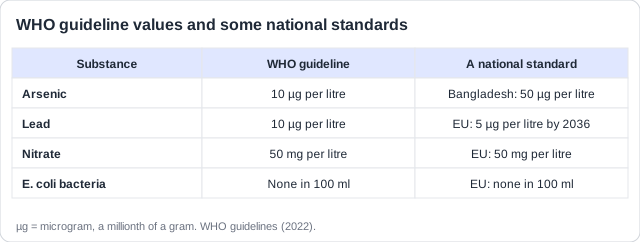
Statutory standards in the USA come from the Safe Drinking Water Act of 1974; in the EU, from the Drinking Water Directive.
Feeling unprepared for exams?
Get a clear study plan, practice with real questions, and know exactly where you stand before exam day. No more guessing.
Why don't all countries simply copy the WHO's numbers?
Why national standards differ
- Some countries set standards less strict than the WHO, because meeting them costs too much.
- Bangladesh allows 50 µg of arsenic per litre, five times the WHO's 10 µg.
- Others set stricter standards: the EU will allow only 5 µg of lead from 2036.
- Standards depend on money, technology, local water and health priorities.
- A standard only protects people if it is monitored and enforced.
Remember it as: Stricter if you can afford it; looser if you can't.
Wells
- From the 1970s, millions of tube wells were dug to escape germs in surface water.
Arsenic
- In the 1990s the groundwater was found to hold natural arsenic, which causes skin lesions and cancers after years of drinking it.
Standard
- Bangladesh kept a standard of 50 µg per litre. At the WHO's 10 µg, far more wells would fail, leaving millions with no supply.
Trade-off
- The looser standard keeps water flowing, but people below it still face a higher cancer risk than the WHO advises.
Standards matter most when a new project could change the water: a mine, a factory or a bottling plant.
Regulations and standards in an EIA
- An environmental impact assessment (EIA) studies a project's effects before it is approved.
- It checks the project against regulations: how much water it may take, what it may release.
- It sets conditions: a water permit, waste standards, regular monitoring.
- It should consult local people, whose wells and farms are affected.
- Weak EIAs, weak laws or weak enforcement leave local people unprotected.
Remember it as: Assess before you build; set limits; keep checking.
Plant
- In 2000 a company making Coca-Cola drinks opened a bottling plant in Plachimada, a farming village. It pumped up to about 500,000 litres of groundwater a day.
Wells
- Villagers, many of them Adivasi farmers, said their wells fell and turned too hard and salty to drink.
Sludge
- The plant's waste sludge was given to farmers as fertiliser. In 2003 tests found cadmium and lead in it.
Licence
- After protests from 2002, the village council refused to renew the licence in 2003. The plant stopped production in 2004.
What a strong EIA would have checked: How much groundwater the area can safely give each year; a limit on pumping below that; standards for the sludge and waste water; and regular testing of the villagers' wells.
Memorize terms 3x faster
Smart flashcards show you cards right before you forget them. Perfect for definitions and key concepts.
When a company from a rich country invests in a developing one, whose rules apply?
Standards in international business
- A foreign company may follow the host country's weaker rules, not its home country's.
- Business agreements can require it to meet national or international standards.
- Since 2010 the UN has recognised a human right to water and sanitation.
- Local government can refuse or withdraw a licence.
- Courts and compensation can make the polluter pay, but often too slowly.
Remember it as: Rules on paper, enforcement in practice.
What protects people
- Clear legal standards for water use and waste.
- A strong EIA with local consultation.
- Licences that can be withdrawn.
- Independent monitoring.
What fails them
- Weak or unenforced laws.
- Jobs and investment put first.
- Slow courts: no payment years later.
- Poor communities with little voice.
Real example: in 2010 a Kerala government committee put Plachimada's losses at 216 crore rupees. A law to set up a tribunal for compensation was passed in 2011, but it never came into force, and no compensation has been paid.
How this comes up: Paper 1: a fact file on a bottling plant, mine or factory, with 'explain how regulations could reduce its impacts' [3-4] or a final 'to what extent' [6]. Paper 2: 'outline the role of the WHO and national governments' [2-4].
The WHO guideline for arsenic in drinking water is 10 micrograms per litre, while Bangladesh's legal standard is 50 micrograms per litre.
Outline the difference between a WHO drinking water guideline and a national standard.
Model answer plan
See the mark-by-mark plan — for / against / judgement, with marking guidance — in study mode.