The water cycle as a system at Higher Level: The same ideas as SL with different examples: the International Space Station, the Aral Sea and Mexico City. At HL, expect to outline why the cycle is closed for matter but open for energy.
Practise this as you read
- Draw the cycle as boxes and labelled arrows.
- Say both halves: closed for matter, open for energy.
Free preview
This is the free notes preview
You're reading the free notes. Aimnova Pro unlocks the full study experience — and you can try it with your first topic free to keep:
- FlashcardsLock in vocabulary and key terms with spaced repetition.
- Practice questionsAnswer exam-style questions and get instant AI marking.
- Mock exams & past-paper vaultSit full mocks and see exactly how examiners award marks.
- Personalised study planA daily plan built around your exam date and weak areas.
Stores and flows: The water cycle is a system. Each store holds water for a while; each flow moves it on.
The points to remember
- The water cycle is a system: stores that hold water, joined by flows that move it.
- Globally it is closed for matter: no water enters or leaves the Earth.
- The amount of water stays about the same over millions of years; it is recycled.
- It is open for energy: sunlight comes in, heat goes out to space.
- A lake or a river basin is an open system: water flows in and out.
Remember it as: Same water, endlessly recycled; new energy, every day.
Matter: closed
- No water in or out of the Earth
- Tiny exceptions: hydrogen lost to space, icy comets
- Recycled between air, land, sea and living things
Energy: open
- Sunlight in: evaporation, melting
- Latent heat given out in condensation
- Heat lost to space
Real example: the International Space Station recycles about 98% of its water, even the astronauts' sweat and urine. It is nearly closed for water, but not quite, so supply ships bring more. The Earth, by contrast, keeps all its water.
Stop wasting time on topics you know
Our AI identifies your weak areas and focuses your study time where it matters. No more overstudying easy topics.
A system diagram shows the cycle as boxes and arrows. It is the drawing the exam asks for, so draw it the same way every time.
How to draw it
- Every store is a box with a noun in it: oceans, groundwater, ice.
- Every flow is an arrow with a process on it: evaporation, infiltration.
- The arrow points the way the water moves: from the ocean up to the air for evaporation.
- A system diagram has no pictures of clouds or trees: only boxes and labelled arrows.
- Each mark for a diagram needs three correct labels, so label every box and arrow.
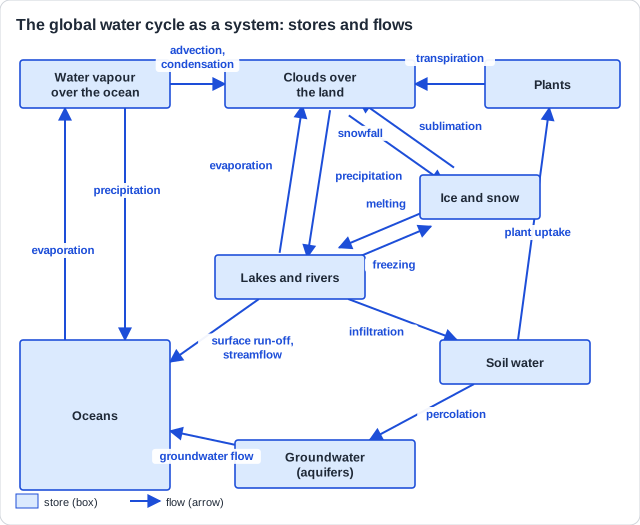
Real example: to draw the Aral Sea as a system, the sea is a box. The Amu Darya and Syr Darya rivers are arrows in; evaporation is the only big arrow out, because no river leaves the sea.
Store or flow?: 'Rain' and 'evaporation' are flows, never boxes. 'Groundwater' and 'glaciers' are stores, never arrows.
The same diagram can show how people change the cycle: mark each changed arrow and say what changes it.
What people change, flow by flow
- Urbanisation: paving means less infiltration and more run-off.
- Deforestation: less transpiration and plant uptake, more run-off.
- Global warming: more melting, less freezing, more evaporation.
- Burning fossil fuels: NOx and SO2 make acid precipitation.
- Pumping wells: less groundwater and less groundwater flow.
- Industry: warmer or polluted streams; cloud seeding adds precipitation.
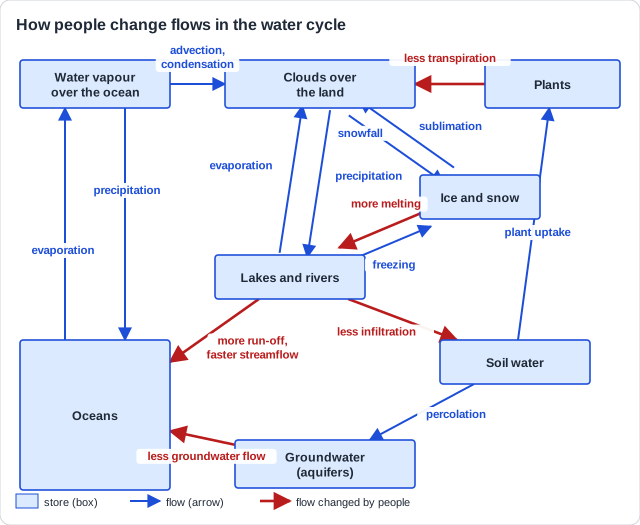
Real example: Mexico City pumps so much water from the aquifer below it that some districts sink by up to 40 cm a year. On a diagram, the arrow out of groundwater grows and the store shrinks.
Words and diagram both score: Up to four marks come from the impacts, each naming the flow, the change and its cause. Up to three come from the diagram: one mark for every three correct labels.
See how examiners mark answers
Answer exam-style questions with model answers. Learn exactly what earns marks and what doesn't.
Why does the water cycle matter? Every ecosystem depends on the water it delivers. Here is what water does for living things.
What water does in ecosystems
- Plants use water in photosynthesis to make glucose and oxygen.
- Water dissolves minerals in the soil so roots can take them up.
- It is a habitat for aquatic life and a solvent for the reactions in every cell.
- It holds plants upright by turgor pressure, and about 70% of an organism is water.
- It moves heat and cools by evaporation; rivers carry nutrients, seeds and sediment.
Remember it as: Food, transport, home, support, cooling.
Real example: Lake Baikal in Siberia holds about a fifth of the world's unfrozen fresh surface water. Thousands of species live in it, and its clear water lets sunlight reach algae deep down for photosynthesis.
Ecosystems, not people: 'Drinking water for towns' or 'irrigation for farms' does not answer a question about ecosystems.
How this comes up: Paper 2, Section B (a): outline why the water cycle is a closed system [4]. Matter and energy both needed.
The water in Lake Baikal today may once have fallen as rain on the dinosaurs.
Outline why the global hydrological cycle is considered a closed system.
Model answer plan
See the mark-by-mark plan — for / against / judgement, with marking guidance — in study mode.