Flows in the water cycle at Higher Level: The same ideas as SL with different examples: the Atacama's snowfields, the Mekong and the Amazon's 'flying rivers'. At HL, expect to read a figure and name a flow it leaves out.
Practise this as you read
- Sort each flow: transfer or transformation.
- Draw the cycle as boxes and labelled arrows.
Free preview
This is the free notes preview
You're reading the free notes. Aimnova Pro unlocks the full study experience — and you can try it with your first topic free to keep:
- FlashcardsLock in vocabulary and key terms with spaced repetition.
- Practice questionsAnswer exam-style questions and get instant AI marking.
- Mock exams & past-paper vaultSit full mocks and see exactly how examiners award marks.
- Personalised study planA daily plan built around your exam date and weak areas.
Water moves between the stores by thirteen flows. Learn each one by what happens to the water.
| Flow | What happens | You can see it in |
|---|---|---|
| Evaporation | Liquid water turns to vapour from seas, lakes, soil | Puddles drying in the sun |
| Transpiration | Plants release water vapour through their leaves | A forest on a hot day |
| Sublimation | Ice turns straight into vapour, skipping liquid | Snow vanishing in dry wind |
| Condensation | Vapour cools and turns into droplets | Clouds, dew, mist |
| Advection | Wind carries vapour or clouds sideways | Sea clouds blown inland |
| Precipitation | Water falls from clouds | Rain, snow, hail |
| Melting / freezing | Ice turns to water / water turns to ice | Spring snowmelt; a frozen lake |
| Surface run-off | Water flows over the ground | Rain running down a road |
| Infiltration | Water enters the soil | Rain soaking into a lawn |
| Percolation | Water moves down through soil and rock | Water reaching an aquifer |
| Streamflow | Water flows in a river channel | The Thames flowing to the sea |
| Groundwater flow | Water moves slowly through rock | A spring feeding a stream |
The four the guide defines, and their neighbours
- Sublimation: ice to vapour, with no liquid stage.
- Advection: wind carrying vapour or clouds, for example from the sea over the land.
- Infiltration: water entering the soil. Percolation: water moving down through it.
- Surface run-off flows over the ground; streamflow flows in rivers.
- Groundwater flow is slow movement through rock towards rivers and the sea.
Real example: on the high, dry Altiplano of the Atacama in Chile, snow that falls on the volcanoes mostly sublimates in the thin, dry air; little of it ever melts into streams.
See how examiners mark answers
Answer exam-style questions with model answers. Learn exactly what earns marks and what doesn't.
Every flow is either a transformation, which changes the state of the water, or a transfer, which moves it to a new place.
The points to remember
- A transformation changes the state of water: liquid, gas or solid.
- Transformations: evaporation, transpiration, condensation, sublimation, melting, freezing.
- A transfer moves water to a new place without changing its state.
- Transfers: advection, precipitation, run-off, infiltration, percolation, streamflow, groundwater flow, plant uptake.
- If the figure says evapotranspiration, write that word, not 'evaporation' or 'transpiration' alone.
Remember it as: Transformation changes its form; transfer changes its place.
Transformations (state changes)
- Evaporation, transpiration
- Condensation
- Sublimation
- Melting, freezing
Transfers (place changes)
- Advection, precipitation
- Run-off, streamflow
- Infiltration, percolation
- Groundwater flow, plant uptake
Real example: in the Mekong, monsoon rain running off the hills into the river is a transfer (run-off), while water evaporating from the Tonlé Sap lake in the dry season is a transformation.
Only the first answer counts: Give one transfer and one transformation, both from the figure. A wrong first answer is not rescued by a right second one.
Evaporation and transpiration both put water vapour into the air, so they are often measured together as evapotranspiration.
The points to remember
- Evaporation is from non-living surfaces: seas, lakes, wet soil.
- Transpiration is from living plants, through stomata.
- Evapotranspiration is the two together: the total loss of water vapour from an area.
- It rises with heat, wind, dry air, more plants and more water available.
- Animals lose water by sweating and breathing, but only plants transpire.
More evapotranspiration
- Hot: puddles dry faster
- Windy: washing dries faster
- Dry air
- Lots of plants
- Plenty of water
Less evapotranspiration
- Cold
- Still air
- Humid air: washing dries slowly
- Few plants
- Dry ground: nothing to lose
Real example: the Amazon rainforest transpires about 20 billion tonnes of water a day, more than the Amazon River carries to the sea. Winds carry this vapour south as 'flying rivers' that bring rain to farms in southern Brazil.
Study smarter, not longer
Most students waste 40% of study time on topics they already know. Our AI tracks your progress and optimizes every minute.
Another favourite question shows a figure with one way water enters the air, and asks for one more.
Ways water vapour enters the atmosphere
- Evaporation from oceans, lakes, rivers and wet soil.
- Transpiration (or evapotranspiration) from plants.
- Sublimation from snow and ice.
- Small amounts from respiration by animals and from burning fuels.
- Pick one the figure does not already show.
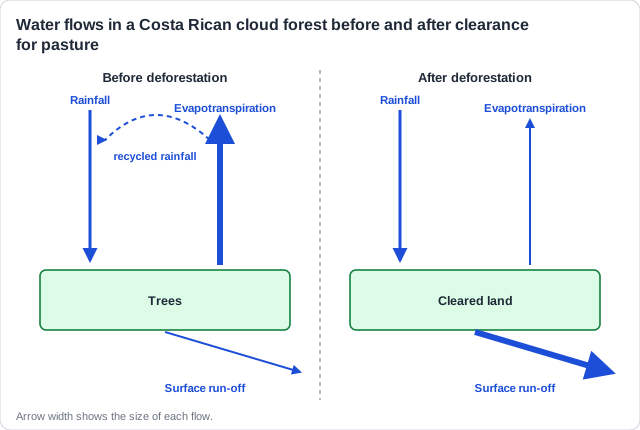
Real example: for this cloud forest, sublimation would be wrong (there is no snow), but evaporation from wet leaves, streams or the nearby Pacific would be a correct extra input.
Check it is not already there: If the figure already shows evapotranspiration, 'transpiration' repeats it. Choose evaporation from water or soil, or sublimation.
The guide expects you to create a systems diagram of the water cycle and use it. Build it in five steps.
Five steps to draw it
- Draw a box for each store: oceans, atmosphere, ice, lakes and rivers, soil, groundwater, plants.
- Join them with arrows in the direction the water moves.
- Write the process on every arrow, using the guide's names.
- Mark which arrows are transformations (state changes) and which are transfers.
- Check every box has at least one arrow in and one out: nothing is a dead end.
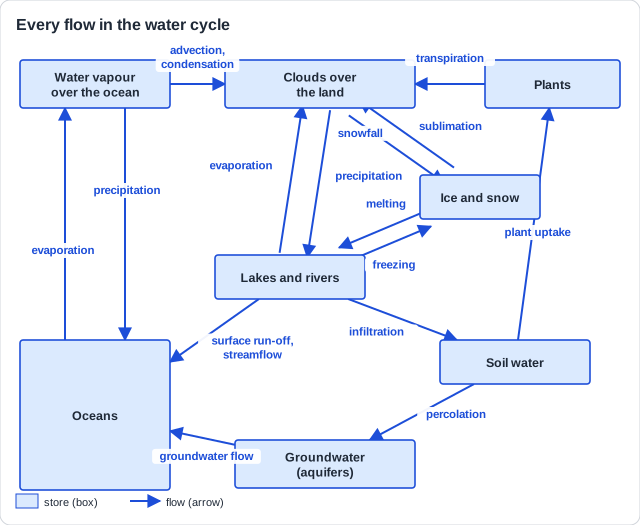
Real example: to draw the Nile's water cycle, start with boxes for the Ethiopian Highlands' clouds, Lake Nasser and the Mediterranean, then add arrows: precipitation, run-off, streamflow, evaporation from the lake and streamflow to the sea.
Use it, too: Once drawn, the diagram answers questions: which flow did paving change? Which store is filling? Point to the arrow or box.
Practice with exam-style questions
Answer exam-style questions and get AI feedback that shows you exactly what examiners want to see in a full-marks response.
How this comes up: Paper 2, Section A: state an input of water into the atmosphere not shown on a figure [1].
Figure 1 shows the flows of water in a Costa Rican cloud forest before and after it was cleared for cattle pasture.
State one input of water into the atmosphere not shown in Figure 1.
Model answer plan
See the mark-by-mark plan — for / against / judgement, with marking guidance — in study mode.