Indicator species at Higher Level: This statement is Higher Level only. It uses the animals that live in water to judge how polluted it is, and asks how good a particular species is for the job.
Practise this as you read
- Outline one tolerant and one intolerant indicator species.
- Evaluate the choice of a species as an indicator.
Free preview
This is the free notes preview
You're reading the free notes. Aimnova Pro unlocks the full study experience — and you can try it with your first topic free to keep:
- FlashcardsLock in vocabulary and key terms with spaced repetition.
- Practice questionsAnswer exam-style questions and get instant AI marking.
- Mock exams & past-paper vaultSit full mocks and see exactly how examiners award marks.
- Personalised study planA daily plan built around your exam date and weak areas.
Living alarms: Some animals cannot survive in polluted water; others thrive in it. Finding one or the other tells you about the water without testing a single chemical.
What an indicator species is
- An indicator species shows the state of its environment by being present, absent or abundant.
- Intolerant (sensitive) species die or leave when the water is polluted.
- Tolerant species are adapted to polluted water and can increase in it.
- Most water indicators are invertebrates living on the river bed.
- They show pollution over weeks or months, not just on the day of sampling.
Remember it as: Sensitive species leave first; tolerant species take over.
Know your predicted grade
Take timed mock exams and get detailed feedback on every answer. See exactly where you're losing marks.
Intolerant species are the ones you hope to find. Nymphs live under stones on the river bed.
Intolerant species
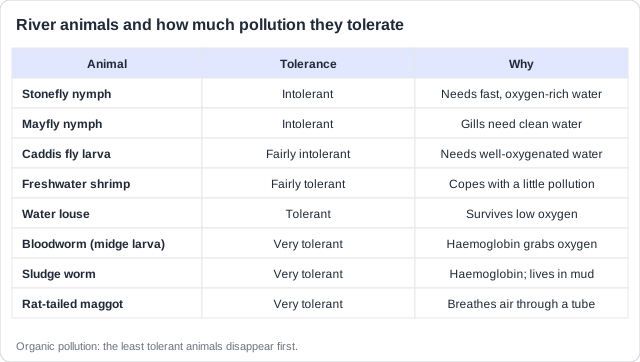
- Stonefly nymphs and mayfly nymphs are the classic intolerant species.
- They need cool, fast, oxygen-rich water; their gills cannot cope with low oxygen.
- Organic pollution raises the BOD, so they are the first to disappear.
- Their return shows that a river or lake has recovered.
- Caddis fly larvae are fairly intolerant too.
Remember it as: Stoneflies and mayflies: no oxygen, no nymphs.
Before
- Huge swarms of burrowing mayflies (Hexagenia) once hatched from the mud of western Lake Erie each summer.
1950s
- Nutrient pollution caused blooms; their decay left the bottom water without oxygen. The nymphs in the mud died, and the mayflies vanished.
Clean-up
- From the 1970s, the USA and Canada cut the phosphate going into the lake from sewage and detergents.
1990s
- The mayflies came back, a sign that the bottom water had oxygen again.
Tolerant species are adapted to water with little oxygen. Finding only them, with no sensitive species, is the sign of pollution.
Tolerant species
- Sludge worms (Tubifex) and bloodworms (midge larvae) are classic tolerant species.
- Both have haemoglobin, which grabs what little oxygen there is.
- Rat-tailed maggots breathe air through a long tube, like a snorkel.
- Water lice survive moderately low oxygen.
- With fewer competitors and predators, tolerant species can become very abundant.
Remember it as: Red worms, red flag: haemoglobin means low oxygen.
Intolerant: clean water
- Stonefly nymphs.
- Mayfly nymphs.
- Caddis fly larvae.
Tolerant: polluted water
- Sludge worms.
- Bloodworms.
- Rat-tailed maggots, water lice.
Real example: in the 1950s the tidal River Thames in London was so full of sewage that stretches had no oxygen in summer. Surveys found almost no fish, and the mud held mainly tolerant worms. After new sewage works were built, over 100 kinds of fish returned.
Get feedback like a real examiner
Submit your answers and get instant feedback — what you did well, what's missing, and exactly what to write to score full marks.
Exam questions ask you to evaluate whether a species is a good choice of indicator. Weigh what makes it useful against what limits it.
What makes a good indicator, and its limits
- Sedentary: it stays put, so it shows local conditions and is easy to count.
- Common and easy to find and identify; colonies give large samples.
- Sensitive to the pollutant, with a known tolerance.
- Takes in the pollutant, e.g. a filter feeder; or high in the food chain.
- But: its absence may have other causes (flow, temperature, predators).
- But: mobile young may pick up pollutants elsewhere; it shows local effects only.
Remember it as: Stays put, easy to find, sensitive, exposed: but absence has many causes.
Stays put
- The dog whelk moves only a few metres, and its young crawl out of eggs on the rocks, so it shows the TBT at that spot.
Easy
- It is common between the tides, and its change, females growing a male organ, is easy to see with a hand lens.
Sensitive
- It responds to only a few nanograms of TBT per litre, so it shows pollution that chemical tests struggle to detect.
Limits
- It lives only on rocky shores, it shows TBT and nothing else, and it can be missing for other reasons, such as wave exposure.
Evaluate means both sides, and a view: Give up to three strengths and up to three limits, each linked to the species' facts, and finish with your judgement: is it a good choice overall?
How this comes up: Paper 1: a fact file on a species, with 'evaluate the choice of this species as an indicator' [4] (May 2026: up to 3 marks for strengths and up to 3 for limits). Paper 2: 'outline one tolerant and one intolerant indicator species'.
A water company plans to use mayfly nymphs to check whether a new sewage outfall is harming a river. Mayfly nymphs live under stones for about a year, need oxygen-rich water and are easy to catch in a kick sample. The adults fly.
Evaluate the choice of mayfly nymphs as an indicator species for this outfall.
Model answer plan
See the mark-by-mark plan — for / against / judgement, with marking guidance — in study mode.