Sewage treatment at Higher Level: This statement is Higher Level only. It follows sewage through the three stages of a treatment works, and asks why so much of the world's sewage is still not treated.
Practise this as you read
- Outline what each stage of sewage treatment achieves.
- Explain why sewage treatment is hard to provide equally in all societies.
Free preview
This is the free notes preview
You're reading the free notes. Aimnova Pro unlocks the full study experience — and you can try it with your first topic free to keep:
- FlashcardsLock in vocabulary and key terms with spaced repetition.
- Practice questionsAnswer exam-style questions and get instant AI marking.
- Mock exams & past-paper vaultSit full mocks and see exactly how examiners award marks.
- Personalised study planA daily plan built around your exam date and weak areas.
From toilet to river, safely: Everything flushed down a toilet or drain ends up as sewage. A sewage works cleans it in stages, so the water it releases, the effluent, does not harm the river or the people downstream.
Why sewage must be treated
- Sewage holds organic matter, pathogens, nutrients and solids.
- Untreated, its organic matter gives a high BOD, so rivers lose their oxygen.
- Its pathogens spread diseases such as cholera and typhoid.
- Its nitrate and phosphate cause eutrophication.
- Treatment cleans it so the effluent can be released safely.
Remember it as: Sewage: oxygen thief, germ carrier, algae feeder.
Real example: in the hot summer of 1858, London's untreated sewage in the River Thames caused the 'Great Stink'. The city then built sewers to carry it east. Today it goes to sewage works such as Beckton, the largest in the UK, and since 2025 the 25 km Thames Tideway Tunnel catches the overflows that used to pour into the river after heavy rain.
Know your predicted grade
Take timed mock exams and get detailed feedback on every answer. See exactly where you're losing marks.
Most sewage works use the same stages, one after another.
Primary and secondary treatment
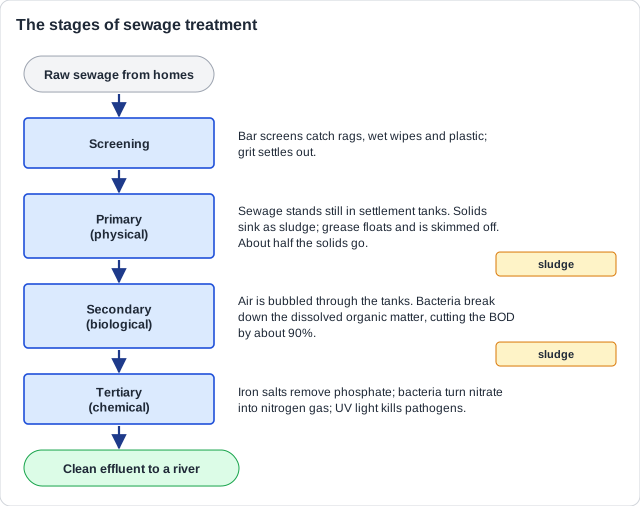
- Screening: bars catch rags, wet wipes and plastic; grit settles.
- Primary (physical): sewage stands in settlement tanks; solids sink as sludge.
- Primary removes about half the suspended solids, but most dissolved matter stays.
- Secondary (biological): air is pumped in; aerobic bacteria decompose organic matter.
- Secondary cuts the BOD by about 90% and kills many pathogens.
Remember it as: Primary lets it settle; secondary lets bacteria eat it.
Primary: physical
- Gravity: solids sink, grease floats.
- No living things needed.
- Removes about half the solids.
Secondary: biological
- Activated sludge or filter beds.
- Aerobic bacteria respire the organic matter.
- Cuts the BOD by about 90%.
After secondary treatment the water looks clean, but it still carries nutrients and some pathogens. Works that release into lakes, rivers used for drinking water or bathing beaches add a third stage.
Tertiary treatment and the sludge
- Tertiary: extra cleaning before the effluent reaches sensitive water.
- Chemical: iron or aluminium salts make phosphate settle out as a solid.
- Biological: bacteria turn nitrate into nitrogen gas (denitrification).
- Disinfection: UV light or chlorine kills the remaining pathogens.
- The sludge is digested by bacteria to make biogas, or spread on farmland.
Remember it as: Tertiary takes out what feeds algae and what makes people ill.
Primary
- Physical.
- Solids settle out.
Secondary
- Biological.
- Bacteria cut the BOD.
Tertiary
- Chemical and biological.
- Removes nutrients and pathogens.
Some small towns use a reed bed as a cheaper, natural tertiary stage.
Get feedback like a real examiner
Submit your answers and get instant feedback — what you did well, what's missing, and exactly what to write to score full marks.
In 2022 only 58% of the world's household wastewater was safely treated, and 3.5 billion people had no safely managed toilet. Treatment is not shared fairly.
Why sewage treatment is not equal everywhere
- Cost: sewers and works cost billions to build and run.
- Energy and skills: pumps and air blowers need power and trained staff.
- Fast-growing cities and informal settlements outgrow their sewers.
- Rural homes are too spread out to connect to a works.
- So poorer countries and communities treat far less of their sewage.
Remember it as: Pipes, power, people and pounds: poorer places lack all four.
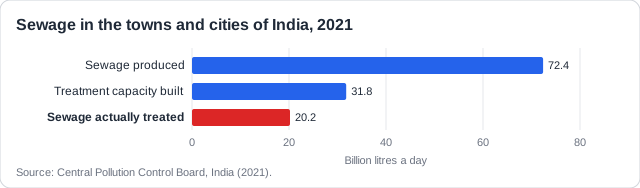
Real example: India built treatment works for under half its urban sewage, and many of them run below capacity because of power cuts, broken pumps or sewers that never reached them. The rest flows untreated into rivers such as the Yamuna. Rich countries struggle too: England's old sewers overflow into rivers after heavy rain.
How this comes up: Paper 2: 'outline' or 'explain' the stages of sewage treatment [3-7], often with a flow diagram to label; or data on how much sewage is treated, with 'suggest' why it is not equal everywhere.
Beckton sewage works in east London treats the sewage of millions of people before releasing the effluent into the River Thames.
Outline what is achieved at the primary, secondary and tertiary stages of sewage treatment.
Model answer plan
See the mark-by-mark plan — for / against / judgement, with marking guidance — in study mode.