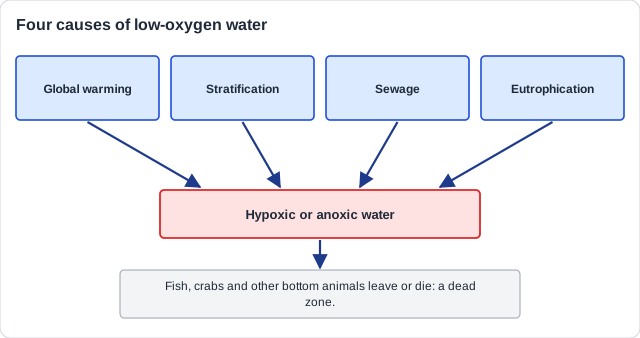
Dead zones at Higher Level: This statement is Higher Level only. It explains how four causes together make water run out of oxygen, and why dead zones are likely to become more common.
Practise this as you read
- Explain how each of the four causes lowers the oxygen in water.
- Explain why hypoxic and anoxic water is likely to become more frequent.
Free preview
This is the free notes preview
You're reading the free notes. Aimnova Pro unlocks the full study experience — and you can try it with your first topic free to keep:
- FlashcardsLock in vocabulary and key terms with spaced repetition.
- Practice questionsAnswer exam-style questions and get instant AI marking.
- Mock exams & past-paper vaultSit full mocks and see exactly how examiners award marks.
- Personalised study planA daily plan built around your exam date and weak areas.
When the water runs out of oxygen: Fish, crabs and insect larvae breathe the oxygen dissolved in water. When it falls very low, they must leave or die, and the area becomes a dead zone.
The words to use
- Hypoxic water has very little dissolved oxygen: below about 2 mg per litre.
- Anoxic water has no dissolved oxygen at all.
- A dead zone is an area of hypoxic or anoxic water where few animals can live.
- Fish swim away; slow animals such as crabs, worms and shellfish die.
- Many dead zones are seasonal: worst in late summer, gone after autumn storms.
Remember it as: Hypo = too little, an = none: hypoxic, then anoxic, then dead.
A few animals cope better. Some jellyfish survive low oxygen, so they can increase where fish disappear.
Know your predicted grade
Take timed mock exams and get detailed feedback on every answer. See exactly where you're losing marks.
Two of the four causes come from the land: the nutrients in fertiliser and the organic matter in sewage.
Eutrophication and sewage
- Eutrophication: nitrate and phosphate cause huge algal blooms.
- The algae die and sink; decomposers use up oxygen as they break them down.
- Sewage adds organic matter that decomposers feed on directly: a high BOD.
- Sewage also adds more nutrients, so it feeds the blooms too.
- Blooms shade the water, so plants below cannot photosynthesise.
Remember it as: Feed the algae, then feed the decomposers: they eat the oxygen.
Inputs
- Rivers carry phosphate from farms and sewage from cities such as Cleveland, Ohio, into the lake.
Bloom
- Algae bloom in the warm surface water during the long summer days.
Decay
- Dead algae sink into the thin, cold bottom layer, where bacteria decompose them and use up its oxygen.
Dead zone
- By late August, much of the bottom water has less than 2 mg of oxygen per litre. Fish leave and bottom animals die until autumn storms mix the lake.
The other two causes decide whether oxygen can get back down to the bottom water: the temperature, and the layers.
Warming and stratification
- Warm water holds less oxygen: 9.1 mg per litre at 20 °C, 7.6 at 30 °C.
- Decomposers work faster when it is warm, so they use oxygen faster.
- Stratification: a warm or fresh layer floats on top and the water stops mixing.
- Freshwater stratification: river water floats on salty sea water.
- The layers stop oxygen from the air reaching the bottom water.
- Global warming heats the surface, so the layers are stronger and last longer.
Remember it as: Warm water holds less; layers let none down.
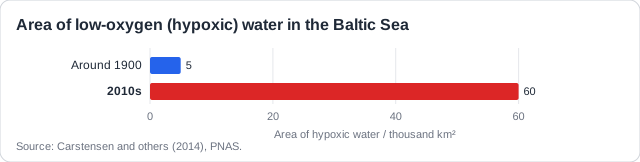
Real example: the Baltic Sea has all four causes. Fresh river water floats on salty water from the North Sea, rivers bring nutrients from farms and cities, and its surface has warmed faster than most seas. Cod eggs that sink into its deep basins now die there.
Get feedback like a real examiner
Submit your answers and get instant feedback — what you did well, what's missing, and exactly what to write to score full marks.
Why does the guide say low-oxygen water is likely to become more frequent? Because each cause is growing, and they make each other worse.
Why dead zones are spreading
- Dead zones are found in over 500 coastal places, and the number keeps rising.
- The ocean has lost about 2% of its oxygen since 1960.
- Four causes add together: warming, stratification, sewage and eutrophication.
- More people means more sewage and more fertiliser for food.
- So hypoxic and anoxic water is likely to become more frequent.
Remember it as: Warmer, more layered, more fed, more flushed: more dead zones.
Warming
- Less oxygen in warm water.
- Stronger, longer layers.
Nutrients
- More fertiliser to feed more people.
- Bigger blooms to decompose.
Sewage
- Growing cities.
- Much of it still untreated.
Reading oxygen data: In a table of monthly oxygen, the lowest values are usually in July or August, when the water is warmest and most layered. Link the low point to decomposition AND to the layers.
How this comes up: Paper 1: a fact file on a lake, river or sea, with 'describe how anoxic conditions develop' [3] (May 2026). Paper 2: 'explain why dead zones are likely to increase' [4], or data on oxygen through the year.
The number of coastal dead zones around the world has risen from about 400 in 2008 to over 500 by 2018.
Explain why hypoxic and anoxic waters are likely to become more frequent in the future.
Model answer plan
See the mark-by-mark plan — for / against / judgement, with marking guidance — in study mode.