Tackling water scarcity at Higher Level: SL learns Singapore; at HL the named country is Israel. At HL, weigh technology against pricing, agreements and fairness, and link the strategies to water stress (4.2.13-4.2.17).
Practise this as you read
- Sort each strategy: supply, demand, or working with others.
- Judge each one: strengths, limits, who pays.
Free preview
This is the free notes preview
You're reading the free notes. Aimnova Pro unlocks the full study experience — and you can try it with your first topic free to keep:
- FlashcardsLock in vocabulary and key terms with spaced repetition.
- Practice questionsAnswer exam-style questions and get instant AI marking.
- Mock exams & past-paper vaultSit full mocks and see exactly how examiners award marks.
- Personalised study planA daily plan built around your exam date and weak areas.
One country, many strategies: Water scarcity can be reduced. A mitigation strategy adds supply, cuts demand, or works with other countries. The best-known examples use all three.
The points to remember
- A mitigation strategy reduces water scarcity or its effects.
- Increase supply: reservoirs, desalination, recycled water, imported water.
- Reduce demand: prices, taxes, rules, efficient devices and efficient farming.
- Work with others: water agreements, shared river management, trading food (virtual water).
- A country uses several strategies together, so no single failure leaves it dry.
Remember it as: Add water, waste less, work with others.
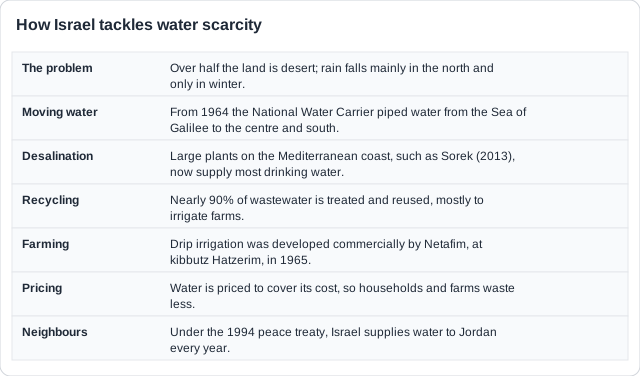
Real example: over half of Israel is desert, and its rain falls mainly in the north and only in winter. Yet it now produces more freshwater than it needs in most years.
Name the country: Questions on this statement want a named country and its named strategies. Learn one country well, with three or four facts and numbers.
Memorize terms 3x faster
Smart flashcards show you cards right before you forget them. Perfect for definitions and key concepts.
Israel increased its supply in three steps: it moved water from the wet north to the dry south, then recycled its wastewater, then turned to desalination.
Adding supply
- Moving water: the National Water Carrier takes water from the wet north to the dry south.
- Desalination on the coast now supplies most of the drinking water.
- Recycling: nearly 90% of wastewater is treated and reused on farms.
- Recycled water on farms leaves freshwater for drinking.
- Desalinated and recycled water are weather-resilient: they do not depend on rain.
Farms use most of Israel's water, so cutting demand starts in the fields.
Cutting demand
- Pricing: households and farms pay what the water costs to supply.
- Drip irrigation on farms: water goes straight to the roots.
- Farms get recycled water instead of freshwater.
- Grow fewer thirsty crops; import some water-intensive food instead.
- Campaigns in droughts asked households to cut use.
Real example: in 1965 the company Netafim, at kibbutz Hatzerim in the Negev desert, began making drip irrigation systems. Drip irrigation is now used on most Israeli farms and sold around the world.
Supply and demand in one answer: Strong answers use both sides: one strategy that adds water and one that cuts use, each with a fact from the named country.
Know your predicted grade
Take timed mock exams and get detailed feedback on every answer. See exactly where you're losing marks.
Water and food cross borders, so countries can tackle scarcity together. Virtual water lets a dry country save its own water by buying water-intensive food from wetter places.
Working with other countries
- Water agreements (treaties) set how much water each country may take or sell.
- Joint management bodies let countries run a shared river together.
- Water markets: users buy and sell the right to use water, so it goes where it is most valued.
- Virtual water trade: importing water-intensive food saves the water needed to grow it.
- Technology sharing: drip irrigation and desalination spread from country to country.
Real example: under their 1994 peace treaty, Israel supplies water to Jordan every year. Israel also sells its desalination and drip-irrigation technology to other dry countries.
Virtual water in an answer: Link it to scarcity: 'importing wheat saves the water that growing it at home would need'.
Questions often ask you to evaluate the strategies: how well do they work, and at what cost?
Strengths and limits
- Strength: several sources, so a drought or a broken agreement does not stop supply.
- Strength: recycling and desalination do not depend on rainfall.
- Limit: desalination uses a lot of energy, often from fossil fuels, and makes salty brine.
- Limit: high costs, so poorer countries cannot copy it easily.
- Limit: imports depend on neighbours; some people dislike drinking recycled water.
Works well because
- Desalination and recycling do not need rain
- Drip irrigation wastes little
- Enough water even in dry years
But
- Desalination burns energy and makes brine
- Costly: hard for poorer countries to copy
- Access is unequal for Palestinians in the West Bank
End with a judgement: An evaluation needs both strengths and limits, then a conclusion: 'Singapore's strategies work well, but they depend on energy and money that many countries do not have.'
Get feedback like a real examiner
Submit your answers and get instant feedback — what you did well, what's missing, and exactly what to write to score full marks.
How this comes up: Paper 2, Section B (c): a [9] essay on how well a named country's strategies work, marked on markbands.
Israel, a country that is over half desert, now produces more freshwater than it needs in most years.
To what extent can technology solve water scarcity in a named country?
Model answer plan
See the mark-by-mark plan — for / against / judgement, with marking guidance — in study mode.