Saving water in food production at Higher Level: The same strategies as SL, with different examples: India's drip subsidies, Dutch greenhouses and Argentina's drought-tolerant wheat. At HL, weigh each strategy's cost and who pays for it.
Practise this as you read
- Compare how much water each strategy saves.
- Weigh strengths against limits for each one.
Free preview
This is the free notes preview
You're reading the free notes. Aimnova Pro unlocks the full study experience — and you can try it with your first topic free to keep:
- FlashcardsLock in vocabulary and key terms with spaced repetition.
- Practice questionsAnswer exam-style questions and get instant AI marking.
- Mock exams & past-paper vaultSit full mocks and see exactly how examiners award marks.
- Personalised study planA daily plan built around your exam date and weak areas.
More crop per drop: Most of the world's water is used to grow food. Saving water in food production systems matters more than any other saving.
The points to remember
- Farming uses about 70% of the freshwater taken from rivers, lakes and aquifers.
- So saving water on farms saves far more than saving it at home.
- The aim: more crop per drop, the same food from less water.
- Five ways: drip irrigation, greenhouses, aquaponics, drought-resistant crops, less meat.
Remember it as: Drip it, roof it, loop it, swap it, eat less meat.
Real example: California grows about 80% of the world's almonds, mostly in the dry Central Valley, and each almond needs about 12 litres of water. In droughts, farms there receive little or no water from the state, so saving water decides whether a farm survives.
Learn what examiners really want
See exactly what to write to score full marks. Our AI shows you model answers and the key phrases examiners look for.
Old-style flood irrigation loses much of its water to evaporation and run-off. Drip irrigation puts the water where the plant needs it.
Watering more wisely
- Drip irrigation: pipes with small holes drip water onto each plant's roots.
- Little water evaporates or runs off, so most of it reaches the crop.
- Water at night or in the cool morning, so less evaporates.
- Mulch and cover crops shade the soil; terracing stops water running off slopes.
- Limits: drip systems cost money to buy and need clean water so the holes do not block.
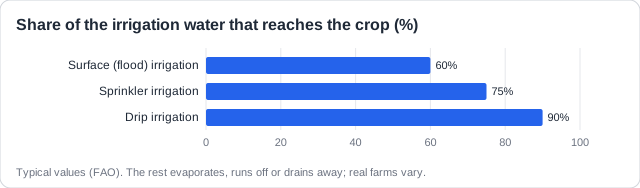
Real example: since 2015 India's 'Per Drop More Crop' scheme has paid part of the cost of drip and sprinkler systems for farmers, because many cannot afford them alone.
Not just 'irrigation': 'Use irrigation' does not answer a question about saving water: irrigation can waste it. Name the method, such as drip irrigation, and say why less water is lost.
A greenhouse is a building of glass or plastic. Its roof can catch rain, and its closed space lets farmers collect water and use it again. Aquaponics goes further: nothing is thrown away.
Greenhouses and aquaponics
- Greenhouses keep the air moist, so plants lose less water than in open fields.
- Rain falling on the roof is harvested into tanks or ponds and used to water the crop.
- Water that drains from the roots is collected, cleaned and recycled.
- Aquaponics: fish waste feeds the plants, and the plants clean the water for the fish.
- The same water goes round again and again; only a little is topped up.
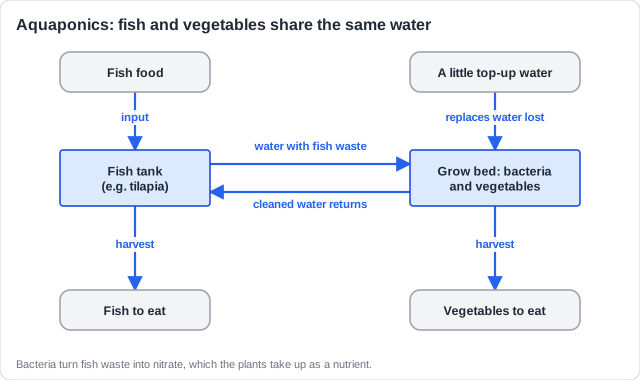
Real example: Dutch greenhouses catch rain on their glass roofs and store it in basins. In closed greenhouses that recycle their drainage water, a kilogram of tomatoes needs about 15 litres, against roughly 200 litres in open fields around the world.
Never wonder what to study next
Get a personalized daily plan based on your exam date, progress, and weak areas. We'll tell you exactly what to review each day.
Some plants need much less water than others. Plant breeders, and sometimes genetic modification, produce drought-resistant crops.
Choosing crops
- Drought-resistant crops grow with less water: farms need less irrigation.
- They raise yields in dry years and let farmers use dry land that grew little before.
- Salt-tolerant crops can use salty water or soils.
- Swap thirsty crops such as cotton or rice for ones that need less, such as oats or millet.
- Limits: seeds can cost more, GM varieties have low genetic diversity, and few kinds exist.
Strengths
- Less irrigation water needed
- Higher yields in dry years
- Dry land can be farmed
Limits
- Seeds can cost more
- GM varieties: low genetic diversity
- Few kinds are available yet
Real example: in 2020 Argentina became the first country to approve a drought-tolerant GM wheat, called HB4, so wheat can be grown with less water in dry years.
Animals eat crops, and those crops need water. So the more meat a country produces, the more water its food system uses. Switching to vegetarian food production saves water.
Less meat, less water
- Animals eat crops that need water, so meat needs far more water than plant food.
- 1 kg of beef needs about 15,400 litres; 1 kg of chicken about 4,300.
- Producing more plant food and less meat means less water for the same people.
- Switching from beef to chicken also saves water, even without going vegetarian.
- Limits: people's culture, taste and income, and farmers' jobs, make change slow.
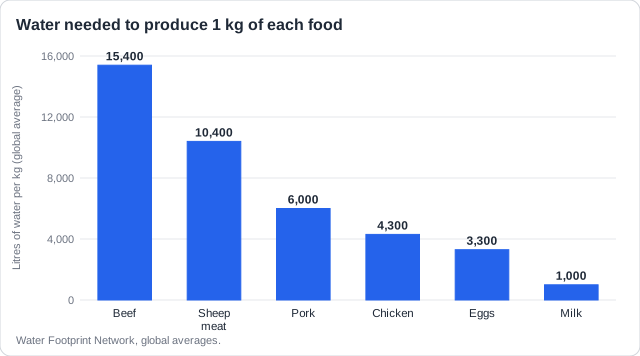
Real example: the Water Footprint Network works out that a 200 g beef steak needs as much water as 47 showers of eight minutes each.
Use the numbers: Quote two figures and compare them: 'beef needs about 15,400 litres per kilogram, nearly four times as much as chicken'.
Stop wasting time on topics you know
Our AI identifies your weak areas and focuses your study time where it matters. No more overstudying easy topics.
How this comes up: Paper 2, Section B (b): evaluate two water conservation strategies in food production [7].
Governments in dry countries are looking for ways to grow more food with less water.
Evaluate drip irrigation and switching to vegetarian food production as strategies to conserve water in food production.
Model answer plan
See the mark-by-mark plan — for / against / judgement, with marking guidance — in study mode.