Freshwater as a planetary boundary at Higher Level: This statement is Higher Level only. It links the planetary boundaries model (1.3) to water: how the freshwater boundary is measured, why it was crossed, and how it could be brought back.
Practise this as you read
- Quote the measured values against the boundary.
- Sort strategies by scale: local, national, global.
Free preview
This is the free notes preview
You're reading the free notes. Aimnova Pro unlocks the full study experience — and you can try it with your first topic free to keep:
- FlashcardsLock in vocabulary and key terms with spaced repetition.
- Practice questionsAnswer exam-style questions and get instant AI marking.
- Mock exams & past-paper vaultSit full mocks and see exactly how examiners award marks.
- Personalised study planA daily plan built around your exam date and weak areas.
A safe limit for the whole planet: Planetary boundaries were set out by scientists at the Stockholm Resilience Centre in 2009. Freshwater change is one of them, and it has been crossed.
The points to remember
- Planetary boundaries mark a safe operating space for humanity in nine Earth systems.
- Freshwater change is one of the nine.
- Rising demand for a limited store of freshwater raises water stress.
- Crossing the boundary risks abrupt and irreversible changes to the water cycle: tipping points.
- The boundary has been crossed: freshwater is outside the safe space.
Remember it as: Inside the boundary is safe; beyond it, the water cycle may tip.
Real example: the Aral Sea in Central Asia was once the fourth-largest lake in the world. From the 1960s its rivers were diverted to irrigate cotton, and it shrank to a small part of its old size. Its fishing industry collapsed and the change has not been reversed: an abrupt and irreversible change to one water system.
Memorize terms 3x faster
Smart flashcards show you cards right before you forget them. Perfect for definitions and key concepts.
Scientists now measure the boundary with two kinds of water. Blue water is what we pump and pipe. Green water feeds farms and forests.
How the boundary is measured
- Blue water: the visible water in rivers, lakes and aquifers.
- Green water: rain held in the soil and used by plants.
- Old measure (2009): blue water used up to about 4,000 km3 a year.
- New measure (2023): the % of land where river flow or soil moisture is outside its natural range.
- Blue water 18.2% of land against a boundary of 10.2%; green water 15.8% against 11.1%.
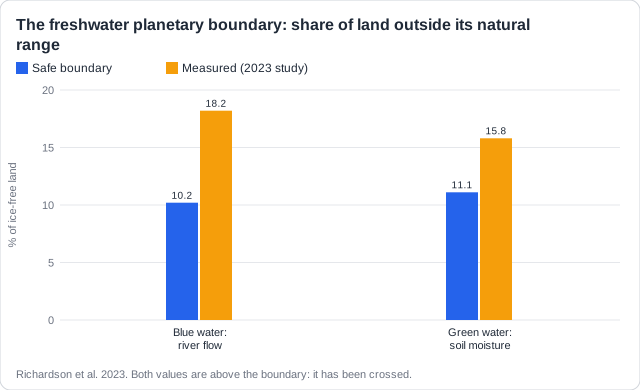
Real example: a 2023 study led by Katherine Richardson found both blue and green water outside the safe space, and crossed since the first half of the 20th century. The Planetary Health Check of 2025 found seven of the nine boundaries crossed, with freshwater still getting worse.
Quality is a different boundary: Polluted water belongs to other boundaries (nutrients, new chemicals). Use pollution in a freshwater answer only if you say it reduces the water available to use.
Demand for freshwater keeps rising while the store stays limited, so more places face water stress.
Why the boundary was crossed
- More people, more irrigation, more meat and industry: demand rises.
- Over-extraction of rivers and aquifers faster than rain refills them.
- Dams and diversions change how rivers flow.
- Deforestation and damaged soils hold less green water and return less rain.
- Climate change makes droughts and floods more extreme.
Real example: scientists warn that if enough of the Amazon rainforest is cleared, it may stop recycling enough rain to keep itself alive and could turn into dry savanna. That would change rainfall far beyond the forest: a tipping point in green water.
Use the Earth-system words: Strong answers use the terms: resilience of the Earth system, tipping point, over-extraction, natural capital, tragedy of the commons, Anthropocene.
Know your predicted grade
Take timed mock exams and get detailed feedback on every answer. See exactly where you're losing marks.
Bringing freshwater use back inside the boundary needs action at every scale, from a household to the United Nations. Each level fixes a different cause.
Bringing it back inside the boundary
- Individuals: save water at home, eat less meat, cut water footprints.
- Farms: drip irrigation, drought-resistant crops, less over-pumping of aquifers.
- Land: protect forests, wetlands and soils, which keep green water in the system.
- Nations: licences, metering, pricing, environmental flows in rivers, impact assessments.
- Global: shared river agreements, UN goal SDG 6 (clean water for all), the UN Water Convention.
- Limits: water is local but the boundary is global; poorer countries need more water to develop.
Why it could work
- Farming uses most water, and drip irrigation saves much of it
- Restored forests and wetlands return green water
- Agreements share rivers fairly
Why it may not
- Demand keeps rising with population
- Climate change keeps pushing the system
- No global body can force countries to act
Real example: Sustainable Development Goal 6 commits every UN member to safe water for all and sustainable water use by 2030, and in 2016 the UN Water Convention on shared rivers was opened to every country in the world.
Global boundary, local water: Water problems are felt locally: saving water in a wet country does not refill an aquifer in a dry one. Say this in a conclusion: global targets only work through local action.
How this comes up: Paper 2, Section B (c): to what extent can mitigation bring freshwater use back within the boundary [9].
The freshwater planetary boundary was crossed in the first half of the 20th century.
To what extent could mitigation strategies be successful in bringing freshwater use back within the planetary boundary?
Model answer plan
See the mark-by-mark plan — for / against / judgement, with marking guidance — in study mode.