Impacts of producing freshwater at Higher Level: This statement is Higher Level only. You learn the environmental costs of making freshwater at a large scale, how each can be reduced, and why none can be removed completely, using desalination in the UAE.
Practise this as you read
- Name each impact and its cause.
- Explain how it is reduced, not removed.
Free preview
This is the free notes preview
You're reading the free notes. Aimnova Pro unlocks the full study experience — and you can try it with your first topic free to keep:
- FlashcardsLock in vocabulary and key terms with spaced repetition.
- Practice questionsAnswer exam-style questions and get instant AI marking.
- Mock exams & past-paper vaultSit full mocks and see exactly how examiners award marks.
- Personalised study planA daily plan built around your exam date and weak areas.
Freshwater is never free: Making freshwater at an industrial scale always leaves something behind: salty brine, fumes, noise or damaged aquifers. Good design can make the harm smaller, but rarely makes it zero.
Brine from desalination
- Brine is the very salty water left over: about 1.5 litres for every litre of freshwater made.
- It is denser than sea water, so it sinks and spreads over the sea bed.
- It can be warm (from thermal plants) and hold chemicals used to clean the plant.
- It lowers oxygen and harms seagrass, coral, fish eggs and larvae.
- Damage to sea life can hurt fishing, fish farming and tourism.
How the harm is reduced: Diffusers spray brine out fast so it mixes into the sea quickly. Discharge it far offshore where currents are strong, not into shallow bays. Dilute it first, or extract salts and minerals from it (brine mining). None of these removes the brine: they reduce the harm.
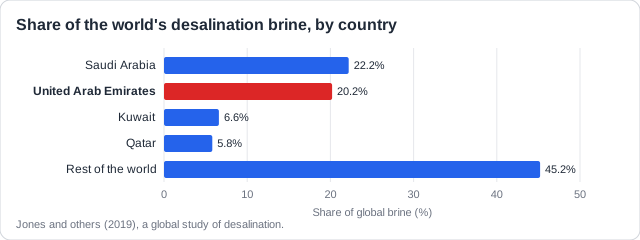
Real example: the United Arab Emirates gets about 42% of its town and city water from desalination, and releases about a fifth of all the world's brine into the Gulf, a shallow, warm, almost enclosed sea where salt builds up.
Feeling unprepared for exams?
Get a clear study plan, practice with real questions, and know exactly where you stand before exam day. No more guessing.
The second big cost of desalination is the energy it needs, and where that energy comes from.
Energy, air pollution and noise
- Desalination uses a lot of energy: pumps push sea water through membranes at high pressure, or heat boils it.
- Most plants are powered by burning fossil fuels, often natural gas, releasing carbon dioxide.
- Burning also causes air pollution: nitrogen oxides and, with oil, sulfur dioxide.
- Pumps, high-pressure equipment and building work make noise that disturbs people and wildlife.
- Intake pipes suck in fish eggs and larvae and trap bigger fish against screens.
How the harm is reduced: Use reverse osmosis instead of boiling: it needs much less energy. Power plants with solar or other renewable energy. Screens and slow intakes protect fish; sound insulation cuts noise.
Real example: many older UAE plants boil sea water using heat from gas-fired power stations next to them. The Taweelah plant in Abu Dhabi, completed in 2023, uses reverse osmosis instead and has over 70 megawatts of solar panels, so it burns far less gas per litre. It still releases brine and still needs power at night.
Pumping groundwater at an industrial scale also has a cost, below ground.
Impacts on aquifers: saline intrusion
- Pumping an aquifer near the coast faster than it refills lowers its water table.
- Sea water then flows in underground: saline intrusion.
- Wells turn salty, and the water is no longer fit for drinking or crops.
- Fix: limit pumping, recharge the aquifer, or switch to other supplies, but recovery takes decades.
Over-pumping
- Farms and towns pump groundwater
- Over 25 times faster than rain refills it
Sea water enters
- The water table falls
- Salty water moves into the aquifer
Result
- About 97% of the groundwater is moderately or highly saline
- It must be desalinated to use
Remember it as: Brine, burning, bangs and briny wells.
Real example: Abu Dhabi's groundwater is mostly fossil water. Its farms pump it so fast that the emirate now has to desalinate some of its own groundwater, adding more brine and burning more fuel.
Memorize terms 3x faster
Smart flashcards show you cards right before you forget them. Perfect for definitions and key concepts.
Dams are industrial freshwater production too: they store water for cities and farms, at a cost.
Impacts of large dams
- A dam traps sediment, so the river below carries less silt and nutrients.
- Without new silt, deltas and coasts erode and farmland gets less fertile.
- The reservoir floods habitat and blocks fish migration.
- Large reservoirs lose water to evaporation and can release methane from rotting plants.
- Fixes: fish passes, planned environmental flows, flushing sediment through, but not all of it.
Real example: Egypt's Aswan High Dam, finished in 1970, stores the Nile in Lake Nasser. The silt that once fertilized the fields every flood now settles in the lake, so farmers use chemical fertilizers and the Nile delta coast is eroding. About 10 billion cubic metres of water evaporates from the lake each year.
How this comes up: Paper 1 (May 2026): discuss the sustainability of desalination from data [4]. Paper 2, Section B: outline the impacts [4]; explain how they can be reduced [7]; to what extent can they be minimized [9].
The United Arab Emirates gets about 42% of its town and city water from desalination plants on the Arabian Gulf.
Explain how the negative environmental impacts of industrial freshwater production can be minimized but not eliminated.
Model answer plan
See the mark-by-mark plan — for / against / judgement, with marking guidance — in study mode.