Industrial-level strategies at Higher Level: This statement is Higher Level only. You learn the big engineering strategies that add water supply, judge them with real examples, and use secondary data to find why a society is short of water.
Practise this as you read
- Name a real example for each strategy.
- Use data to find the causes of water stress.
Free preview
This is the free notes preview
You're reading the free notes. Aimnova Pro unlocks the full study experience — and you can try it with your first topic free to keep:
- FlashcardsLock in vocabulary and key terms with spaced repetition.
- Practice questionsAnswer exam-style questions and get instant AI marking.
- Mock exams & past-paper vaultSit full mocks and see exactly how examiners award marks.
- Personalised study planA daily plan built around your exam date and weak areas.
Big engineering for big shortages: Industrial-level strategies are large projects run by governments or companies. They store water, move it, make new freshwater, or keep it underground.
Storing and moving water
- Dams and reservoirs store river water from wet seasons for dry ones.
- Water transfer moves water by canal or pipeline from a wet region to a dry one.
- Pipelines or tankers (ships, trucks, trains) carry water to places in crisis.
- Estuary storage: a barrage turns the mouth of a river into a freshwater reservoir.
- All are costly and can harm rivers, and transfers can move the water stress somewhere else.
Real example: since December 2014, China's South-North Water Transfer Project has carried water more than 1,000 km by canal from the Danjiangkou Reservoir to Beijing. Over 66 billion cubic metres moved north in its first ten years, but about 330,000 people were moved to enlarge the reservoir.
Estuary storage: Singapore: The Marina Barrage, opened in 2008, closed off the mouth of the Singapore River. Rain from a catchment of about a sixth of the country now fills a freshwater reservoir in the city centre.
Practice with exam-style questions
Answer exam-style questions and get AI feedback that shows you exactly what examiners want to see in a full-marks response.
Where there is no more river water to take, freshwater has to be made.
Making new freshwater
- Desalination removes salt from sea water, usually by reverse osmosis.
- Water treatment plants clean wastewater so it can be used again.
- Solar distillation: the sun evaporates salty water, and the clean vapour condenses.
- Dew and fog harvesting: nets or cool surfaces collect water droplets from the air.
- Cloud seeding (rainmaking): particles such as salt are added to clouds to help raindrops form.
| Strategy | Real example | Limit |
|---|---|---|
| Desalination | Taweelah, Abu Dhabi: about 909,000 cubic metres a day (2023) | Energy and brine |
| Water treatment | Singapore's NEWater: up to about 40% of demand | Costly; people may refuse it |
| Fog harvesting | Dar Si Hmad, Morocco: about 6,300 litres a day for five villages | Only where fog is common |
| Cloud seeding | The UAE fires salt flares into clouds, a few hundred times a year | Extra rain is hard to prove |
| Solar distillation | Small solar stills on homes and islands | Very small amounts |
Remember it as: Store it, move it, make it, bank it underground.
An aquifer can be used as a water bank.
Storing water underground
- Aquifer storage and recovery (ASR): water is pumped into an aquifer when there is plenty and pumped out later.
- Artificial recharge (AR): water soaks into the ground from basins, or is injected down wells, to refill an aquifer.
- Water stored underground loses little to evaporation and takes no land.
- Recharge near a coast holds back sea water from flowing into the aquifer.
Real example: Orange County, California, purifies its wastewater to drinking standard. Since 2023 it has made 130 million gallons a day. Most soaks into the aquifer through recharge basins, and about 30 million gallons a day is pumped down wells near the coast as a barrier that stops sea water seeping into the aquifer.
Feeling unprepared for exams?
Get a clear study plan, practice with real questions, and know exactly where you stand before exam day. No more guessing.
Secondary data can show WHY a society is water stressed, before you pick a strategy.
Using secondary data to find the causes
- Ask a clear question: why did this society run short of water?
- Find secondary data: rainfall records, reservoir levels, population, groundwater, maps of water stress.
- Check each source: who made it, when, and how it was measured.
- Look for patterns: did supply fall, demand rise, or both?
- Conclude with the main causes, and say what the data cannot show.
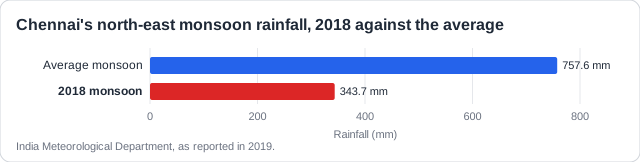
| Data source | What it showed in Chennai, 2019 | Cause it points to |
|---|---|---|
| Rainfall records | 2018 monsoon: 343.7 mm against 757.6 mm on average | Drought |
| Reservoir levels | Four main reservoirs at 0.2% of capacity on 21 June 2019 | Supply ran out |
| Population records | From about 500,000 to over 10 million in a century | Rising demand |
| Water-stress maps | 'Extremely high' stress: over 80% of supply used each year | Demand close to supply |
Real example: in June 2019 the Indian city of Chennai ran out of reservoir water. The data show a failed monsoon on top of decades of growth, so both supply and demand were to blame. From July, trains carried 10 million litres of water a day into the city.
How this comes up: Paper 2, Section B: (a) [4] outline industrial-level strategies; (b) [7] evaluate two strategies in named places; (c) [9] to what extent can they solve water stress. Section A: data on a city's water to find the causes of its stress.
Beijing now gets water from over 1,000 km away, while Orange County in California refills its aquifer with purified wastewater.
Evaluate two industrial-level strategies for addressing water stress.
Model answer plan
See the mark-by-mark plan — for / against / judgement, with marking guidance — in study mode.