Unequal access to water and sanitation at Higher Level: This statement is Higher Level only. You learn the statistics that show who goes without safe water and toilets, how this harms health and development, and one named marginalized group: the Navajo Nation.
Practise this as you read
- Quote statistics as evidence of inequity.
- Link access to health and development.
Free preview
This is the free notes preview
You're reading the free notes. Aimnova Pro unlocks the full study experience — and you can try it with your first topic free to keep:
- FlashcardsLock in vocabulary and key terms with spaced repetition.
- Practice questionsAnswer exam-style questions and get instant AI marking.
- Mock exams & past-paper vaultSit full mocks and see exactly how examiners award marks.
- Personalised study planA daily plan built around your exam date and weak areas.
Who gets safe water is not equal: Access to safe water and toilets is inequitable. The poorest, most rural and most marginalized go without the most.
The evidence of inequity
- 2.1 billion people, 1 in 4, have no safely managed drinking water (2024).
- 3.4 billion have no safely managed sanitation; 354 million still defecate in the open.
- People in the least developed countries are more than twice as likely to lack basic water and sanitation.
- Rural people, Indigenous peoples and low-income groups are left behind most.
- Women and girls fetch the water in most homes without it on site.
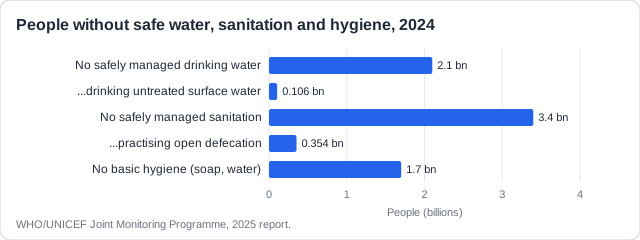
Real example: these figures come from the Joint Monitoring Programme. Safely managed is the highest level it measures.
Get feedback like a real examiner
Submit your answers and get instant feedback — what you did well, what's missing, and exactly what to write to score full marks.
Without safe water and sanitation, disease spreads.
Impacts on human health
- Diarrhoea and cholera spread when faeces reach drinking water.
- Repeated illness stops children absorbing food: undernutrition and stunting.
- No water for handwashing spreads infections, such as COVID-19.
- Worms and other parasites spread through soil polluted by faeces.
- Unsafe water can hold chemicals such as arsenic or uranium that cause long-term illness.
Remember it as: No toilet, dirty water, sick child.
Real example: the World Health Organization estimates that safe water, sanitation and hygiene could have prevented at least 1.4 million deaths in 2019, over a million of them from diarrhoea, and 395,000 of them children under five.
Sustainable development needs healthy people with time to learn and work.
Impacts on sustainable development
- Time: hours spent fetching water cannot be spent in school or work.
- Girls miss school when schools have no private toilets during their periods.
- Illness means lost work and medical costs, keeping families poor.
- The poor often pay more per litre, from trucks or vendors, than people with taps.
- So unequal access blocks Sustainable Development Goal 6: water and sanitation for all by 2030.
Real example: in sub-Saharan Africa and Central and Southern Asia, many women and girls spend more than 30 minutes a day collecting water, according to the 2025 Joint Monitoring Programme report: time taken from school, paid work and rest.
Learn what examiners really want
See exactly what to write to score full marks. Our AI shows you model answers and the key phrases examiners look for.
The Navajo Nation shows that inequity exists even in one of the richest countries in the world.
The evidence for the Navajo Nation
- About 30% of Navajo homes have no running water (the Nation's figure).
- The Dine are 67 times more likely than other Americans to lack running water or a toilet.
- Families haul water by truck, many 5 to 10 miles, two or three times a week.
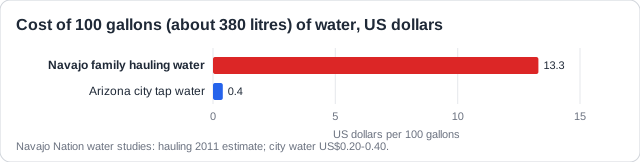
- Hauled water costs about US$13 per 100 gallons; city tap water costs under US$0.50.
- Some wells are polluted by uranium from over 500 old mines.
Why
- Remote, scattered homes
- Water rights never settled
- Little money for pipes
Health
- Hard to wash hands
- Uranium in some wells
- COVID-19 spread fast in 2020
Development
- Hours spent hauling water
- Money spent on fuel and water
- Harder to run businesses
Real example: in May 2020 the Navajo Nation had one of the highest COVID-19 infection rates per person in the USA, in homes where washing hands meant using hauled water. In 2023 the US Supreme Court ruled that the government did not have to secure water for the Nation.
How this comes up: Paper 2, Section A: data on access by group, compare and suggest impacts. Section B: (a) [4] the evidence of inequity for a named group; (b) [7] explain the impacts; (c) [9] to what extent.
About 30% of homes on the Navajo Nation in the USA have no running water.
Explain how inequitable access to drinkable water and sanitation negatively impacts human health and sustainable development, with reference to a named marginalized group.
Model answer plan
See the mark-by-mark plan — for / against / judgement, with marking guidance — in study mode.