Acidification and sediments at Higher Level: This statement is Higher Level only. It follows the carbon the ocean absorbs: first dissolved in the water, making it more acidic, then into living things and down to the seabed, where it can become rock or fossil fuel.
Practise this as you read
- Distinguish the short-term and long-term stores of ocean carbon.
- Explain how seabed sediments can become fossil fuels.
Free preview
This is the free notes preview
You're reading the free notes. Aimnova Pro unlocks the full study experience — and you can try it with your first topic free to keep:
- FlashcardsLock in vocabulary and key terms with spaced repetition.
- Practice questionsAnswer exam-style questions and get instant AI marking.
- Mock exams & past-paper vaultSit full mocks and see exactly how examiners award marks.
- Personalised study planA daily plan built around your exam date and weak areas.
Two kinds of store: Carbon that enters the ocean is stored in two ways. In the short term it stays in the water as dissolved carbon dioxide, which makes the sea more acidic. Over the long term it ends up in living things and then on the seabed.
Short term: dissolved CO₂ and acid
- In the short term, carbon is stored as dissolved carbon dioxide in sea water.
- Dissolved CO₂ reacts with water to make carbonic acid, so the sea becomes more acidic: ocean acidification.
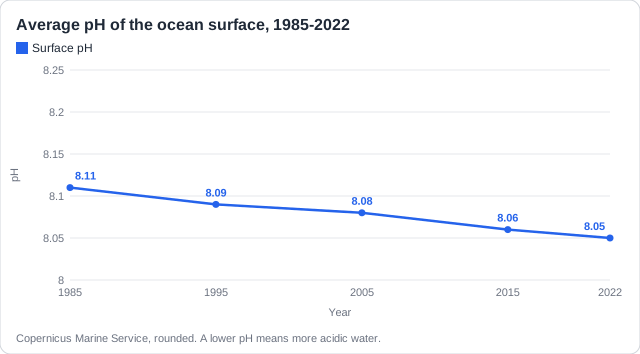
- Surface pH fell from about 8.2 before industry to about 8.05 today.
- The acid uses up carbonate, which corals and shellfish need to build calcium carbonate shells.
- Shells grow more slowly, are thinner, or even dissolve.
Remember it as: Short term: in the water, as acid.
Real example: sea butterflies in the Southern Ocean build thin shells of calcium carbonate. In 2012 scientists from the British Antarctic Survey found shells there with their surface partly dissolved, in water made corrosive by extra carbon dioxide.
Get feedback like a real examiner
Submit your answers and get instant feedback — what you did well, what's missing, and exactly what to write to score full marks.
Some of the dissolved carbon does not stay as acid. Living things take it up and turn it into biomass.
Longer term: into living things
- Over the longer term, carbon is taken into living things as biomass.
- Phytoplankton turn dissolved CO₂ into sugars by photosynthesis; animals eat them.
- Some plankton build shells of calcium carbonate, locking carbon in.
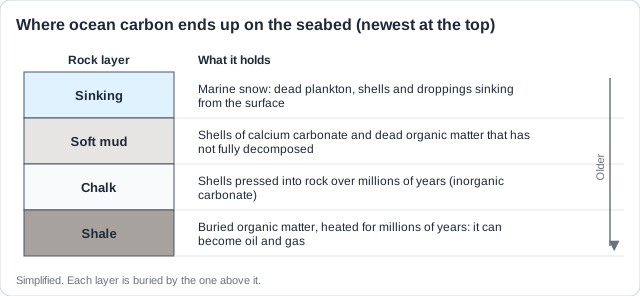
- Dead bodies, shells and droppings sink as marine snow.
- This biomass accumulates on the seabed, layer on layer.
Remember it as: Long term: into plankton, then down to the seabed.
Dissolved
- Carbon dioxide from the air dissolves in the cold surface water of the North Atlantic.
Plankton
- Each spring coccolithophores bloom there; their blooms are so large they turn the sea milky blue in satellite photos.
Food web
- Tiny animals eat the algae; their droppings, packed with chalk plates, sink fast.
Seabed
- Plates, shells and dead matter settle as a grey ooze on the seabed, thousands of metres down.
Real example: a single bloom of coccolithophores can cover more than 100,000 km² of sea, and each cell carries a coat of carbonate plates that will sink when it dies.
On the seabed the remains are slowly buried by more sediment. Over millions of years they turn into rock.
Seabed sediments and fossil fuels
- Seabed sediments hold inorganic carbonates: shells that become chalk and limestone.
- They also hold organic matter that is not fully decomposed, because there is little oxygen in the mud.
- Buried deeper, the sediments are squeezed and heated for millions of years.
- The organic matter can become fossil fuels: oil and natural gas.
- So this carbon is stored for millions of years, until people burn it.
Remember it as: Shells become chalk; buried plankton becomes oil.
Real example: the White Cliffs of Dover in England are chalk, laid down on a sea floor 70 to 100 million years ago. The oil and gas under the North Sea formed from plankton buried in sea mud about 150 million years ago.
Learn what examiners really want
See exactly what to write to score full marks. Our AI shows you model answers and the key phrases examiners look for.
How this comes up: Paper 2: a Section B part (a) [4] or (b) [7] on how the ocean stores carbon, or a Section A question on a pH graph or a drawing of seabed layers.
The ocean has absorbed about a quarter of the carbon dioxide released by people since 1850.
Distinguish between how this carbon is stored in the ocean in the short term and in the long term.
Model answer plan
See the mark-by-mark plan — for / against / judgement, with marking guidance — in study mode.