The ocean carbon sink at Higher Level: This statement is Higher Level only. It shows how the ocean takes carbon dioxide out of the air and stores it, how this has slowed the rise in carbon dioxide, and why the sink could weaken.
Practise this as you read
- Outline the two ways carbon reaches the deep ocean.
- Explain why a saturation point may be reached.
Free preview
This is the free notes preview
You're reading the free notes. Aimnova Pro unlocks the full study experience — and you can try it with your first topic free to keep:
- FlashcardsLock in vocabulary and key terms with spaced repetition.
- Practice questionsAnswer exam-style questions and get instant AI marking.
- Mock exams & past-paper vaultSit full mocks and see exactly how examiners award marks.
- Personalised study planA daily plan built around your exam date and weak areas.
The ocean soaks up carbon: The ocean is the largest carbon sink that people did not build. It takes carbon dioxide out of the air and carries it down to the deep sea, where it stays for hundreds of years.
The points to remember
- A carbon sink takes in more carbon than it gives out.
- Carbon dioxide dissolves in sea water where the ocean meets the air.
- Cold water dissolves more CO₂ than warm water.
- In the far North Atlantic and the Southern Ocean, cold, dense water sinks, carrying the carbon down.
- Phytoplankton take in CO₂ by photosynthesis; their dead remains sink to the deep.
- Carbon in the deep ocean stays there for centuries: it is sequestered (stored away).
Remember it as: Dissolve it, sink it, store it.
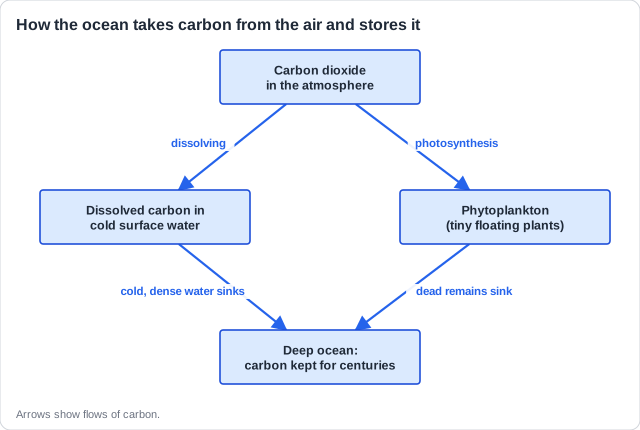
Real example: the Southern Ocean around Antarctica is cold, stormy and well mixed. It takes up about 40% of the human-made carbon dioxide the whole ocean absorbs, then cold water sinks there and carries it to the deep sea.
Learn what examiners really want
See exactly what to write to score full marks. Our AI shows you model answers and the key phrases examiners look for.
Since the Industrial Revolution people have burned coal, oil and gas, adding carbon dioxide to the air. Not all of it has stayed there.
A brake on rising carbon dioxide
- Burning fossil fuels adds CO₂ to the air.
- The ocean takes up about a quarter of the CO₂ people release each year.
- So it has moderated (slowed) the rise of CO₂ in the air, and so global warming.
- The ocean holds about 50 times as much carbon as the atmosphere.
- As CO₂ in the air rose, the ocean took up more each decade: 1.1 to 2.8 billion tonnes of carbon a year.
Remember it as: Half stays up, a quarter to the sea, a quarter to the land.
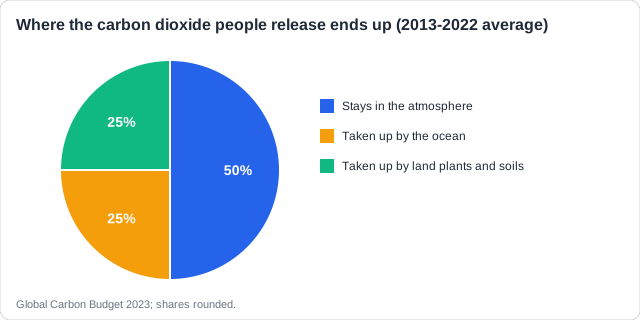
Real example: at Mauna Loa in Hawaii, carbon dioxide in the air has risen from about 315 ppm in 1958 to about 421 ppm in 2023. Without the ocean and land sinks it would be rising about twice as fast.
The ocean cannot soak up carbon dioxide for ever. Scientists warn it may reach a saturation point, and the warming we cause makes this worse.
Why the sink may weaken
- The more CO₂ the surface water holds, the less more it can take: it nears a saturation point.
- Fossil fuels warm the ocean, and warmer water holds less CO₂; it may even release some.
- Warming makes the layers mix less, so less carbon is carried down and fewer nutrients come up.
- Dissolved CO₂ makes the sea more acidic, which can harm phytoplankton and their uptake.
- Warmer water might speed up photosynthesis and raise uptake a little: the effects are uncertain.
- A weaker sink leaves more CO₂ in the air: more warming, a positive feedback.
Remember it as: A warm fizzy drink goes flat: warm water lets its gas go.
Takes up less
- Surface water nearer saturation.
- Warmer water holds less gas.
- Less mixing carries less carbon down.
- Acid water harms phytoplankton.
Might take up more
- More CO₂ in the air pushes more into the sea.
- Warmer water may speed up photosynthesis in some places.
Real example: a can of cola opened warm fizzes over and goes flat quickly; a cold one keeps its gas. The ocean behaves the same way: as it warms, each litre can hold less carbon dioxide.
Never wonder what to study next
Get a personalized daily plan based on your exam date, progress, and weak areas. We'll tell you exactly what to review each day.
How this comes up: Paper 2: a Section B part (a) [4] on how the oceans act as a sink, a part (b) [7] on why the sink may weaken, or a Section A data question on a graph of carbon uptake.
Between 2013 and 2022 the ocean took up about a quarter of the carbon dioxide released by burning fossil fuels.
Outline how the oceans act as a carbon sink.
Model answer plan
See the mark-by-mark plan — for / against / judgement, with marking guidance — in study mode.