aimnova.
DashboardMy LearningPaper MasteryStudy Plan

Aimnova site navigation

Stay in the loop

Get the latest study resources and updates

New features, study tips and exam insights — straight to your inbox.

IB Diploma

  • IB Past Papers
  • IB Study Notes
  • IB Question Bank
  • IB Mock Exams
  • IB Revision

IB Subjects

  • IB Math AA
  • IB Math AI
  • IB Economics
  • IB Business Management
  • IB Physics
  • IB Biology
  • View all IB subjects→

IB Past Papers

  • IB Math AA HL Past Papers
  • IB Math AA SL Past Papers
  • IB Math AI HL Past Papers
  • IB Math AI SL Past Papers
  • IB Economics HL Past Papers
  • IB Economics SL Past Papers
  • IB ESS Past Papers
  • View all past papers→

Study Resources

  • Study Notes
  • Question Bank
  • Mock Exams
  • Flashcards
  • Revision Guide
  • Exam Skills
  • Command Terms
  • Grade Calculator
  • Exam Timetable 2026

Aimnova

  • Features
  • Pricing
  • For Teachers
  • For Schools
  • For Parents
  • About Us
  • Blog
  • Contact
aimnova.

AI-powered study platform for smarter revision, past-paper analysis and examiner-style feedback.

TermsPrivacyCookies·© 2026 Aimnova. All rights reserved.4d879c2

Aimnova is not affiliated with or endorsed by the International Baccalaureate Organization (IB).

NotesESS HLTopic 4.1Water temperature and depth
Back to ESS HL Topics
4.1.105 min read

Water temperature and depth (ESS HL)

IB Environmental Systems and Societies • Unit 4

Smart study tools

Turn reading into results

Move beyond passive notes. Answer exam-style questions, get AI feedback, and build the skills that earn top marks.

Get Started Free

Contents

  • Temperature and depth at Higher Level
  • Warm above, cold below
  • Layers that do not mix
  • Densest at 4 °C: lakes freeze from the top
  • Exam-style question
Temperature and depth at Higher Level: This statement is Higher Level only. It explains why water is warm above and cold below, why the layers stay apart, and why lakes freeze from the top down.

Practise this as you read

  • Describe a temperature-depth graph with numbers.
  • Explain why ice forms on top and life survives below.

Free preview

This is the free notes preview

You're reading the free notes. Aimnova Pro unlocks the full study experience — and you can try it with your first topic free to keep:

  • FlashcardsLock in vocabulary and key terms with spaced repetition.
  • Practice questionsAnswer exam-style questions and get instant AI marking.
  • Mock exams & past-paper vaultSit full mocks and see exactly how examiners award marks.
  • Personalised study planA daily plan built around your exam date and weak areas.
Start Studying Free Full access to Aimnova Pro · cancel anytime
Warm on top, cold below: Sunlight heats only the top of a lake or sea. Warm water is lighter than cold water, so it stays on top, and the water gets colder the deeper you go.

The points to remember

  • The sun warms only the surface, so warm water sits above and cold water below.
  • Warm water is less dense, so it floats on the colder, denser water.
  • Near the top, wind keeps the water mixed, so its temperature stays steady.
  • Below that, temperature falls quickly with depth, then more slowly.
  • Deep ocean water is cold everywhere: about 2 to 5 °C, even under the tropics.
Remember it as: Sun on top, cold at the bottom.
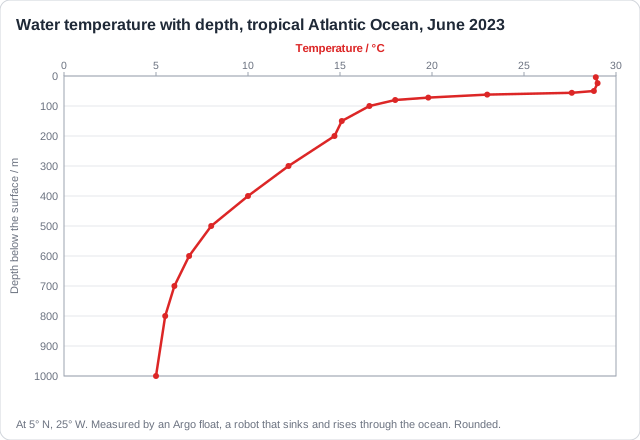
Depth graph from an Argo float in the tropical Atlantic, June 2023: about 29 °C from the surface to 50 m, falling fast to about 17 °C at 100 m, then slowly to 15 °C at 200 m, 8 °C at 500 m and 5 °C at 1000 m
Read it from the top down: steady, then a fast fall, then a slow fall.

Real example: in June 2023 an Argo float in the Atlantic near the equator measured 29 °C from the surface to 50 m. By 100 m the water was about 17 °C, and at 1000 m only 5 °C.

Stop wasting time on topics you know

Our AI identifies your weak areas and focuses your study time where it matters. No more overstudying easy topics.

Try Smart Study FreeYour first topic is free to keep • No credit card required

Because warm water floats on cold water, the layers resist mixing. Scientists call a body of water with layers like this stratified.

Layers that do not mix

  • Water of different density does not mix easily: the light layer floats on the heavy one.
  • So the warm and cold layers stay apart for long periods: persistent stratification.
  • Wind can only stir the top layer; it cannot push light water down into heavy water.
  • Little mixing means nutrients stay trapped in the deep water and oxygen from the air does not reach it.
  • So different organisms live at different depths.
Remember it as: Light on heavy: the layers stay put.

Top layer

  • Warm and light.
  • Stirred by wind.
  • Gets oxygen from the air.

Deep layer

  • Cold and dense.
  • Hardly moves.
  • Cut off from the air.

Real example: Lake Tanganyika in Africa is 1,470 m deep and warm all year. Its layers almost never mix, so below about 150 m the water has had no oxygen for a very long time and almost nothing lives there.

Water has one strange property: it is heaviest not when it is coldest, but at 4 °C. This decides how lakes freeze in winter.

Densest at 4 °C

  • Fresh water is densest at 4 °C.
  • In autumn, surface water cooled to 4 °C sinks, until the whole lake is at 4 °C.
  • Water cooled below 4 °C is lighter, so it stays on top.
  • So a lake freezes from the surface downwards, at 0 °C.
  • Ice floats (it is less dense than water) and insulates the water below.
  • Fish and other life survive the winter in the 4 °C water at the bottom.
Remember it as: 4 °C sinks, colder floats, ice on top.
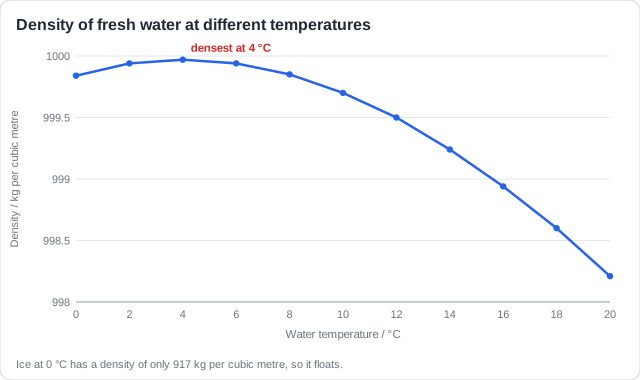
Line graph of fresh water density: it rises from 999.84 kg per cubic metre at 0 °C to a peak of 999.97 at 4 °C, then falls to 998.21 at 20 °C; ice is only 917
The peak at 4 °C is the key point.

So in winter the layers turn upside down: the coldest water lies at the top, just under the ice, and the 4 °C water lies at the bottom.
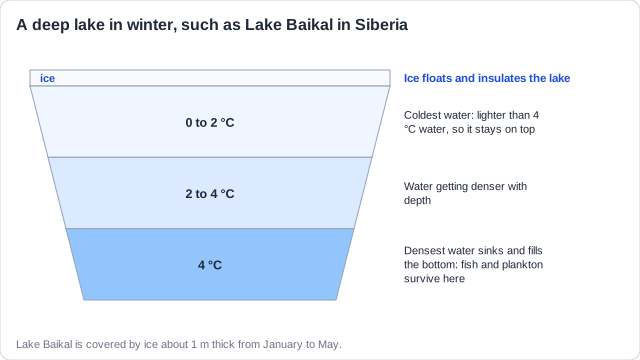
Cross-section of a lake in winter: floating ice on top, water at 0 to 2 °C under the ice, then 2 to 4 °C, and the densest 4 °C water filling the bottom, where fish and plankton survive
Winter layers: the coldest water is at the top, just under the ice.

Real example: Lake Baikal in Siberia freezes over with ice about 1 m thick from January to May. Underneath, omul and Baikal seals live through the winter; the seals keep breathing holes open in the ice.

See how examiners mark answers

Answer exam-style questions with model answers. Learn exactly what earns marks and what doesn't.

Try Exam Vault FreeYour first topic is free to keep • No credit card required
How this comes up: Paper 2, Section A: a depth graph with 'Describe the variation in temperature' [2], or a short question on why lakes freeze from the top.
Depth graph from an Argo float in the tropical Atlantic, June 2023: about 29 °C from the surface to 50 m, falling fast to about 17 °C at 100 m, then slowly to 15 °C at 200 m, 8 °C at 500 m and 5 °C at 1000 m
The same float as in the first section.
IB-style questionDescribe[2 marks]

The figure above shows water temperature measured at different depths by an Argo float in the tropical Atlantic Ocean in June 2023.

Describe the variation in temperature from 0 to 1000 m depth shown on the graph.

Model answer plan

See the mark-by-mark plan — for / against / judgement, with marking guidance — in study mode.

Claim your free topic

IB Exam Questions on Water temperature and depth

Practice with IB-style questions filtered to Topic 4.1.10. Get instant AI feedback on every answer.

Practice Topic 4.1.10 QuestionsBrowse All ESS HL Topics

How Water temperature and depth Appears in IB Exams

Examiners use specific command terms when asking about this topic. Here's what to expect:

Define

Give the precise meaning of key terms related to Water temperature and depth.

AO1
Describe

Give a detailed account of processes or features in Water temperature and depth.

AO2
Explain

Give reasons WHY — cause and effect within Water temperature and depth.

AO3
Evaluate

Weigh strengths AND limitations of approaches in Water temperature and depth.

AO3
Discuss

Present arguments FOR and AGAINST with a balanced conclusion.

AO3

See the full IB Command Terms guide →

Related ESS HL Topics

Continue learning with these related topics from the same unit:

4.1.1What drives the water cycle
4.1.2The water cycle as a system
4.1.3Where the world's water is stored
4.1.4Flows in the water cycle
View all ESS HL topics

Practice with flashcards

Spaced repetition flashcards for Water temperature and depth

Improve your exam technique

Command terms, paper structure, and mark-scheme tips for ESS HL

Previous
4.1.9Ocean carbon: acidification and sediments
Next
Stratification and the thermocline4.1.11

5 practice questions on Water temperature and depth

Students who practiced this topic on Aimnova scored 82% on average. Try free practice questions and get instant AI feedback.

Try 3 Free QuestionsView All ESS HL Topics