Properties of water at Higher Level: This statement is Higher Level only. It shows how water's unusual physical and chemical properties, all coming from its polar molecule, support and sustain life.
Practise this as you read
- Link each property to what it does for living things.
- Explain why water heats slowly and why ice floats.
Free preview
This is the free notes preview
You're reading the free notes. Aimnova Pro unlocks the full study experience — and you can try it with your first topic free to keep:
- FlashcardsLock in vocabulary and key terms with spaced repetition.
- Practice questionsAnswer exam-style questions and get instant AI marking.
- Mock exams & past-paper vaultSit full mocks and see exactly how examiners award marks.
- Personalised study planA daily plan built around your exam date and weak areas.
One molecule, many jobs: Almost everything special about water comes from one fact: the water molecule is polar. Its ends attract the ends of other water molecules.
The points to remember
- Water is polar: the oxygen end is slightly negative, the hydrogen ends slightly positive.
- So water molecules attract each other with hydrogen bonds.
- Cohesion = water sticking to water: surface tension lets insects stand on a pond.
- Cohesion also holds a column of water together as it is pulled up a plant's xylem.
- Adhesion = water sticking to other things: it climbs narrow tubes and soil pores (capillary action).
- Surface tension and water pressure also keep cells firm and their shape.
Remember it as: Cohesion: water to water. Adhesion: water to anything else.
Cohesion
- Water molecules attract each other.
- Surface tension: a pond skater stands on the water.
- A water column in a tree does not break.
Adhesion
- Water is attracted to other surfaces.
- Water climbs the walls of narrow xylem tubes.
- Water clings to soil grains, so soil holds water for roots.
Real example: the coast redwoods of California are the tallest trees on Earth; the tallest, Hyperion, is about 116 m. Water evaporating from the leaves pulls an unbroken column up the xylem: cohesion holds the column together and adhesion holds it to the tube walls.
Stop wasting time on topics you know
Our AI identifies your weak areas and focuses your study time where it matters. No more overstudying easy topics.
Because water is polar, salts and many other substances dissolve in it. And because water is clear, light passes through it.
Solvent and clear: the points to remember
- Water is a solvent: many substances dissolve in it, because its molecules are polar.
- Nutrients dissolve in soil water, so roots can take them up.
- Blood and sap transport dissolved substances round a body or a plant.
- Water is the medium for the chemical reactions of life and most of a cell's mass.
- Water is transparent: light reaches water plants, so they photosynthesise down to about 200 m in clear sea.
- Animals can see through it to hunt, find a mate and avoid predators.
- Cloudy water (high turbidity) blocks light, so less photosynthesis happens deeper down.
Remember it as: Water carries what life needs and lets the light in.
Solvent
- Nitrate and phosphate in soil water reach roots.
- Blood carries glucose and salts.
Transparent
- Seagrass and kelp photosynthesise underwater.
- A heron sees the fish it hunts.
Turbid
- Mud and algae cloud the water.
- Less light, so plants grow less deep.
Real example: in 1968 scientists at Lake Tahoe, USA, could see a white disc 31 m below the surface. By 2022 it vanished at about 22 m, because fine soil from roads and building sites, and more algae, made the water turbid.
Water takes a lot of energy to warm up and gives it out slowly as it cools. This is its high specific heat capacity.
Heat: the points to remember
- Water has a high specific heat capacity: it takes a lot of energy to warm it up.
- The reason: hydrogen bonds must be broken first, so water heats and cools slowly.
- So lakes and seas are stable habitats: their temperature swings little.
- Bodies, mostly water, keep a steady temperature, so enzymes keep working.
- Oceans store heat and moderate the climate of coasts; currents carry that heat around the world.
- Latent heat: evaporating water takes heat away, so sweating, panting and transpiration cool living things.
Remember it as: Slow to warm, slow to cool: a steady home for life.
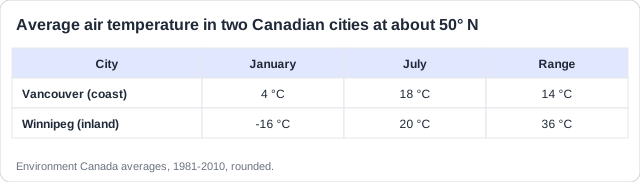
Real example: when you sweat, the water takes latent heat from your skin as it evaporates: about 2,400 kJ for every litre. That is why sweating, a dog's panting and a tree's transpiration all cool.
See how examiners mark answers
Answer exam-style questions with model answers. Learn exactly what earns marks and what doesn't.
Most liquids get denser as they freeze. Water does not: ice is lighter than the water it floats on. Water's ability to hold gases also depends on its temperature and pressure.
Density and gases: the points to remember
- Ice is less dense than liquid water, so it floats.
- Floating ice insulates the water below, so lakes do not freeze solid and fish survive winter.
- Sea ice is a habitat: polar bears hunt seals from it.
- Water's density changes with temperature and salt, which drives layering and ocean currents.
- Oxygen and carbon dioxide dissolve in water: fish breathe the oxygen; water plants use the CO₂.
- Cold water holds more gas than warm water; higher pressure dissolves more gas too.
- The oceans remove CO₂ from the air by dissolving it, which slows global warming.
Remember it as: Ice floats, cold water breathes.
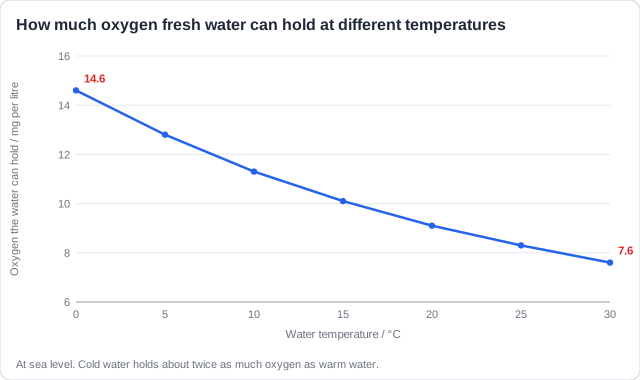
Real example: brown trout need streams that stay cool, because warm water cannot hold enough oxygen for them. And in the Arctic, polar bears hunt seals from floating sea ice; without ice that floats, there would be no platform to hunt from.
How this comes up: Paper 2, Section B: a part (a) [4] on four properties, a part (b) [7] explaining how the properties support life, or a short [2] on one property such as specific heat capacity.
Lake Malawi in East Africa holds more kinds of fish than any other lake on Earth, about 1,000 species, and is up to 700 m deep.
With reference to four properties of water, describe how they support and sustain life in the lake.
Model answer plan
See the mark-by-mark plan — for / against / judgement, with marking guidance — in study mode.