Upwellings at Higher Level: This statement is Higher Level only. It explains how wind drives upwelling, why upwelling makes seas so productive, how El Niño interrupts it, and how lakes turn over with the seasons.
Practise this as you read
- Explain why upwelling raises productivity, naming the nutrients.
- Outline how El Niño affects upwelling and fish catches.
Free preview
This is the free notes preview
You're reading the free notes. Aimnova Pro unlocks the full study experience — and you can try it with your first topic free to keep:
- FlashcardsLock in vocabulary and key terms with spaced repetition.
- Practice questionsAnswer exam-style questions and get instant AI marking.
- Mock exams & past-paper vaultSit full mocks and see exactly how examiners award marks.
- Personalised study planA daily plan built around your exam date and weak areas.
Deep water comes up: When wind pushes the surface water away from a coast, deep water rises to fill the gap. This is upwelling, and it changes the life of the whole sea above it.
The points to remember
- Upwelling = a mass, vertical movement of cold, nutrient-rich water from the depths to the surface.
- It starts with wind: the wind pushes surface water away from a coast.
- Deep water rises to replace the water that was blown away.
- Downwelling is the opposite: surface water piles up and sinks.
- Upwelling happens in oceans and in freshwater lakes.
Remember it as: Wind pushes the top away; the deep comes up.
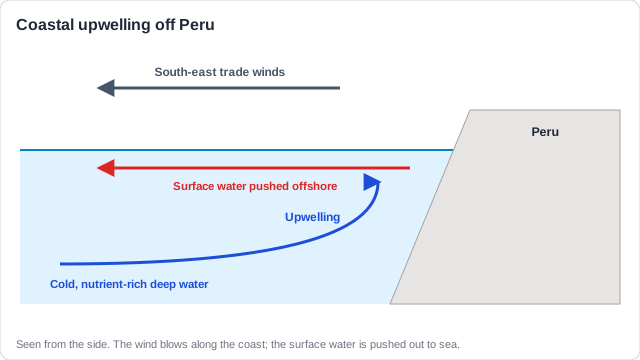
Real example: off Peru, the south-east trade winds blow along the coast and push surface water out to sea. Cold water rises in its place, so the sea off Lima is cold even though the city is in the tropics.
See how examiners mark answers
Answer exam-style questions with model answers. Learn exactly what earns marks and what doesn't.
Upwelling matters because of what the deep water carries. Nutrients build up in deep water, where dead matter decomposes, but there is no light for plants to use them. Upwelling brings them into the light.
Why upwelling raises productivity
- Deep water is rich in nutrients (nitrate, phosphate), released by decomposition.
- Upwelling brings these nutrients into the sunlit surface water.
- Nutrients are often the limiting factor, so phytoplankton and seaweed grow fast: a bloom.
- More producers feed more zooplankton, then fish, seabirds and sea lions: secondary productivity rises.
- The food web becomes more complex, so productivity rises further.
- Upwelling zones cover about 1% of the ocean but give about a fifth of the world's fish catch.
Remember it as: Nutrients up, plankton bloom, fish follow.
Real example: Peru's anchoveta fishery is the largest single-species fishery in the world. The upwelling also feeds millions of seabirds; their droppings were once dug up and sold as fertiliser.
Watch the reason: An answer that says productivity rises because of 'more sunlight' or 'more photosynthesis', with no mention of nutrients, scores nothing. The extra growth comes from the nutrients the deep water brings up.
Off Peru, upwelling weakens every few years. This is linked to a swing in the winds and sea temperatures of the Pacific called ENSO.
El Niño and upwelling
- Normally the trade winds push warm surface water west, away from Peru, so cold water upwells there.
- In an El Niño year the trade winds weaken, and warm water spreads back east to Peru.
- Warm water now covers the coast, so upwelling brings up warm, nutrient-poor water.
- Phytoplankton decline, then the anchoveta, then the seabirds and the fishing industry.
- In a La Niña year the winds are stronger, upwelling is stronger and fishing is good.
- El Niño and La Niña are two phases of one cycle: ENSO (El Niño-Southern Oscillation).
Remember it as: El Niño: weak winds, warm water, no upwelling, no fish.
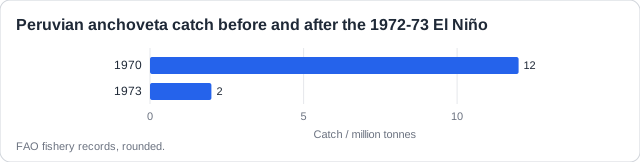
Real example: during the 1972-73 El Niño, warm water covered the coast of Peru. The upwelling brought up little nutrient, the anchoveta failed, and the catch fell from about 12 million tonnes in 1970 to about 2 million in 1973.
Study smarter, not longer
Most students waste 40% of study time on topics they already know. Our AI tracks your progress and optimizes every minute.
Lakes have upwelling too, but it follows the seasons. In a deep lake in a cool climate, the layers form and break up twice a year.
Upwelling in lakes: turnover
- In summer a deep temperate lake is stratified: warm on top, cold below, no mixing.
- In autumn the surface cools to 4 °C and sinks: the whole lake mixes (turnover).
- Turnover lifts nutrients from the bottom to the surface and carries oxygen down.
- In winter ice covers the lake, with 4 °C water at the bottom.
- In spring the ice melts, the surface warms to 4 °C and the lake mixes again.
- So lakes have seasonal cycles of upwelling, each followed by a burst of growth.
Remember it as: Summer layers, autumn mix, winter ice, spring mix.
Summer
Lake Mendota in Wisconsin, USA, is warm on top and cold below; its bottom water runs low in oxygen.
Autumn
The surface cools, sinks and the lake mixes: nutrients come up and oxygen goes down.
Winter
Ice covers the lake from about December; 4 °C water lies at the bottom.
Spring
The ice melts, the lake mixes again and the nutrients feed a spring bloom of algae.
Real example: Lake Mendota is one of the most studied lakes in the world. Scientists have recorded its ice and its mixing for over 150 years, and each spring turnover is followed by a bloom of algae.
How this comes up: Paper 2: a drawing of an upwelling with 'explain why productivity increases' [2], a one-mark 'outline' on a depth graph, or a Section B part on El Niño and fish catches.
The figure above shows the coastal waters off Peru.
Explain why the phenomenon shown in the figure leads to an increase in the rates of productivity in the coastal waters.
Model answer plan
See the mark-by-mark plan — for / against / judgement, with marking guidance — in study mode.