Thermohaline circulation at Higher Level: This statement is Higher Level only. It explains how differences in temperature and salt drive a slow, worldwide ocean circulation, how it begins in the North Atlantic, and how it shapes climate.
Practise this as you read
- Outline the North Atlantic conveyor belt step by step.
- Draw the global conveyor belt on a map.
Free preview
This is the free notes preview
You're reading the free notes. Aimnova Pro unlocks the full study experience — and you can try it with your first topic free to keep:
- FlashcardsLock in vocabulary and key terms with spaced repetition.
- Practice questionsAnswer exam-style questions and get instant AI marking.
- Mock exams & past-paper vaultSit full mocks and see exactly how examiners award marks.
- Personalised study planA daily plan built around your exam date and weak areas.
Heat and salt move the ocean: Deep below the waves, the whole ocean is slowly on the move. What drives it is density: water that is cold and salty is heavy and sinks, and other water flows in to take its place. This is the thermohaline circulation.
The points to remember
- Thermohaline: 'thermo' means heat, 'haline' means salt.
- Sea water's density depends on its temperature and its salinity.
- Cold water is denser than warm water; salty water is denser than fresh water.
- So cold, salty water is the densest of all: it sinks.
- These density differences drive a slow, worldwide circulation of the ocean: the thermohaline circulation.
Remember it as: Cold and salty sinks; warm or fresh floats.
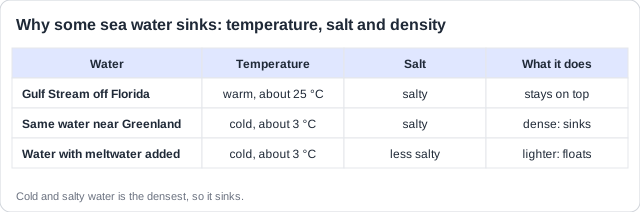
Real example: the Gulf Stream leaves the coast of Florida at about 25 °C. It is too warm to sink there, even though it is salty. Only when it reaches the cold seas near Greenland does it become dense enough to sink.
Stop wasting time on topics you know
Our AI identifies your weak areas and focuses your study time where it matters. No more overstudying easy topics.
The North Atlantic is the engine of the whole system. Here warm water from the tropics turns into cold, salty, dense water and sinks to the bottom of the ocean.
The North Atlantic conveyor belt
- Wind-driven currents such as the Gulf Stream carry warm surface water from the equator north.
- On the way the water loses fresh water by evaporation, so it becomes saltier.
- Near Greenland and Norway it cools: now it is cold and salty, so it is very dense.
- It sinks and flows back south along the ocean floor as a deep current towards the equator.
- This loop is the North Atlantic conveyor belt.
- Rivers and melting ice caps add fresh, light water to the North Atlantic, which works against the sinking.
Remember it as: Warm north on top, evaporate, cool, sink, flow south below.
Florida
- Warm water leaves the Caribbean in the Gulf Stream, pushed along by the winds.
Mid-Atlantic
- Crossing the Atlantic, it loses water by evaporation, so its salt is left behind: it gets saltier.
Greenland
- In the Labrador and Greenland Seas, winter winds chill it to about 3 °C. Cold and salty, it sinks.
Deep south
- It flows south along the ocean floor as North Atlantic Deep Water, back towards the equator.
Real example: each winter, sinking in the Labrador Sea and the Greenland Sea sends millions of cubic metres of water a second down to depths of 2,000 m or more.
The North Atlantic loop is one part of a bigger loop that joins every ocean. Scientists call it the ocean conveyor belt.
The global conveyor belt
- The North Atlantic is where the conveyor belt begins: the water sinks there.
- The deep water flows south down the Atlantic and east round Antarctica.
- It spreads north into the Indian and Pacific Oceans, warms slowly and rises (upwells).
- It returns as warm surface currents, through the Indian Ocean and round Africa, back to the Atlantic.
- One full loop takes about 1,000 years.
- It carries oxygen and nutrients to the deep ocean, and carbon down from the surface.
Remember it as: Sink in the North Atlantic, rise in the Pacific, 1,000 years round.
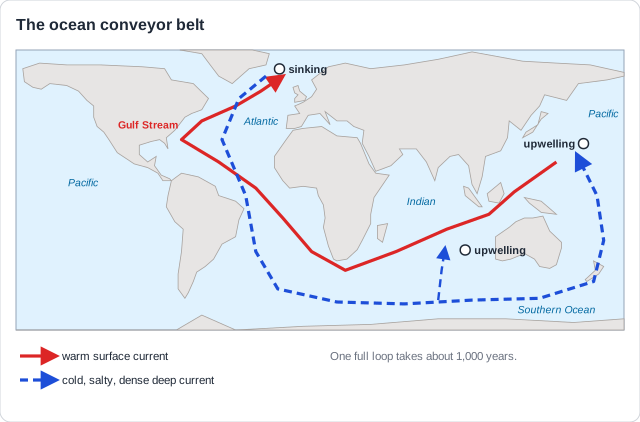
Sink
Mark sinking in the North Atlantic, between Greenland and Norway.
Deep flow
Draw a dashed arrow south down the Atlantic, then east round Antarctica, then north into the Indian and Pacific Oceans.
Rise
Mark upwelling in the North Pacific and the Indian Ocean.
Surface return
Draw a solid arrow back west through Indonesia, round southern Africa and north up the Atlantic as the Gulf Stream.
See how examiners mark answers
Answer exam-style questions with model answers. Learn exactly what earns marks and what doesn't.
The conveyor belt carries heat as well as water. Changing it changes the climate.
Heat, climate, and a slowing conveyor
- The conveyor belt carries heat from the tropics towards the poles: it distributes heat around the world.
- So it affects climate: north-west Europe is milder than places at the same latitude elsewhere.
- Melting ice and more rain make the North Atlantic fresher, so less water sinks.
- The Atlantic part has weakened by about 15% since the 1950s.
- A big slowdown could cool north-west Europe, shift rain belts and reduce the ocean's carbon uptake.
- A shutdown would be a tipping point: hard to reverse.
Remember it as: Fresher North Atlantic, less sinking, slower belt, colder Europe.
Strong conveyor
- Heat carried north to Europe.
- Oxygen and nutrients sent deep.
- Carbon taken down.
Weakened conveyor
- Less heat to north-west Europe.
- Deep water short of oxygen.
- Less carbon taken down.
Real example: the coast of Norway stays free of sea ice in winter as far north as Hammerfest, at 70° N, while the northern Baltic Sea at about 65° N freezes most winters. South of Greenland, a patch of ocean has cooled while the rest of the world warmed: scientists link this 'cold blob' to a slowing conveyor.
How this comes up: Paper 2: a Section B part (a) [4] on how the conveyor is driven, a part (b) [7] on how melting ice could change it, or a map to annotate with the conveyor belt.
The Gulf Stream carries warm water from the Caribbean towards Europe, yet water from it later sinks to the floor of the North Atlantic.
Outline how differences in temperature and salinity drive the North Atlantic conveyor belt.
Model answer plan
See the mark-by-mark plan — for / against / judgement, with marking guidance — in study mode.