Stratification at Higher Level: This statement is Higher Level only. It describes the layers that form in deep water, the thermocline between them, and how the layers differ in oxygen and nutrients.
Practise this as you read
- Identify the thermocline on a depth graph.
- Explain why oxygen and nutrients differ above and below it.
Free preview
This is the free notes preview
You're reading the free notes. Aimnova Pro unlocks the full study experience — and you can try it with your first topic free to keep:
- FlashcardsLock in vocabulary and key terms with spaced repetition.
- Practice questionsAnswer exam-style questions and get instant AI marking.
- Mock exams & past-paper vaultSit full mocks and see exactly how examiners award marks.
- Personalised study planA daily plan built around your exam date and weak areas.
Three layers: In a stratified lake or sea, a warm layer sits on cold water, with a thin layer between them where the temperature drops fast. That middle layer is the thermocline.
The points to remember
- Stratification = water in layers of different temperature and density.
- On top: the warm mixed layer, stirred by wind (in a lake, the epilimnion).
- Below: cooler water (in a lake, the hypolimnion).
- Between them: the thermocline, a transition layer where temperature falls fast with depth.
- Density changes fast there too (the pycnocline), so the thermocline is a barrier to mixing.
Remember it as: Mixed on top, thermocline in the middle, cold below.
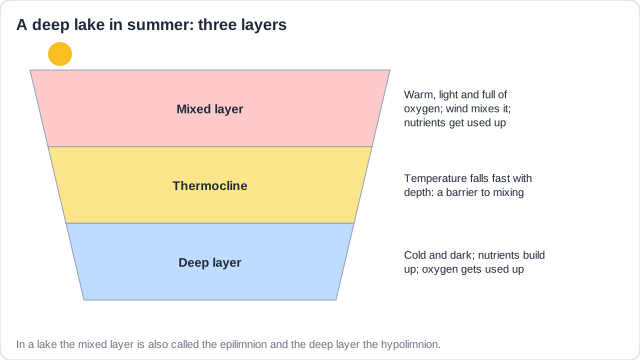
Real example: Loch Ness in Scotland is 230 m deep. In summer the top 30 m or so warms to about 14 °C, while the water below the thermocline stays at about 6 °C all year round.
Stop wasting time on topics you know
Our AI identifies your weak areas and focuses your study time where it matters. No more overstudying easy topics.
Stratification is not only a lake feature. It forms wherever warm or fresh water can sit on top of colder or saltier water without being stirred.
Where stratification happens
- Stratification happens in deeper lakes, coastal areas, enclosed seas and the open ocean.
- In the tropics the ocean's thermocline lasts all year.
- In temperate lakes and seas it forms in summer and breaks down in autumn.
- Near coasts, light fresh river water can float on salty sea water.
- In an enclosed sea little new water flows in, so the layers can last for thousands of years.
Remember it as: Lakes, coasts, enclosed seas, open ocean.
Deeper lakes
- Loch Ness: warm summer layer on cold water.
Coasts
- River water floating on sea water in a bay.
Enclosed seas
- The Black Sea: layered for thousands of years.
Open ocean
- The tropics: a thermocline all year.
Real example: the Black Sea is joined to the ocean only by the narrow Bosphorus. Fresh river water floats on salty deep water, and below about 150 m there is no oxygen at all, only hydrogen sulphide.
The layers do not only differ in temperature. Because they hardly mix, they also hold different amounts of dissolved oxygen and mineral nutrients.
Oxygen and nutrients
- The warm surface water is rich in dissolved oxygen, from the air and from photosynthesis.
- But phytoplankton use up its mineral nutrients (nitrate, phosphate), so it is nutrient-poor.
- Dead matter sinks below the thermocline, where decomposers release nutrients: the deep water is nutrient-rich.
- Decomposers use up oxygen below, and the thermocline stops new oxygen arriving: the deep water is oxygen-poor.
- So the surface has light and oxygen but few nutrients; the deep water has nutrients but no light and little oxygen.
Remember it as: Top: oxygen, no food. Bottom: food, no oxygen.
Real example: every summer the deep water of Chesapeake Bay, USA, becomes a dead zone. Fresh river water floats on the salty bay water, so oxygen from the air cannot reach the bottom, where decomposers use it up.
See how examiners mark answers
Answer exam-style questions with model answers. Learn exactly what earns marks and what doesn't.
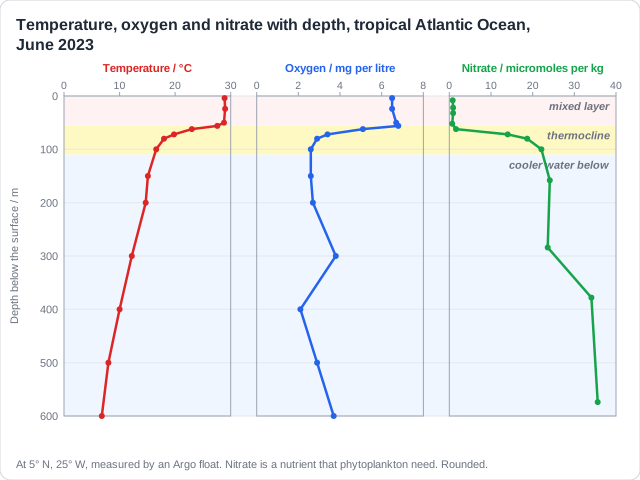
How this comes up: Paper 2, Section A: depth graphs of temperature, oxygen or nutrients, with short questions to identify the thermocline or explain a difference between the layers.
The figure above shows temperature, oxygen and nitrate measured at different depths in the tropical Atlantic Ocean in June 2023.
Explain why nitrate is low in the mixed layer but high below the thermocline.
Model answer plan
See the mark-by-mark plan — for / against / judgement, with marking guidance — in study mode.