Habitat conservation at Higher Level: Different places from SL: Chile's new parks, the Everglades, Maungatautari, Velondriake and the Great Barrier Reef. At HL, ask who pays for managing a habitat, which laws protect it, and whether it is fair to the people who live beside it.
Practise this as you read
- Name the active management a habitat needs, and why.
- Judge an in situ strategy: how well it works, for and against.
Free preview
This is the free notes preview
You're reading the free notes. Aimnova Pro unlocks the full study experience — and you can try it with your first topic free to keep:
- FlashcardsLock in vocabulary and key terms with spaced repetition.
- Practice questionsAnswer exam-style questions and get instant AI marking.
- Mock exams & past-paper vaultSit full mocks and see exactly how examiners award marks.
- Personalised study planA daily plan built around your exam date and weak areas.
Save the home, save the species: Habitat conservation protects species by protecting the place they live. It is in situ conservation: every species in that habitat is protected at once.
The points to remember
- Habitat conservation protects the natural environment, so all its species are protected together.
- It keeps food webs, pollination, nutrient cycling and natural behaviour working.
- Large wild populations keep genetic diversity high, and natural selection goes on.
- Two ways: protect wild areas (laws, parks, reserves, marine protected areas) or actively manage them.
- Harder when habitat is already destroyed or fragmented, or threats (poaching, invasives, climate, farming) go on.
Remember it as: Save the home, save the family.
National parks
- Large areas protected by law.
- People visit, but cannot farm, build or hunt.
Nature reserves
- Often smaller, for particular habitats or species.
- Access may be limited.
Marine protected areas
- Areas of sea and coast.
- Fishing limited, or banned in no-take zones.
Example (HL): Chile. About 21% of Chile's land and 41% of its sea are protected. Since 2018 the government and private foundations have added five national parks in Patagonia, on land once used for sheep and cattle. One protected landscape shelters the huemul, pumas, condors and old forest together.
Better than captivity in the long run: Keeping a species in its habitat keeps its natural behaviour, its food web and a large gene pool; a zoo keeps only a few animals. This is the usual advantage asked of in situ over ex situ conservation.
Stop wasting time on topics you know
Our AI identifies your weak areas and focuses your study time where it matters. No more overstudying easy topics.
Some habitats disappear even when they are protected by law. They survive only if people keep working on them. This is active management.
What active management does
- Stop succession: grazing, cutting scrub and controlled burning keep open habitats open.
- Remove invasive species and predators that people brought in.
- Restore damage: bring back the water flow, replant native plants, clean up pollution.
- Guard it: anti-poaching patrols, and quotas, closed seasons and size limits for harvesting.
- Close roads: less fragmented habitat, fewer road deaths, less noise, and harder for poachers to get in.
Remember it as: Graze, burn, weed, water, guard.
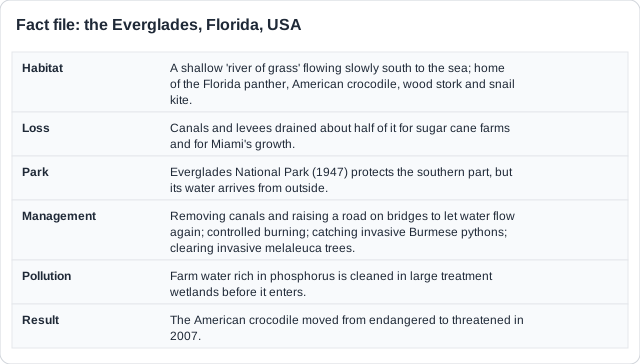
Example (HL): the Everglades, Florida. This shallow 'river of grass' needs water flowing south. Canals drained about half of it for sugar cane and Miami. The national park now depends on management outside it: canals removed, a road raised on bridges so water flows again, controlled burning, and teams catching invasive Burmese pythons.
Why removing invasive plants can be controversial: People may use the plants for timber, jobs, fuel or shade, or enjoy them; some species feed or nest in them; cutting them releases carbon and can leave soil to erode; it is costly, may harm native plants, and some say every species has a right to exist.
Why closing roads helps
- Habitat is less fragmented; animals reach food and water.
- Populations are less isolated, so the gene pool mixes.
- Less noise and disturbance; fewer road deaths.
- Poachers can no longer drive in.
Example: grizzly bears, USA
- In the northern Rocky Mountains, forest roads are closed and dug up in grizzly habitat.
- Grizzlies avoid roads, and more are killed where roads are dense.
Say how, not just 'bigger': 'The habitat gets larger' or 'poaching is harder' is not enough. Give the mechanism: less fragmented, fewer road deaths, no vehicle access for poachers.
Fence the pests out: An ecosanctuary protects native species from the predators people brought in. Inside a pest-exclusion fence, every pest is removed, then native species are reintroduced.
The points to remember
- The fence stops introduced predators (rats, stoats, cats, possums) climbing over or digging under.
- Inside, pests are removed; then native species are reintroduced and breed safely.
- Birds bred inside spill over into the land around.
- It suits places where the main threat is introduced predators, as in New Zealand.
- Limits: costly to build and check; a fallen tree or flood can breach it; mice often get back in.
- Limits: a small area holds a small gene pool; animals that leave meet predators again.
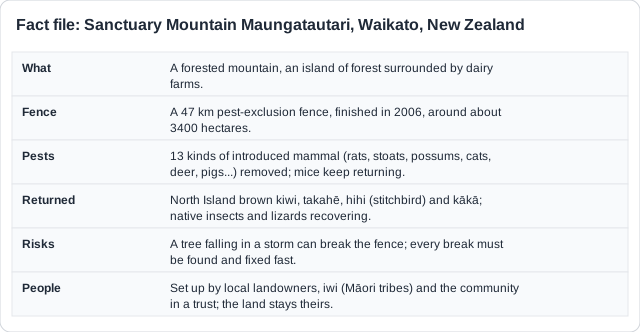
Example (HL): Sanctuary Mountain Maungatautari. In 2006 a 47 km fence was finished round a forested mountain in the Waikato. Thirteen kinds of mammal pest were removed, and kiwi, takahē and hihi were returned. Local landowners and iwi run it together, and the land stays theirs.
Numbers in a sanctuary: percentage change: Percentage change = (new - old) ÷ old x 100. A count that rises from 40 birds to 110 birds is (110 - 40) ÷ 40 x 100 = +175%. A fall gives a minus sign: 29 800 to 24 850 is a 16.6% decrease.
See how examiners mark answers
Answer exam-style questions with model answers. Learn exactly what earns marks and what doesn't.
Where a reserve is placed matters as much as what happens inside it. Look at its neighbours and how far it is from a town.
The points to remember
- Surrounding land use: farms bring fertiliser, pesticides and livestock; plantations bring invasive trees.
- Near a city: pet cats, fires, trampling, pollution, roads and poachers are close.
- Near a city also brings visitors, volunteers, money and support.
- Far from towns: less disturbance, but harder to patrol and fewer paying visitors.
- Few villages nearby means less conflict over land when the reserve is set up.
- Planning rules can control the neighbours, such as no new homes close to the reserve.
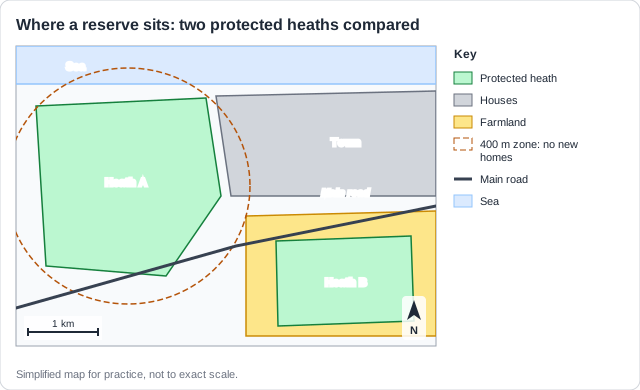
Example (HL): two different neighbours. Zealandia, 2 km from central Wellington, gets many visitors and volunteers, but city cats kill birds that leave it. Maungatautari, among dairy farms, has few visitors, and its long fence edge meets cattle and farm run-off. The Everglades' water passes sugar cane farms first, so it must be cleaned of phosphorus before it enters the park.
Asked why a park was put in a place?: Use the figures: high biodiversity or endemic species there, a threat such as fast deforestation, a link to another park, few villages to object, and a chance for ecotourism.
Some protected areas are run by the people who live beside them and use them. At sea these are called locally managed marine areas (LMMAs).
The points to remember
- The local community manages it: the people whose fishing or farming affects it.
- People feel ownership, so they take responsibility and keep the rules.
- It raises local awareness and changes behaviour; more people get involved.
- It uses local knowledge of the area.
- Flexible and fast: less bureaucracy, a quick response to local threats, closer monitoring.
- Policing by the community, in a way that fits local custom.
Remember it as: Our sea, our rules, our eyes.
Example (HL): Velondriake, Madagascar. In 2004 the fishing village of Andavadoaka closed one reef to octopus fishing for a few months. When it reopened, fishers landed more and bigger octopus. Other villages copied it, and in 2006 they formed Velondriake, an LMMA whose rules are set by the villages' own law and enforced by fishers.
The advantage of community management itself: When asked why community management works, do not list no-take zones, bigger fish, more jobs or tourism. Say what the community brings: ownership, local knowledge, fast and flexible decisions, policing.
Community-based
- Local support, so rules are kept.
- Cheaper: the community patrols.
- People still earn a living.
Strict protection
- Best for the most sensitive species.
- No-take zones give full recovery.
- Needs rangers, money and a strong law.
Study smarter, not longer
Most students waste 40% of study time on topics they already know. Our AI tracks your progress and optimizes every minute.
When a country's protected areas grow, from a few small parks to a large network, species gain in several ways.
The points to remember
- Protected areas ban damaging activities (building, hunting, logging): a safe place to live and breed.
- More and bigger areas protect more habitats, and so more species.
- They give room for top predators, which need large areas.
- Core habitat lies further from people, so edge effects are smaller.
- Areas that join up allow genetic mixing, like corridors.
- More ecotourism, funding and community involvement keep conservation going.
Example (HL): the Great Barrier Reef, Australia. In 2004 the marine park was rezoned: no-take zones grew from under 5% to about a third of the park. Within a few years coral trout, a fish caught for food, were more common and larger inside the no-take zones than in fished areas next to them.
Three separate ways, not one: In an Explain [3], give three different mechanisms from the list, each linked to species. Avoid vague phrases such as 'it reduces limiting factors'.
Climate change is the biggest test for habitat conservation, because a reserve cannot move but the climate its species need can.
The points to remember
- Strength: large, connected reserves let species move as climate zones shift.
- Strength: healthy, diverse ecosystems are more resilient; forests, peat and mangroves store carbon.
- Limit: boundaries are fixed while species' ranges move uphill or towards the poles.
- Limit: rising seas, drought, fire, storms and coral bleaching reach inside reserves.
- Responses: corridors, buffer zones, new reserves where species are moving to; cut other stresses.
- Judgement: it helps but cannot work alone; emissions must be cut by international action.
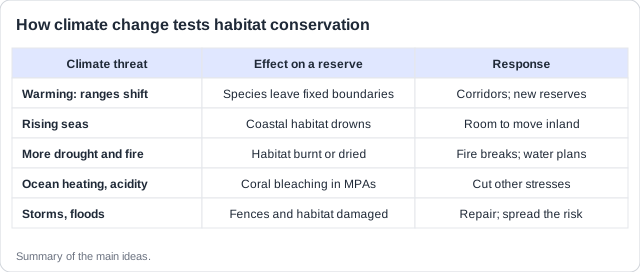
Example (HL): the Great Barrier Reef again. Its zoning protects fish and coral from fishing, but marine heatwaves bleached large areas in 2016, 2017, 2020, 2022 and 2024. Managers cut other stresses, such as farm run-off and coral-eating starfish, to help reefs recover between heatwaves.
It can also slow climate change: Protecting sea otters in their kelp forests keeps sea urchins in check, so the kelp grows, photosynthesises more and takes in more carbon dioxide.
Ready to ace Habitat conservation strategies?
You've seen the preview. Here's what you'll unlock:
Bite-Sized Study Notes
Full syllabus broken into chunks that stick
Exam Practice
See exactly how to score full marks
AI Feedback
Know exactly what examiners want
Smart Study Plan
Know exactly what to study next