The Convention on Biological Diversity at Higher Level: The same treaty as SL, told through the Arabian oryx, India's biodiversity law, the high seas and Madagascar's periwinkle. At HL, expect to evaluate the CBD: what it has achieved, and why it is only as strong as each country makes it.
Practise this as you read
- Sort each CBD measure into species-based or habitat-based.
- Balance its reach against weak enforcement.
Free preview
This is the free notes preview
You're reading the free notes. Aimnova Pro unlocks the full study experience — and you can try it with your first topic free to keep:
- FlashcardsLock in vocabulary and key terms with spaced repetition.
- Practice questionsAnswer exam-style questions and get instant AI marking.
- Mock exams & past-paper vaultSit full mocks and see exactly how examiners award marks.
- Personalised study planA daily plan built around your exam date and weak areas.
One treaty for all of life: The Convention on Biological Diversity is the main UN treaty on biodiversity. It asks countries to protect both single species (ex situ) and whole habitats (in situ).
The points to remember
- The CBD is a UN treaty, agreed at the Rio Earth Summit in 1992; 196 parties have joined.
- Goal 1: conserve biodiversity. Goal 2: use it sustainably.
- Goal 3: share the benefits of genetic resources fairly.
- It covers species-based conservation: ex situ, e.g. zoos, botanic gardens, seed banks.
- It covers habitat-based conservation: in situ, e.g. national parks and reserves.
- The USA signed but never ratified it, so it is not bound by it.
Remember it as: Conserve it, use it wisely, share it fairly.
| Kind of conservation | Real example |
|---|---|
| Species-based (ex situ) | The Arabian oryx: extinct in the wild by 1972, bred in zoos, returned to Oman from 1982 |
| Habitat-based (in situ) | Oman's oryx sanctuary; after Oman cut it by 90% for oil, it was the first site ever removed from the World Heritage list (2007) |
Say 'both': If asked what the CBD covers, name both kinds: species-based, ex situ (seed banks, zoos) AND habitat-based, in situ (national parks, reserves).
Never wonder what to study next
Get a personalized daily plan based on your exam date, progress, and weak areas. We'll tell you exactly what to review each day.
The CBD's main tool is the national plan. Each country decides how it will meet its promises, in a national biodiversity strategy and action plan.
The points to remember
- Every party writes a national biodiversity strategy and action plan (NBSAP).
- It sets out how the country will conserve and sustainably use its biodiversity.
- Habitat measures: protected areas, restoring damaged habitats, controlling invasive species.
- Species measures: action plans for threatened species, laws on hunting and trade, seed banks.
- It also covers education and public awareness, research and monitoring.
Real example: India's Biological Diversity Act of 2002 put its CBD promises into law. It set up a National Biodiversity Authority: a company that wants to use an Indian plant or animal must get permission and share the benefits with local communities.
The plan is only a start: A national strategy is a promise on paper. It works only if the country funds it, passes laws and enforces them.
Species-based and habitat-based measures work best together. Shark fins show how: sharks were being killed for shark fin soup, and several efforts cut the trade.
How conservation efforts can cut a wildlife trade
- Education and campaigns change what people want to buy, so demand falls.
- Bans on the trade in wildlife parts make them harder to get.
- Reserves where shark fishing is banned protect sharks in their habitat.
- Patrols in reserves stop poaching.
- Shark tourism makes live sharks more valuable to local people.
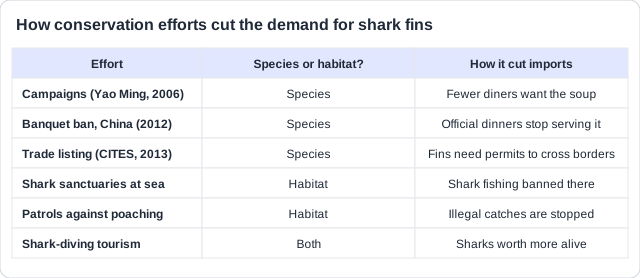
Say HOW: 'Efforts to reduce the trade' is not enough: say how (education, a law, a ban). 'Fewer sharks are caught' needs a reason (a reserve bans fishing). Taxes on imports are not a conservation effort.
Real example: in 2013 the CITES treaty listed the oceanic whitetip, three hammerheads and the porbeagle, so their fins need permits to cross borders. In 2011 the Bahamas banned all shark fishing in its waters, where shark dives now earn millions of dollars a year.
Stop wasting time on topics you know
Our AI identifies your weak areas and focuses your study time where it matters. No more overstudying easy topics.
Most of the ocean belongs to no country. The CBD aims to find the most important parts of this high seas so that they can be protected.
The points to remember
- About two-thirds of the ocean lies outside any country's waters: the high seas.
- No single country can protect it, so the CBD works to identify important areas there.
- These are called ecologically or biologically significant marine areas (EBSAs): more than 300 are described.
- Identifying them is the first step to protecting them as marine protected areas.
Real example: the Costa Rica Thermal Dome, a patch of cool, rich water in the eastern Pacific, stretches beyond Costa Rica's waters; blue whales feed and raise calves there. The CBD lists it as a significant area. The High Seas Treaty, adopted in 2023 and in force since January 2026, now lets countries create marine protected areas on the high seas.
Identify, then protect: The CBD's role on the high seas is to identify the important areas. Protecting them needs countries to agree to it, which is harder when no one owns the water.
Wild species hold genetic resources. The CBD's third goal is that the people who look after them share the profits.
The points to remember
- The Nagoya Protocol (2010) is part of the CBD.
- It promotes fair and equitable sharing of the benefits of genetic resources.
- A company must get the permission of the country (and community) where it finds a plant or animal.
- It must share the benefits: money, jobs, research or technology.
- This stops biopiracy and gives countries a reason to protect their species.
Remember it as: Ask first, share after.
Real example: the rosy periwinkle of Madagascar gave two drugs, vincristine and vinblastine, used against childhood leukaemia and Hodgkin's disease. The drugs earned large sums, but Madagascar received almost nothing: the kind of case the Nagoya Protocol aims to prevent.
See how examiners mark answers
Answer exam-style questions with model answers. Learn exactly what earns marks and what doesn't.
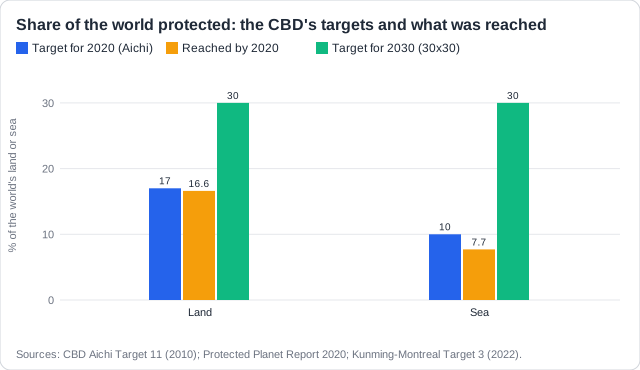
The CBD sets shared targets. The first set, the Aichi targets, ran to 2020; the current set, the Kunming-Montreal framework, runs to 2030.
The points to remember
- Aichi targets (2010): 20 targets for 2020, e.g. protect 17% of land and 10% of sea.
- None of the 20 was fully met by 2020.
- Kunming-Montreal framework (2022): 23 targets for 2030.
- Target 3, 30x30: protect 30% of land and 30% of sea by 2030.
- Also: restore 30% of damaged ecosystems; cut harmful subsidies by US$500 billion a year.
Strengths of the CBD
- Almost every country has joined.
- Makes each country plan: national strategies.
- Covers species AND habitats, land AND sea.
- Shares the benefits of genes fairly.
Limitations of the CBD
- Targets are not legally binding: no penalties.
- Aichi targets missed; progress is slow.
- Parks can be 'paper parks' with no rangers.
- Depends on money poorer countries lack.
Real example: at the 2024 meeting in Cali, Colombia, countries set up the Cali Fund: companies that profit from genetic data taken from nature are asked to pay into it, but paying is voluntary.
How this comes up: Paper 2, Section B (b): evaluate a treaty or strategy [7], with points on both sides and a conclusion. Paper 1 may ask how conservation efforts cut a trade shown on a graph [1].
In 2022 the parties to the Convention on Biological Diversity agreed the Kunming-Montreal framework.
Evaluate the Convention on Biological Diversity as a way of conserving biodiversity.
Model answer plan
See the mark-by-mark plan — for / against / judgement, with marking guidance — in study mode.