Assessing conservation success at Higher Level: This statement is Higher Level only. You judge whether a conservation or restoration project really worked, for nature and for people, and whether another way would have done better.
Practise this as you read
- Test each claim against its evidence.
- Judge all three levels, then decide.
Free preview
This is the free notes preview
You're reading the free notes. Aimnova Pro unlocks the full study experience — and you can try it with your first topic free to keep:
- FlashcardsLock in vocabulary and key terms with spaced repetition.
- Practice questionsAnswer exam-style questions and get instant AI marking.
- Mock exams & past-paper vaultSit full mocks and see exactly how examiners award marks.
- Personalised study planA daily plan built around your exam date and weak areas.
Judging a project, not just describing it: Many projects claim to have saved a species or restored a habitat. To judge a claim, ask three questions, from the project's own results out to the bigger picture.
Three questions to judge success
- Level 1: did it succeed as planned? Compare the results with the project's own goals.
- Level 2: was it well received by the local communities it affected?
- Level 3: was this the best way to conserve nature, or would another way have done more?
- A claim of success is only as strong as the evidence behind it.
- A project can pass one level and fail another: judge all three.
Remember it as: Did it work? Did people welcome it? Was it the best way?
Real example: in 2007 African countries launched the Great Green Wall, aiming to restore 100 million hectares by 2030. A United Nations review in 2020 found only about 4 million hectares restored inside its target zone: level 1 was far behind plan, even though some local projects were popular.
Learn what examiners really want
See exactly what to write to score full marks. Our AI shows you model answers and the key phrases examiners look for.
Level 1 asks whether the project did what it set out to do. That needs measurements, not just photographs or a founder's word.
How to test a claim of success
- Set clear goals first: area restored, species numbers, trees surviving.
- Measure before and after, and compare with a similar site left alone (a control).
- Use biodiversity measures: species counted, a diversity index, a species' threat status.
- Ask who measured it: the project itself, or independent scientists who published?
- Check over the long term: planted trees can die, and a heatwave can undo years of work.
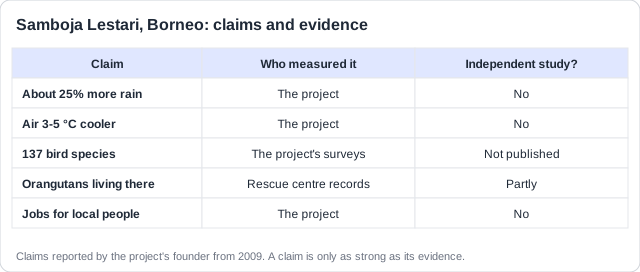
Real example: from 2001 the forester Willie Smits restored about 1,800 hectares of burnt grassland at Samboja Lestari, with a ring of fire-resistant sugar palms and a home for rescued orangutans. He reported about 25% more rain, cooler air and 137 bird species. Few of these figures were ever tested independently.
Level 2 asks how the project affected the people who live there. A project that local people resent is unlikely to last.
Was it well received?
- Did local people get jobs, income or food from it?
- Did they keep access to land, water, fuel and sacred sites?
- Were they asked and involved from the start, or was it imposed?
- Were costs and benefits shared fairly?
- Measure it with questionnaires, interviews and how many people take part.
Real example: in 1977 Wangari Maathai started the Green Belt Movement. Women were paid a small sum for each seedling that survived, and the trees gave firewood, fruit and shade. Over 51 million trees have been planted, and Maathai won the Nobel Peace Prize in 2004. The government, however, opposed her when she protested against building on Nairobi's Uhuru Park in 1989.
Both sides of level 2: Well received by some is not well received by all: say who gained and who lost.
Never wonder what to study next
Get a personalized daily plan based on your exam date, progress, and weak areas. We'll tell you exactly what to review each day.
Level 3 is the hardest question: even a project that worked might not have been the best use of the money and land. Compare it with the other ways.
Was this the best way?
- Protecting forest that still stands is usually cheaper and keeps more species than replanting.
- Letting land regrow naturally can cost little where seeds and wild trees are close by.
- Planting one fast tree gives cover quickly but little wildlife.
- Planting a mix of native trees costs more but brings the forest back faster.
- Compare cost per hectare, species gained, speed and how long the result lasts.
Planting one fast tree
- Cheap and quick to grow.
- Few animals use it.
- Weeds and fire can return.
Planting framework species
- 20 to 30 native trees.
- Shade out weeds fast.
- Fruit draws seed-carrying birds.
Real example: in 1994 Stephen Elliott and colleagues set up FORRU-CMU. They plant 20 to 30 native framework species. Birds and bats then carry in seeds of other trees, so the forest rebuilds itself, which costs less over time than planting every species by hand.
An exam may give you a restoration measure, with facts about it, and ask you to evaluate it. Weigh what it achieves against its limits. Coral transplanting is a common case.
Strengths of coral transplanting
- Helps a damaged reef recover: habitat and biodiversity come back.
- Can save rare or threatened corals and the species that live on them.
- Rebuilds food webs and the reef's productivity.
- Brings back tourism and fisheries (nursery grounds), with jobs and income.
- Protects the coast: a living reef absorbs wave energy from storms.
- Corals filter the water, making it clearer; reefs also have cultural value.
Real example: since 2007 the Coral Restoration Foundation has grown fragments of staghorn and elkhorn coral on underwater frames and planted them on damaged reef. In the 2023 marine heatwave, the sea was so warm that corals had to be moved to tanks on land, and many planted corals bleached: the cause of the damage had not gone away.
Limitations of coral transplanting
- Does not remove the cause: warm water, acidification, pollution, overfishing, starfish.
- Success rates may be low; the original reef may never fully return.
- Expensive; needs trained divers, time to grow and monitoring for years.
- The site must be protected: boats and people kept away while corals grow.
- Fragments cut from few parents have low genetic diversity, so disease can wipe them out.
- Some question the ethics of such heavy human intervention.
Say how, not just that: 'It restores the reef' alone is not enough: say what it brings back, such as habitat, fish or storm protection.
Stop wasting time on topics you know
Our AI identifies your weak areas and focuses your study time where it matters. No more overstudying easy topics.
How this comes up: Paper 1: evaluate a restoration measure from a fact file [6], with at most [4] a side and [1] for a conclusion. Paper 2: evaluate a named project [7], or to what extent conservation succeeds [9].
Since 2001, about 1,800 hectares of burnt grassland at Samboja Lestari in Borneo have been replanted with rainforest trees, with a ring of sugar palms against fire and a home for rescued orangutans.
Evaluate the success of the Samboja Lestari restoration project.
Model answer plan
See the mark-by-mark plan — for / against / judgement, with marking guidance — in study mode.